
一种结合代谢组学和宏基因组学的方法来鉴别用于生产硬质奶酪的原料乳。
A Combined Metabolomic and Metagenomic Approach to Discriminate Raw Milk for the Production of Hard Cheese.
作者信息
Bellassi Paolo, Rocchetti Gabriele, Nocetti Marco, Lucini Luigi, Masoero Francesco, Morelli Lorenzo
机构信息
Department for Sustainable Food Process-DiSTAS, Università Cattolica del Sacro Cuore, Via Emilia Parmense 84, 29122 Piacenza, Italy.
Primary Production Department, Parmigiano Reggiano Cheese Consortium, Via J. F. Kennedy 18, 42124 Reggio Emilia, Italy.
出版信息
Foods. 2021 Jan 6;10(1):109. doi: 10.3390/foods10010109.
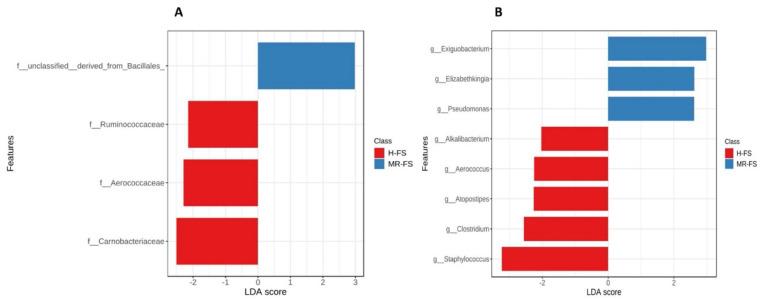
The chemical composition of milk can be significantly affected by different factors across the dairy supply chain, including primary production practices. Among the latter, the feeding system could drive the nutritional value and technological properties of milk and dairy products. Therefore, in this work, a combined foodomics approach based on both untargeted metabolomics and metagenomics was used to shed light onto the impact of feeding systems (i.e., hay vs. a mixed ration based on hay and fresh forage) on the chemical profile of raw milk for the production of hard cheese. In particular, ultra-high-performance liquid chromatography quadrupole time-of-flight mass spectrometry (UHPLC-QTOF) was used to investigate the chemical profile of raw milk (n = 46) collected from dairy herds located in the Po River Valley (Italy) and considering different feeding systems. Overall, a total of 3320 molecular features were putatively annotated across samples, corresponding to 734 unique compound structures, with significant differences ( < 0.05) between the two feeding regimens under investigation. Additionally, supervised multivariate statistics following metabolomics-based analysis allowed us to clearly discriminate raw milk samples according to the feeding systems, also extrapolating the most discriminant metabolites. Interestingly, 10 compounds were able to strongly explain the differences as imposed by the addition of forage in the cows' diet, being mainly glycerophospholipids (i.e., lysophosphatidylethanolamines, lysophosphatidylcholines, and phosphatidylcholines), followed by 5-(3',4'-Dihydroxyphenyl)-gamma-valerolactone-4'--glucuronide, 5a-androstan-3a,17b-diol disulfuric acid, and N-stearoyl glycine. The markers identified included both feed-derived (such as phenolic metabolites) and animal-derived compounds (such as lipids and derivatives). Finally, although characterized by a lower prediction ability, the metagenomic profile was found to be significantly correlated to some milk metabolites, with , , and establishing a higher number of significant correlations with the discriminant metabolites. Therefore, taken together, our preliminary results provide a comprehensive foodomic picture of raw milk samples from different feeding regimens, thus supporting further ad hoc studies investigating the metabolomic and metagenomic changes of milk in all processing conditions.
牛奶的化学成分会受到乳制品供应链中不同因素的显著影响,包括初级生产实践。在后者中,饲养系统可能会影响牛奶和乳制品的营养价值及技术特性。因此,在本研究中,采用了一种基于非靶向代谢组学和宏基因组学的联合食品组学方法,以阐明饲养系统(即干草饲养与基于干草和新鲜草料的混合日粮饲养)对用于生产硬质奶酪的原料乳化学特征的影响。具体而言,使用超高效液相色谱四极杆飞行时间质谱(UHPLC-QTOF)来研究从位于意大利波河流域的奶牛群中采集的原料乳(n = 46)的化学特征,并考虑不同的饲养系统。总体而言,在所有样本中总共推定注释了3320个分子特征,对应于734种独特的化合物结构,在所研究的两种饲养方案之间存在显著差异(<0.05)。此外,基于代谢组学分析的监督多元统计使我们能够根据饲养系统清晰地区分原料乳样本,还推断出最具区分性的代谢物。有趣的是,10种化合物能够有力地解释奶牛日粮中添加草料所造成的差异,主要是甘油磷脂(即溶血磷脂酰乙醇胺、溶血磷脂酰胆碱和磷脂酰胆碱),其次是5-(3',4'-二羟基苯基)-γ-戊内酯-4'-O-葡萄糖醛酸、5α-雄甾烷-3α,17β-二醇二硫酸酯和N-硬脂酰甘氨酸。鉴定出的标志物包括饲料来源的(如酚类代谢物)和动物来源的化合物(如脂质及其衍生物)。最后,尽管宏基因组图谱的预测能力较低,但发现其与一些牛奶代谢物显著相关,其中,和与区分性代谢物建立了更多的显著相关性。因此,综合来看,我们的初步结果提供了来自不同饲养方案的原料乳样本的全面食品组学图景,从而支持进一步的专项研究,以调查在所有加工条件下牛奶的代谢组学和宏基因组学变化。


 Zotero 插件