Neuroscience Graduate Program, Vanderbilt University, Village at Vanderbilt, Suite 2200, 1500 21st Avenue South, Nashville, TN, 37212, USA.
Department of Psychiatry and Behavioral Sciences, Vanderbilt University Medical Center, PMB 40, 230 Appleton Place, Nashville, TN, 37203, USA.
J Neurodev Disord. 2021 Jan 9;13(1):6. doi: 10.1186/s11689-020-09354-x.
Individuals with autism spectrum disorder (ASD) often experience elevated stress during social interactions and may have difficulty forming and maintaining peer relationships. The autonomic nervous system (ANS) directs physiological changes in the body in response to a number of environmental stimuli, including social encounters. Evidence suggests the flexibility of the ANS response is an important driving factor in shaping social behavior. For youth with ASD, increased stress response and/or atypical ANS regulation to benign social encounters may therefore influence social behaviors, and, along with developmental and experiential factors, shape psychological outcomes.
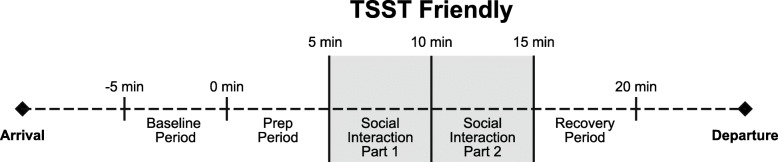
The current study measured ANS response to a peer-based social interaction paradigm in 50 typically developing (TD) children and 50 children with ASD (ages 10-13). Respiratory sinus arrhythmia (RSA), a cardiac measure of parasympathetic influence on the heart, and pre-ejection period (PEP), a sympathetic indicator, were collected. Participants engaged in a friendly, face-to-face conversation with a novel, same-aged peer, and physiological data were collected continuously before and during the interaction. Participants also reported on state anxiety following the interaction, while parents reported on the child's social functioning and number of social difficulties.
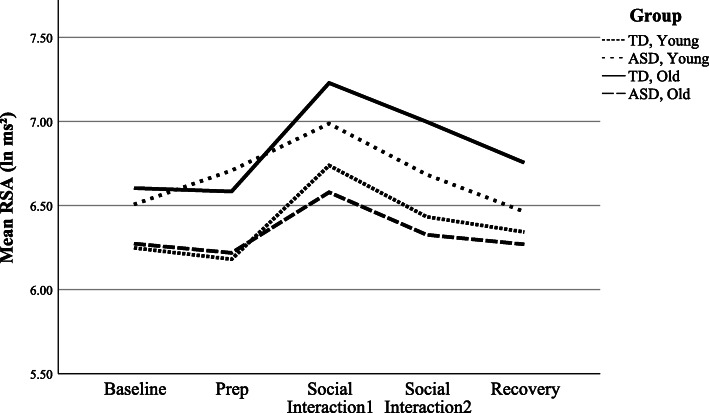
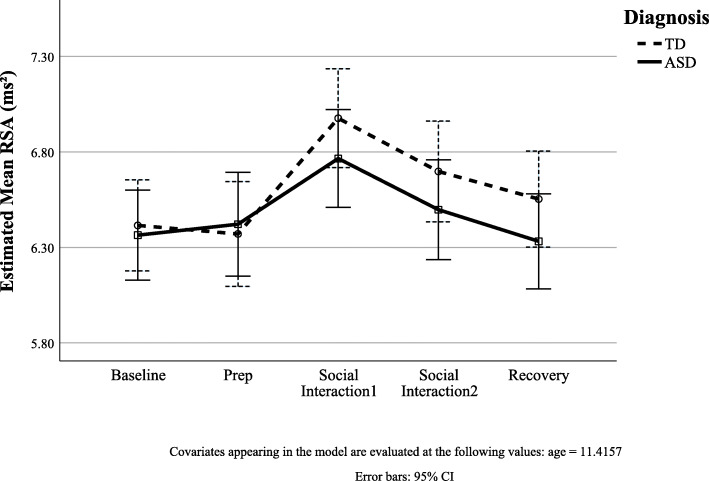
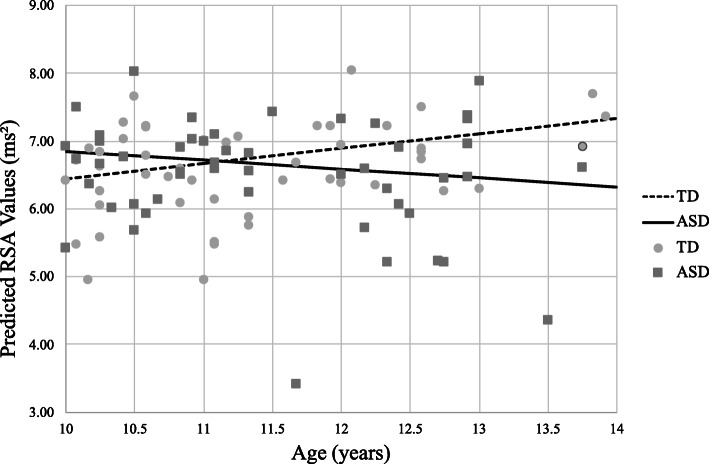
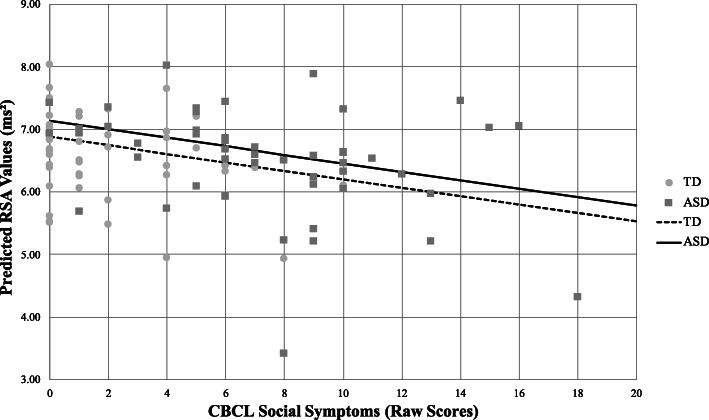
Linear mixed models revealed that, while there were no diagnostic effects for RSA or PEP, older youth with ASD appeared to demonstrate a blunted parasympathetic (RSA) response. Further, increased severity of parent-reported social symptoms was associated with lower RSA. Youth with ASD reported more anxiety following the interaction; however, symptoms were not related to RSA or PEP response based on linear mixed modeling.
Physiological regulation, age, and social functioning likely influence stress responses to peer interactions for youth with ASD. Parasympathetic functioning, as opposed to sympathetic arousal, may be especially important in behavioral regulation, as older youth with ASD demonstrated atypical regulation and response to the social interaction paradigm. Future studies should help to further elucidate the developmental factors contributing to stress responses in ASD, the impact of physiological response on observable social behavior, and potential long-term consequences of chronic social stress in youth with ASD.
自闭症谱系障碍(ASD)患者在社交互动中经常会感到压力升高,并且可能难以建立和维持同伴关系。自主神经系统(ANS)会指导身体对许多环境刺激(包括社交接触)做出生理变化。有证据表明,ANS 反应的灵活性是塑造社交行为的重要驱动因素。对于 ASD 青少年来说,对良性社交接触的应激反应增加和/或 ANS 调节异常,可能会影响社交行为,并与发育和经验因素一起,影响心理结果。
本研究测量了 50 名典型发育(TD)儿童和 50 名 ASD 儿童(10-13 岁)对基于同伴的社交互动范式的 ANS 反应。呼吸窦性心律失常(RSA),即心脏迷走神经影响的心脏测量指标,以及射前期(PEP),即交感神经指标,都被采集。参与者与一个新的、同龄的同伴进行友好的面对面交谈,在互动之前和期间连续采集生理数据。参与者在互动后报告状态焦虑,而父母则报告孩子的社交功能和社交困难的数量。
线性混合模型显示,虽然 RSA 或 PEP 没有诊断效应,但年龄较大的 ASD 青少年似乎表现出迷走神经(RSA)反应迟钝。此外,父母报告的社交症状严重程度与 RSA 降低有关。ASD 青少年在互动后报告了更多的焦虑;然而,根据线性混合建模,症状与 RSA 或 PEP 反应无关。
生理调节、年龄和社交功能可能会影响 ASD 青少年对同伴互动的应激反应。与交感神经兴奋相比,副交感神经功能可能在行为调节中更为重要,因为年龄较大的 ASD 青少年在社交互动范式中表现出异常的调节和反应。未来的研究应该有助于进一步阐明 ASD 中应激反应的发育因素、生理反应对可观察到的社交行为的影响,以及 ASD 青少年慢性社交应激的潜在长期后果。