Serwach Karolina, Gruszczynska-Biegala Joanna
Molecular Biology Unit, Mossakowski Medical Research Centre, Polish Academy of Sciences, Warsaw, Poland.
Front Mol Neurosci. 2020 Dec 23;13:617422. doi: 10.3389/fnmol.2020.617422. eCollection 2020.
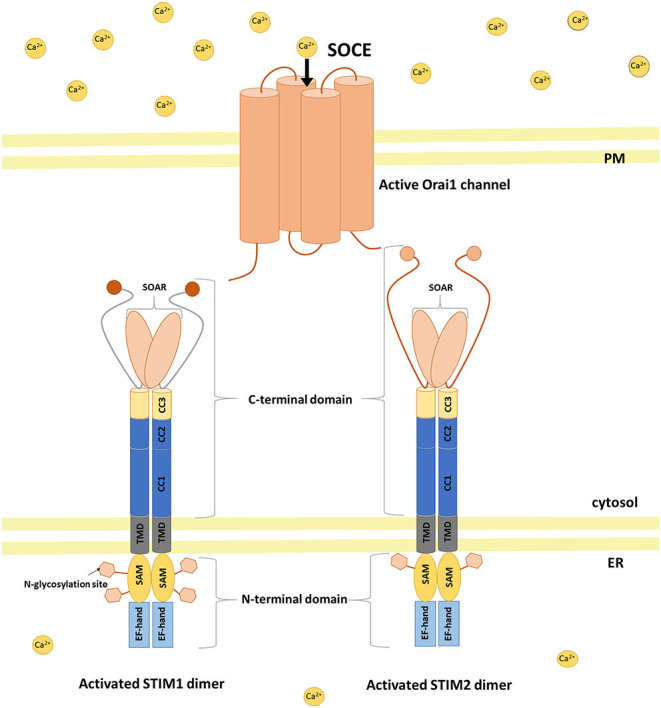
Stromal interaction molecules (STIMs), including STIM1 and STIM2, are single-pass transmembrane proteins that are located predominantly in the endoplasmic reticulum (ER). They serve as calcium ion (Ca) sensors within the ER. In the central nervous system (CNS), they are involved mainly in Orai-mediated store-operated Ca entry (SOCE). The key molecular components of the SOCE pathway are well-characterized, but the molecular mechanisms that underlie the regulation of this pathway need further investigation. Numerous intracellular target proteins that are located in the plasma membrane, ER, cytoskeleton, and cytoplasm have been reported to play essential roles in concert with STIMs, such as conformational changes in STIMs, their translocation, the stabilization of their interactions with Orai, and the activation of other channels. The present review focuses on numerous regulators, such as Homer, SOCE-associated regulatory factor (SARAF), septin, synaptopodin, golli proteins, partner of STIM1 (POST), and transcription factors and proteasome inhibitors that regulate STIM-Orai interactions in the CNS. Further we describe novel roles of STIMs in mediating Ca influx via other than Orai pathways, including TRPC channels, VGCCs, AMPA and NMDA receptors, and group I metabotropic glutamate receptors. This review also summarizes recent findings on additional molecular targets of STIM proteins including SERCA, IPRs, end-binding proteins (EB), presenilin, and CaMKII. Dysregulation of the SOCE-associated toolkit, including STIMs, contributes to the development of neurodegenerative disorders (e.g., Alzheimer's disease, Parkinson's disease, and Huntington's disease), traumatic brain injury, epilepsy, and stroke. Emerging evidence points to the role of STIM proteins and several of their molecular effectors and regulators in neuronal and glial physiology and pathology, suggesting their potential application for future therapeutic strategies.
基质相互作用分子(STIMs),包括STIM1和STIM2,是单次跨膜蛋白,主要位于内质网(ER)中。它们作为内质网内的钙离子(Ca)传感器。在中枢神经系统(CNS)中,它们主要参与由Orai介导的储存性钙内流(SOCE)。SOCE途径的关键分子成分已得到充分表征,但该途径调控的分子机制仍需进一步研究。据报道,许多位于质膜、内质网、细胞骨架和细胞质中的细胞内靶蛋白与STIMs协同发挥重要作用,如STIMs的构象变化、它们的转位、它们与Orai相互作用的稳定以及其他通道的激活。本综述重点关注众多调节因子,如Homer、SOCE相关调节因子(SARAF)、septin、突触足蛋白、golli蛋白、STIM1的伙伴蛋白(POST),以及在中枢神经系统中调节STIM - Orai相互作用的转录因子和蛋白酶体抑制剂。此外,我们还描述了STIMs在通过除Orai途径之外的其他途径介导钙内流中的新作用,包括瞬时受体电位通道C(TRPC)通道、电压门控性钙通道(VGCCs)、α-氨基-3-羟基-5-甲基-4-异恶唑丙酸(AMPA)和N-甲基-D-天冬氨酸(NMDA)受体,以及I组代谢型谷氨酸受体。本综述还总结了关于STIM蛋白其他分子靶点的最新发现,包括肌浆网钙ATP酶(SERCA)、肌醇1,4,5-三磷酸受体(IPRs)、尾结合蛋白(EB)、早老素和钙/钙调蛋白依赖性蛋白激酶II(CaMKII)。包括STIMs在内的SOCE相关工具包的失调会导致神经退行性疾病(如阿尔茨海默病、帕金森病和亨廷顿病)、创伤性脑损伤、癫痫和中风的发生。新出现的证据表明STIM蛋白及其一些分子效应器和调节因子在神经元和神经胶质细胞的生理和病理过程中发挥作用,这表明它们在未来治疗策略中的潜在应用价值。