Kinboshi Masato, Ikeda Akio, Ohno Yukihiro
Department of Pharmacology, Osaka University of Pharmaceutical Sciences, Takatsuki, Japan.
Department of Epilepsy, Movement Disorders and Physiology, Graduate School of Medicine, Kyoto University, Kyoto, Japan.
Front Neurol. 2020 Dec 23;11:626658. doi: 10.3389/fneur.2020.626658. eCollection 2020.
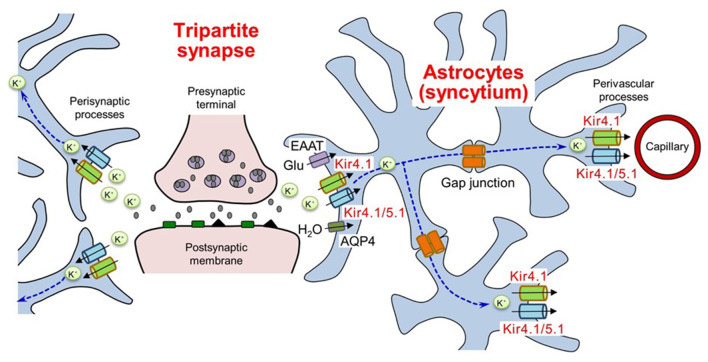
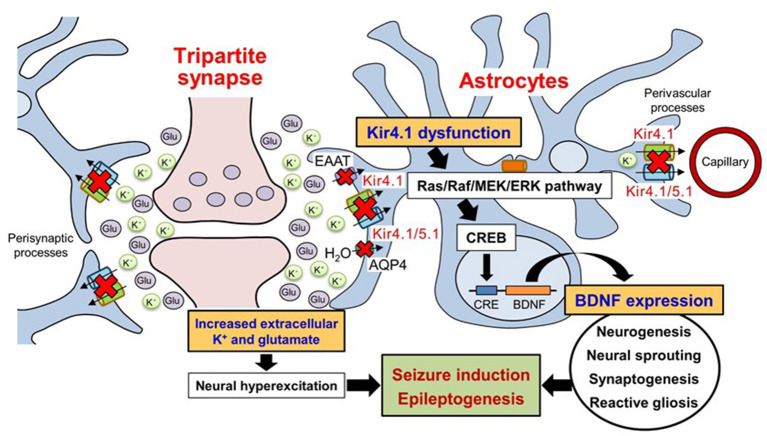
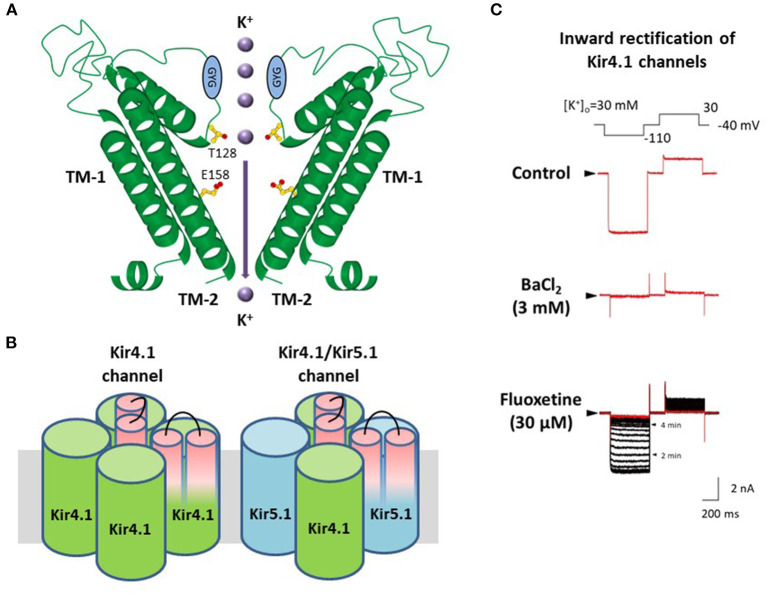
Astrocytes regulate potassium and glutamate homeostasis via inwardly rectifying potassium (Kir) 4.1 channels in synapses, maintaining normal neural excitability. Numerous studies have shown that dysfunction of astrocytic Kir4.1 channels is involved in epileptogenesis in humans and animal models of epilepsy. Specifically, Kir4.1 channel inhibition by gene mutation or expressional down-regulation increases the extracellular levels of potassium ions and glutamate in synapses and causes hyperexcitation of neurons. Moreover, recent investigations demonstrated that inhibition of Kir4.1 channels facilitates the expression of brain-derived neurotrophic factor (BDNF), an important modulator of epileptogenesis, in astrocytes. In this review, we summarize the current understanding on the role of astrocytic Kir4.1 channels in epileptogenesis, with a focus on functional and expressional changes in Kir4.1 channels and their regulation of BDNF secretion. We also discuss the potential of Kir4.1 channels as a therapeutic target for the prevention of epilepsy.
星形胶质细胞通过突触中的内向整流钾(Kir)4.1通道调节钾离子和谷氨酸稳态,维持正常的神经兴奋性。大量研究表明,星形胶质细胞Kir4.1通道功能障碍与人类癫痫及癫痫动物模型的癫痫发生有关。具体而言,基因突变或表达下调对Kir4.1通道的抑制会增加突触中钾离子和谷氨酸的细胞外水平,并导致神经元过度兴奋。此外,最近的研究表明,抑制Kir4.1通道会促进星形胶质细胞中脑源性神经营养因子(BDNF)的表达,BDNF是癫痫发生的重要调节因子。在这篇综述中,我们总结了目前对星形胶质细胞Kir4.1通道在癫痫发生中作用的认识,重点关注Kir4.1通道的功能和表达变化及其对BDNF分泌的调节。我们还讨论了Kir4.1通道作为预防癫痫治疗靶点的潜力。