Wang Kai, Ding Lin, Yang Can, Hao Xingjie, Wang Chaolong
Key Laboratory for Environment and Health, Department of Epidemiology and Biostatistics, School of Public Health, Tongji Medical College, Huazhong University of Science and Technology, Wuhan, China.
Department of Mathematics, The Hong Kong University of Science and Technology, Hong Kong, China.
Front Genet. 2020 Dec 16;11:608630. doi: 10.3389/fgene.2020.608630. eCollection 2020.
Although the association between mouth ulcers and psychiatric traits has been reported by observational studies, their causal relationship remains unclear. Mendelian randomization (MR), powered by large-scale genome-wide association studies (GWAS), provides an opportunity to clarify the causality between mouth ulcers and psychiatric traits.
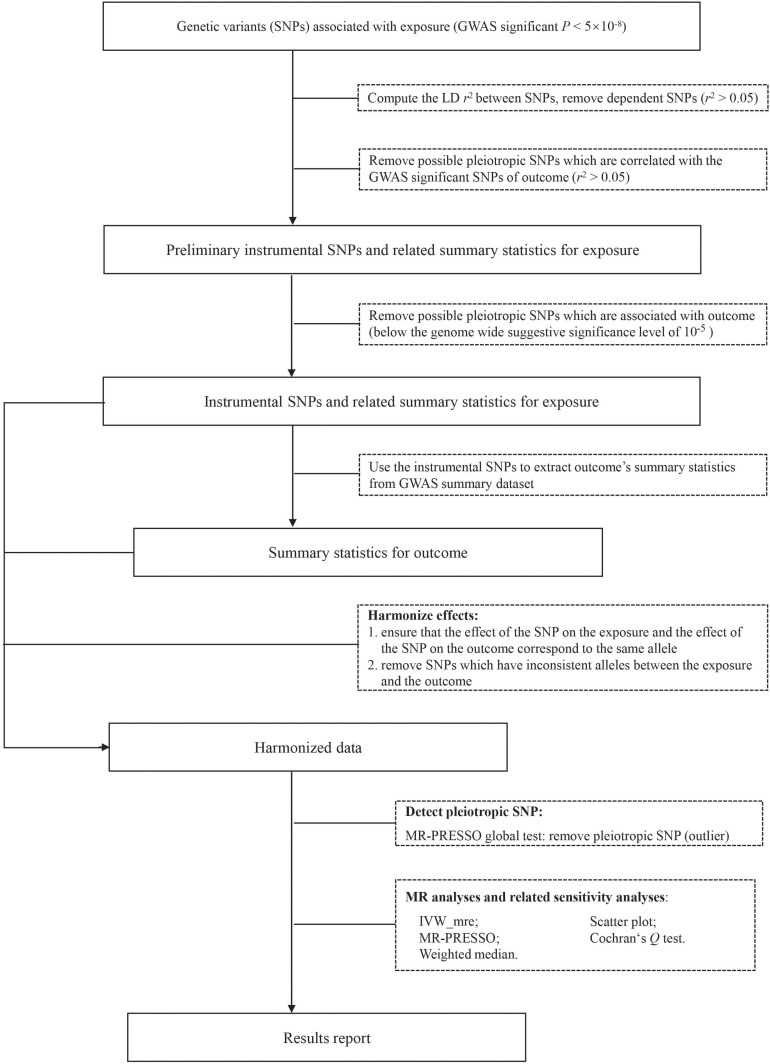
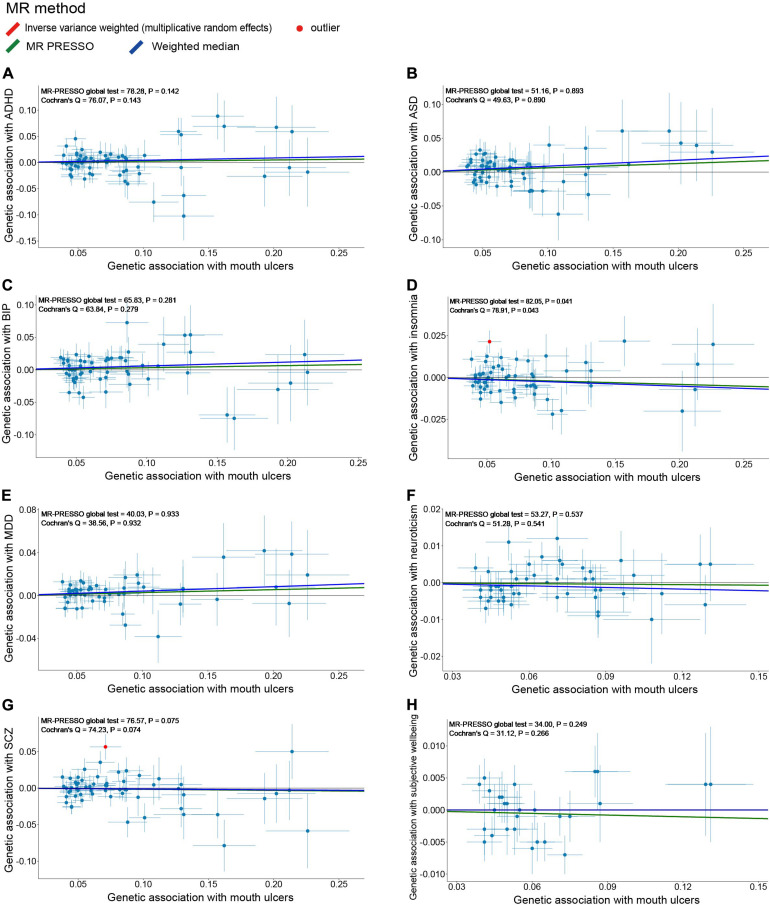
We collected summary statistics of mouth ulcers (sample size = 461,106) and 10 psychiatric traits from the largest publicly available GWAS on Europeans, including anxiety disorder ( = 83,566), attention deficit/hyperactivity disorder ( = 53,293), autism spectrum disorder ( = 46,350), bipolar disorder ( = 51,710), insomnia ( = 1,331,010), major depressive disorder ( = 480,359), mood instability ( = 363,705), neuroticism ( = 168,105), schizophrenia ( = 105,318), and subjective wellbeing ( = 388,538). We applied three two-sample bi-directional MR analysis methods, namely the Inverse Variance Weighted (IVW) method, the MR pleiotropy residual sum and outlier (MR-PRESSO) method, and the weighted median method, to assess the causal relationship between each psychiatric trait and mouth ulcers.
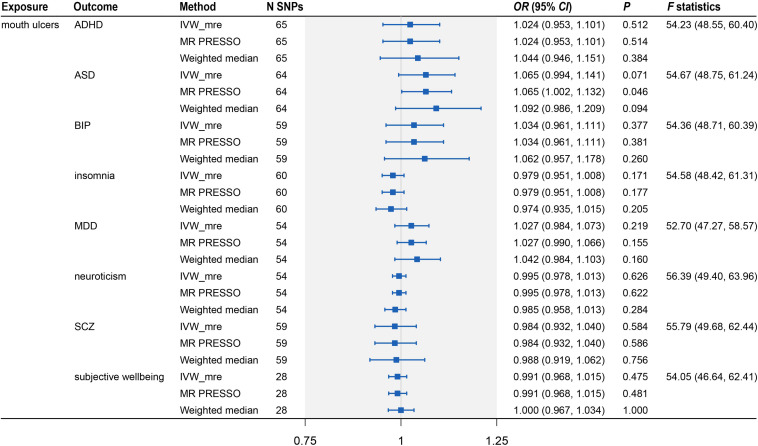
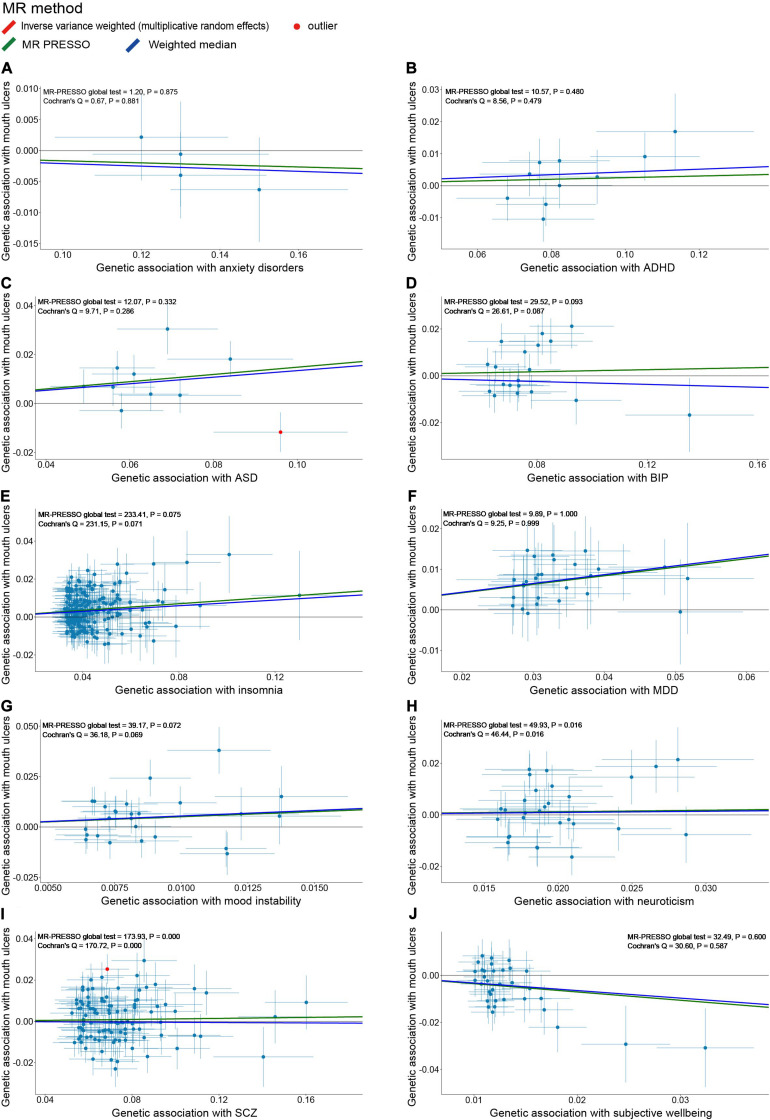
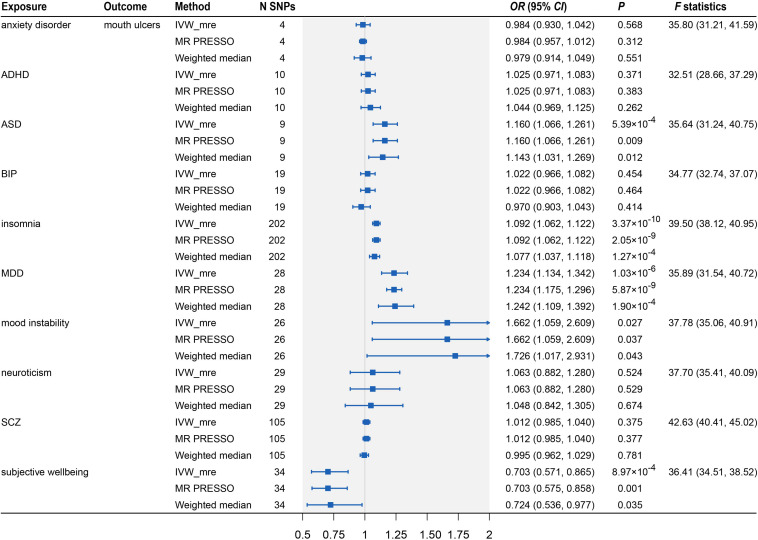
We found significant effects of autism spectrum disorder, insomnia, major depressive disorder, and subjective wellbeing on mouth ulcers, with the corresponding odds ratio () from the IVW method being 1.160 [95% confidence interval (): 1.066-1.261, = 5.39 × 10], 1.092 (1.062-1.122, = 3.37 × 10), 1.234 (1.134-1.342, = 1.03 × 10), and 0.703 (0.571-0.865, = 8.97 × 10), respectively. We also observed suggestive evidence for mood instability to cause mouth ulcers [IVW, OR = 1.662 (1.059-2.609), = 0.027]. These results were robust to weak instrument bias and heterogeneity. We found no evidence on causal effects between other psychiatric traits and mouth ulcers, in either direction.
Our findings suggest a protective effect of subjective wellbeing and risk effects of autism spectrum disorder, insomnia, major depressive disorder, and mood instability on mouth ulcers. These results clarify the causal relationship between psychiatric traits and the development of mouth ulcers.
尽管观察性研究报告了口腔溃疡与精神特质之间的关联,但其因果关系仍不明确。由大规模全基因组关联研究(GWAS)驱动的孟德尔随机化(MR)为阐明口腔溃疡与精神特质之间的因果关系提供了契机。
我们从欧洲人最大的公开可用GWAS中收集了口腔溃疡(样本量 = 461,106)和10种精神特质的汇总统计数据,包括焦虑症( = 83,566)、注意力缺陷多动障碍( = 53,293)、自闭症谱系障碍( = 46,350)、双相情感障碍( = 51,710)、失眠( = 1,331,010)、重度抑郁症( = 480,359)、情绪不稳定( = 363,705)、神经质( = 168,105)、精神分裂症( = 105,318)和主观幸福感( = 388,538)。我们应用了三种双样本双向MR分析方法,即逆方差加权(IVW)法、MR多效性残差和异常值(MR-PRESSO)法以及加权中位数法,来评估每种精神特质与口腔溃疡之间的因果关系。
我们发现自闭症谱系障碍、失眠、重度抑郁症和主观幸福感对口腔溃疡有显著影响,IVW法对应的优势比(OR)分别为1.160 [95%置信区间(CI):1.066 - 1.261,P = 5.39×10⁻⁶]、1.09(1.062 - 1.122,P = 3.37×10⁻⁹)、1.234(1.134 - 1.342,P = 1.03×10⁻⁵)和0.703(0.571 - 0.865,P = 8.97×10⁻⁴)。我们还观察到情绪不稳定导致口腔溃疡的提示性证据[IVW,OR = 1.662(1.059 - 2.609),P = 0.027]。这些结果对弱工具偏倚和异质性具有稳健性。我们没有发现其他精神特质与口腔溃疡之间存在因果效应的证据,无论方向如何。
我们的研究结果表明主观幸福感对口腔溃疡有保护作用,而自闭症谱系障碍、失眠、重度抑郁症和情绪不稳定对口腔溃疡有风险作用。这些结果阐明了精神特质与口腔溃疡发生之间的因果关系。