Chaudhary Abhilasha, Kumari Vinay, Neetu Neetu
Department of Nursing, Nepal Medical College and Teaching Hospital, Kathmandu, Nepal.
Chitkara School of Health Sciences, Chitkara University, Punjab, India.
Crit Care Res Pract. 2020 Dec 23;2020:8898172. doi: 10.1155/2020/8898172. eCollection 2020.
Poor sleep quality is common in the intensive care unit (ICU), where several factors including environmental factors contribute to sleep deprivation.
This study aims to assess and compare the effectiveness of earplugs and eye mask versus ocean sound on sleep quality among ICU patients.
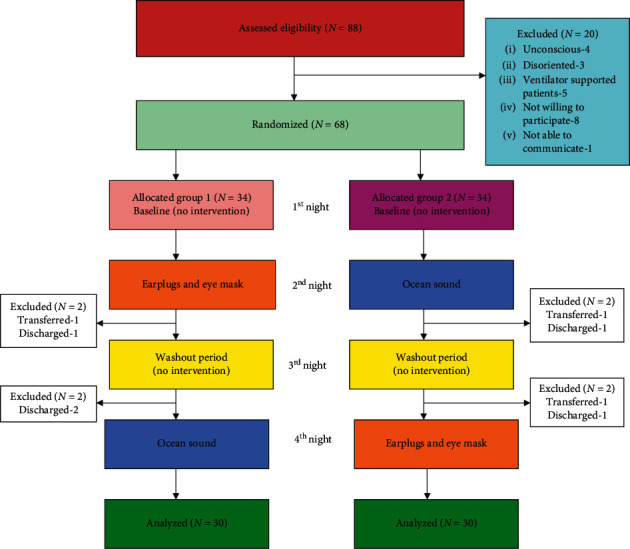
A true experimental crossover design was used. . Medical ICU of the Maharishi Markandeshwar Institute of Medical Sciences and Research Hospital, Mullana, India. Sixty-eight patients admitted in the medical ICU were randomly allocated by lottery methods into group 1 and group 2.
Nocturnal nine-hour (10 : 00 pm to 7 : 00 am) for a four-night period were measured. Earplugs and eye mask versus ocean sound were crossed over between two groups. Subjective sleep quality of four nights was assessed using a structured sleep quality scale. Scores for each question range from 0 to 3, with a higher score indicating poor sleep quality.
Repeated measures ANOVA showed that there was a significant change in the sleep quality score (=0.001), which showed that sleep quality score was improved after the administration of earplugs and eye mask and ocean sound. Fisher's LSD post hoc comparison showed a significant difference (=0.001).
Earplugs and eye mask were better than ocean sound in improving sleep quality. Earplugs, eye mask, and ocean sound are safe and cost effective, which could be used as an adjuvant to pharmacological interventions to improve sleep quality among ICU patients. However, further research in this area needs to be conducted. This trial is registered with NCT03215212.
睡眠质量差在重症监护病房(ICU)很常见,包括环境因素在内的多种因素会导致睡眠剥夺。
本研究旨在评估和比较耳塞眼罩与海洋音效对ICU患者睡眠质量的影响。
采用真实验交叉设计。印度穆拉纳市玛赫西·马尔坎德什瓦尔医学科学与研究医院的内科ICU。通过抽签法将68名入住内科ICU的患者随机分为1组和2组。
测量四个晚上夜间9小时(晚上10点至早上7点)的情况。两组交叉使用耳塞眼罩和海洋音效。使用结构化睡眠质量量表评估四个晚上的主观睡眠质量。每个问题的得分范围为0至3分,得分越高表明睡眠质量越差。
重复测量方差分析显示睡眠质量得分有显著变化(P = 0.001),表明使用耳塞眼罩和海洋音效后睡眠质量得分有所改善。Fisher最小显著差异法事后比较显示有显著差异(P = 0.001)。
在改善睡眠质量方面,耳塞眼罩比海洋音效更好。耳塞、眼罩和海洋音效安全且具有成本效益,可作为药物干预的辅助手段来改善ICU患者的睡眠质量。然而,该领域需要进一步研究。本试验已在ClinicalTrials.gov注册,注册号为NCT03215212。