Feldt Matthew M
Pediatric Endocrinologist, Children's Mercy Hospital, Kansas City, MO, USA.
Case Rep Endocrinol. 2020 Dec 23;2020:8883969. doi: 10.1155/2020/8883969. eCollection 2020.
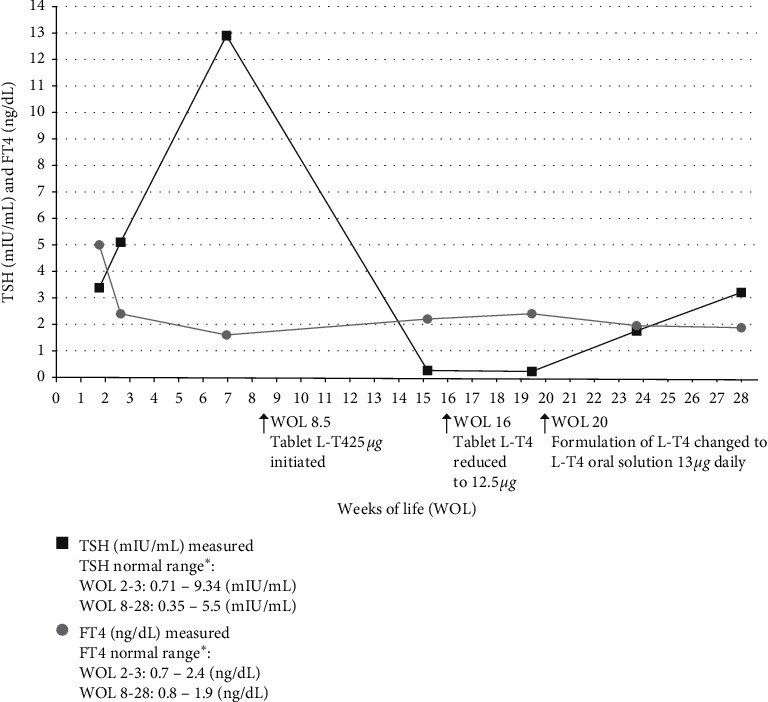
Endocrine disorders are more common and appear earlier in people with trisomy 21 (T21) than in the general population, with thyroid dysfunction being the most common, including both congenital and acquired hypothyroidism. The treatment for biotinidase deficiency, a condition that occurs in approximately 1 : 110,000 people, is with biotin (vitamin B7) supplementation. However, biotin can interfere with endocrine laboratory assays and cause falsely low thyroid-stimulating hormone (TSH) and elevated free thyroxine (FT4) levels. This can interfere with the timely diagnosis and subsequent treatment of congenital hypothyroidism (CH). This case report describes an infant with partial biotinidase deficiency that was confirmed on day 10 of life. Routine screening erroneously reported "normal" TSH that caused delayed diagnosis of CH due to interference with the TSH assay from concurrent biotin use. Once the biotin treatment was withheld for 4 days and the thyroid function tests repeated, an elevated TSH became apparent. Treatment with tablet levothyroxine (L-T4) was started and subsequently changed to L-T4 oral solution (Tirosint®-SOL) to overcome treatment administration difficulties encountered with the tablet form. This resulted in improved TSH control due to more accurate and consistent dosing compared with the tablet formulation. This is the first report of the use of L-T4 oral solution in an infant with T21 and biotinidase deficiency.
内分泌紊乱在21三体综合征(T21)患者中比普通人群更常见且出现得更早,其中甲状腺功能障碍最为常见,包括先天性和后天性甲状腺功能减退。生物素酶缺乏症的发病率约为1:110,000,其治疗方法是补充生物素(维生素B7)。然而,生物素会干扰内分泌实验室检测,导致促甲状腺激素(TSH)水平假性降低和游离甲状腺素(FT4)水平升高。这可能会干扰先天性甲状腺功能减退症(CH)的及时诊断和后续治疗。本病例报告描述了一名在出生第10天确诊为部分生物素酶缺乏症的婴儿。常规筛查错误地报告TSH“正常”,由于同时使用生物素干扰了TSH检测,导致CH诊断延迟。一旦停用生物素治疗4天并重复进行甲状腺功能测试,TSH升高就变得明显。开始使用左旋甲状腺素片(L-T4)治疗,随后改为L-T4口服溶液(Tirosint®-SOL),以克服片剂形式治疗给药时遇到的困难。与片剂相比,由于给药更准确和一致,这导致TSH控制得到改善。这是首次报道在患有T21和生物素酶缺乏症的婴儿中使用L-T4口服溶液。