Singh Rajani
Anatomy, Uttar Pradesh University of Medical Sciences, Saifai, IND.
Cureus. 2020 Dec 6;12(12):e11940. doi: 10.7759/cureus.11940.
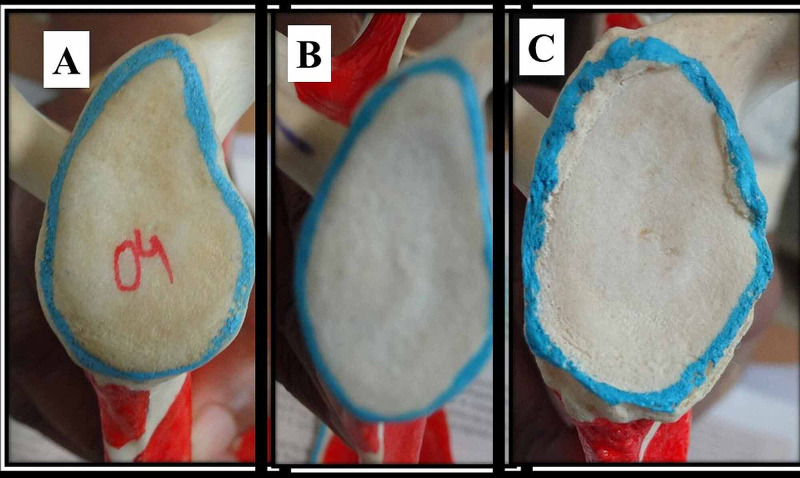
Background and objective The head of the humerus articulates with the glenoid cavity (GC) to form the shoulder joint. Understanding the various shapes and sizes of GC is important not only to analyse the stability of the glenohumeral joint but also to design prostheses for shoulder arthroplasty. Morphometric data on GC among the North Indian population is scarce. Hence, the aim of this study was to provide morphological and morphometric data on GC among the North Indian population. Methods This study was conducted in the department of anatomy of two medical colleges using undamaged dry scapulae. The shapes of GC and supero-inferior (SI) and maximum anteroposterior diameters above and below the notch were recorded. Statistical analysis and Student's t-test were carried out to identify statistically significant differences in diameters of the two sides of GC. Results The most common and least common shapes of GC were pear and inverted comma shapes respectively. The mean SI glenoid diameter was 33.6 ± 3.2 mm. The mean of H1 and H2 diameter was 23.6 ± 3.1 and 15.3 ± 2.1 mm respectively. The mean GC indices on the right and left sides were 72.16 and 68.14 respectively. In all of the above measurements, bilateral differences were not statistically significant (p-values of ˃0.05). Conclusions The morphometric data on GC may be used to design prostheses for shoulder arthroplasty among the North Indian population. The information is also useful in detecting various pathological conditions of the shoulder like rotator cuff disease, osteochondral defects, and Bankart lesions.
背景与目的 肱骨头与关节盂(GC)相连形成肩关节。了解GC的各种形状和大小不仅对于分析盂肱关节的稳定性很重要,而且对于设计肩关节置换术的假体也很重要。北印度人群中关于GC的形态测量数据稀缺。因此,本研究的目的是提供北印度人群中GC的形态学和形态测量数据。方法 本研究在两所医学院的解剖学系使用未受损的干燥肩胛骨进行。记录GC的形状以及缺口上方和下方的上下径(SI)和最大前后径。进行统计分析和学生t检验以确定GC两侧直径的统计学显著差异。结果 GC最常见和最不常见的形状分别是梨形和倒逗号形。GC的平均SI直径为33.6±3.2毫米。H1和H2直径的平均值分别为23.6±3.1毫米和15.3±2.1毫米。左右两侧的平均GC指数分别为72.16和68.14。在上述所有测量中,双侧差异无统计学意义(p值>0.05)。结论 GC的形态测量数据可用于为北印度人群设计肩关节置换术的假体。该信息对于检测肩部的各种病理状况,如肩袖疾病、骨软骨缺损和Bankart损伤也很有用。