Shukla Shashi Kant, Mikkola Jyri-Pekka
Technical Chemistry, Department of Chemistry, Chemical-Biological Centre, Umeå University, Umeå, Sweden.
Industrial Chemistry and Reaction Engineering, Department of Chemical Engineering, Johan Gadolin Process Chemistry Centre, Åbo Akademi University, Åbo-Turku, Finland.
Front Chem. 2020 Dec 23;8:598662. doi: 10.3389/fchem.2020.598662. eCollection 2020.
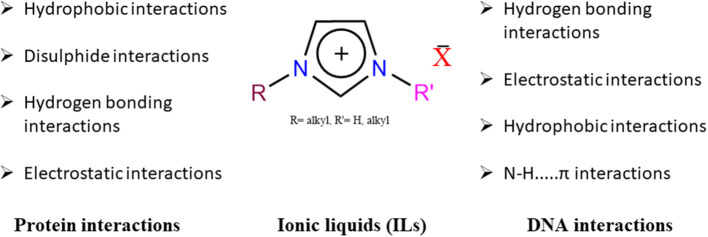
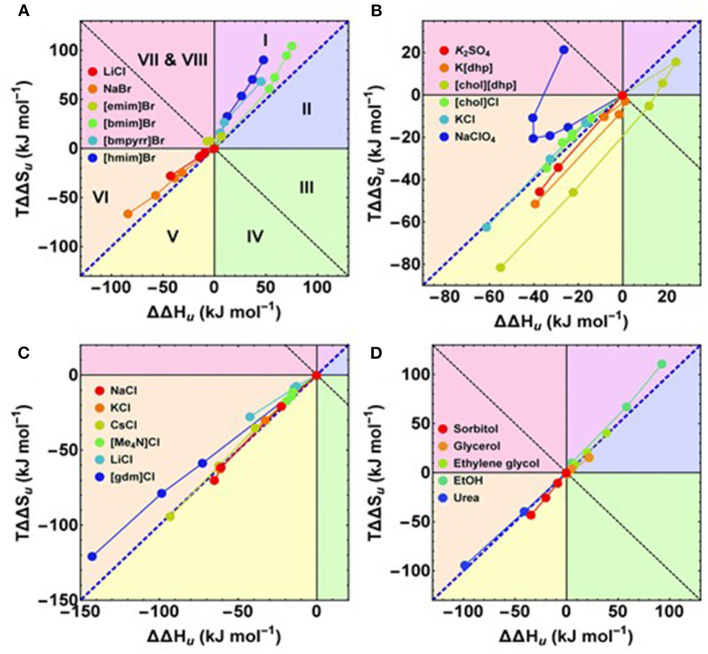
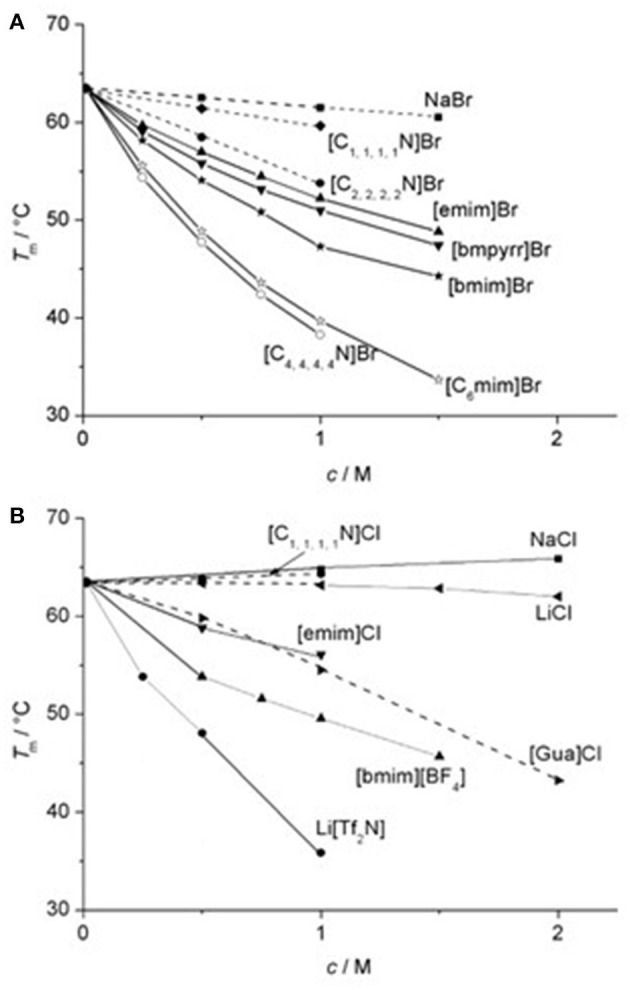
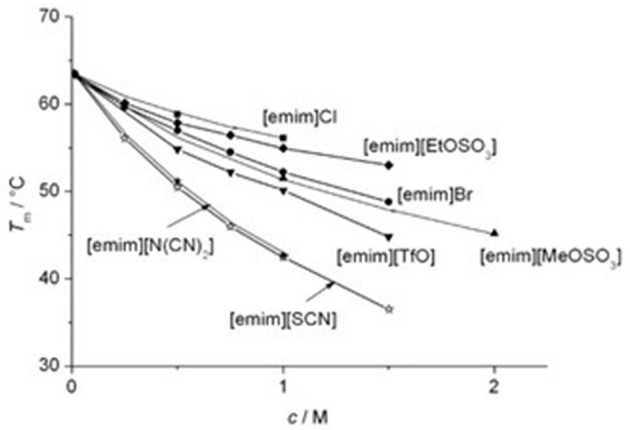
Ionic liquids (ILs) have been receiving much attention as solvents in various areas of biochemistry because of their various beneficial properties over the volatile solvents and ILs availability in myriad variants (perhaps as many as 10) owing to the possibility of paring one cation with several anions and as well as formulations as zwitterions. Their potential as solvents lies in their tendency to offer both directional and non-directional forces toward a solute molecule. Because of these forces, ionic liquids easily undergo intermolecular interactions with a range of polar/non-polar solutes, including biomolecules such as proteins and DNA. The interaction of genomic species in aqueous/non-aqueous states assists in unraveling their structure and functioning, which have implications in various biomedical applications. The charge density of ionic liquids renders them hydrophilic and hydrophobic, which retain intact over long-range of temperatures. Their ability in stabilizing or destabilizing the 3D-structure of a protein or the double-helical structure of DNA has been assessed superior to the water and volatile organic solvents. The aptitude of an ion in influencing the structure and stability of a native protein depends on their ranking in the Hofmeister series. However, at several instances, a reverse Hofmeister ordering of ions and specific ion-solute interaction has been observed. The capability of an ionic liquid in terms of the tendency to promote the coiling/uncoiling of DNA structure is noted to rely on the basicity, electrostatic interaction, and hydrophobicity of the ionic liquid in question. Any change in the DNA's double-helical structure reflects a change in its melting temperature ( ), compared to a standard buffer solution. These changes in DNA structure have implications in biosensor design and targeted drug-delivery in biomedical applications. In the current review, we have attempted to highlight various aspects of ionic liquids that influence the structure and properties of proteins and DNA. In short, the review will address the issues related to the origin and strength of intermolecular interactions, the effect of structural components, their nature, and the influence of temperature, pH, and additives on them.
离子液体(ILs)作为生物化学各个领域的溶剂受到了广泛关注,这是因为它们相较于挥发性溶剂具有多种有益特性,并且由于可以将一种阳离子与多种阴离子配对以及形成两性离子形式,离子液体有无数种变体(可能多达10种)。它们作为溶剂的潜力在于能够对溶质分子提供定向和非定向力。由于这些力,离子液体容易与一系列极性/非极性溶质发生分子间相互作用,包括蛋白质和DNA等生物分子。基因组物种在水相/非水相状态下的相互作用有助于揭示其结构和功能,这在各种生物医学应用中具有重要意义。离子液体的电荷密度使其具有亲水性和疏水性,并且在很宽的温度范围内保持不变。它们在稳定或破坏蛋白质的三维结构或DNA的双螺旋结构方面的能力已被评估为优于水和挥发性有机溶剂。离子影响天然蛋白质结构和稳定性的能力取决于它们在霍夫迈斯特序列中的排名。然而,在一些情况下,已经观察到离子的反向霍夫迈斯特排序和特定的离子 - 溶质相互作用。离子液体促进DNA结构卷曲/解卷曲的能力被认为取决于所讨论的离子液体的碱性、静电相互作用和疏水性。与标准缓冲溶液相比,DNA双螺旋结构的任何变化都反映了其解链温度( )的变化。DNA结构的这些变化在生物传感器设计和生物医学应用中的靶向药物递送方面具有重要意义。在当前的综述中,我们试图强调离子液体影响蛋白质和DNA结构及性质的各个方面。简而言之,该综述将探讨与分子间相互作用的起源和强度、结构成分的影响、它们的性质以及温度、pH和添加剂对它们的影响相关的问题。