Ameri Mahboobe, Movahed Ehsan, Farokhzadian Jamileh
M.Sc. Student of Human Ecology, Faculty of Health, Kerman University of Medical Sciences, Kerman, Iran.
Health Education and Health Promotion, Faculty of Health, Jiroft University of Medical Sciences, Jiroft, Iran.
J Educ Health Promot. 2020 Nov 26;9:317. doi: 10.4103/jehp.jehp_188_20. eCollection 2020.
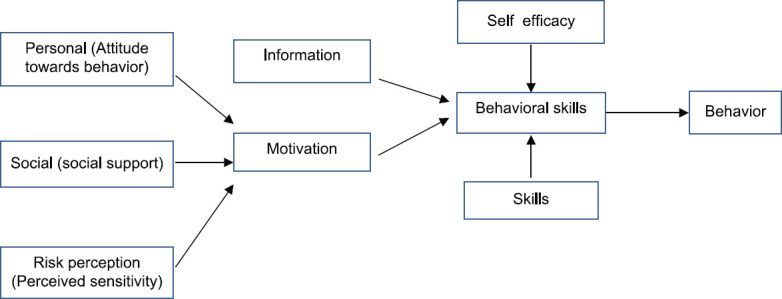
Adherence to treatment is one of the major challenges in patients with HIV/ADIS. If the patients do not adhere, they will face recurrent consequences, such as disease progression. The aim of this study was to investigate the effect of information, motivation, and behavioral Skills (IMB) model on medication adherence, diet adherence, and physical activity in HIV/ADIS patients.
This interventional study was conducted on 122 patients with 20 years of age and over with HIV/AIDS in Kerman City, Iran, in 2018. A total of patients were selected by census method and categorized into the intervention and control groups. Later, a researcher-made questionnaire on IMB was used before and 3 months after the intervention to assess medication adherence, diet adherence, and physical activity .The intervention study consisted of at least 8 training sessions (90 min) over a 12-week period.
In adherence to medication, information ( = 0.034) and personal motivation ( = 0.003) constructs and in adherence to diet, information ( = 0.025), personal motivation ( = 0.001), self-efficacy ( = 0.010), and skills ( = 0.011) were significantly different between the two groups after the intervention ( = 0.011). However, regarding the adherence to physical activity, no significant difference was found between the two groups after the intervention.
The IMB model can be effective in promoting the diet adherence in HIV/AIDS patients. In this regard, more qualitative and quantitative studies are recommended on the adherence to medication and physical activity.
坚持治疗是艾滋病毒/艾滋病患者面临的主要挑战之一。如果患者不坚持治疗,他们将面临反复出现的后果,如疾病进展。本研究的目的是调查信息、动机和行为技能(IMB)模型对艾滋病毒/艾滋病患者药物依从性、饮食依从性和身体活动的影响。
2018年,在伊朗克尔曼市对122名20岁及以上的艾滋病毒/艾滋病患者进行了这项干预性研究。通过普查方法选取了总共122名患者,并将其分为干预组和对照组。随后,在干预前和干预后3个月使用研究人员自制的IMB问卷来评估药物依从性、饮食依从性和身体活动。干预研究包括在12周内至少进行8次培训课程(每次90分钟)。
在药物依从性方面,干预后两组之间的信息(P = 0.034)和个人动机(P = 0.003)结构存在显著差异;在饮食依从性方面,信息(P = 0.025)、个人动机(P = 0.001)、自我效能感(P = 0.010)和技能(P = 0.011)在两组之间存在显著差异(P = 0.011)。然而,在身体活动依从性方面,干预后两组之间未发现显著差异。
IMB模型可有效促进艾滋病毒/艾滋病患者的饮食依从性。在这方面,建议对药物依从性和身体活动进行更多的定性和定量研究。