Wang Yu-Hao, Wang Dian-Ri, Guo Yu-Chen, Liu Ji-Yuan, Pan Jian
State Key Laboratory of Oral Disease, West China Hospital of Stomatology, Sichuan University, Chengdu, 610041, PR China.
National Clinical Research Center for Oral Diseases & Department of Oral and Maxillofacial Surgery, West China Hospital of Stomatology, Sichuan University, Chengdu, 610041, PR China.
Regen Ther. 2020 Nov 28;15:285-294. doi: 10.1016/j.reth.2020.11.002. eCollection 2020 Dec.
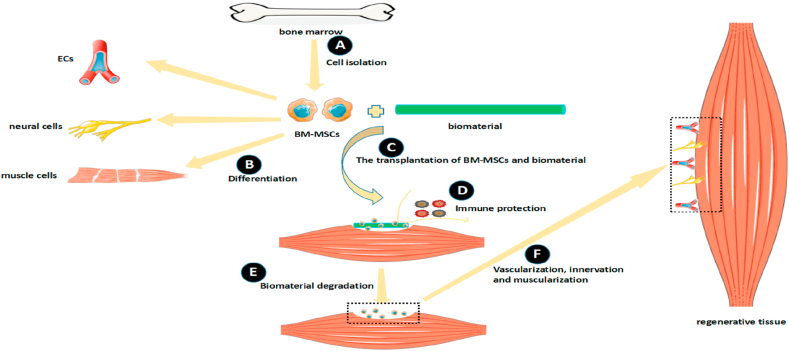
Skeletal muscle injuries have bothered doctors and caused great burdens to the public medical insurance system for a long time. Once injured, skeletal muscles usually go through the processes of inflammation, repairing and remodeling. If repairing and remodeling stages are out of balance, scars will be formed to replace injured skeletal muscles. At present, clinicians usually use conventional methods to restore the injured skeletal muscles, such as flap transplantation. However, flap transplantation sometimes needs to sacrifice healthy autologous tissues and will bring extra harm to patients. In recent years, stem cells-based tissue engineering provides us new treatment ideas for skeletal muscle injuries. Stem cells are cells with multiple differentiation potential and have ability to differentiate into adult cells under special condition. Skeletal muscle tissues also have stem cells, called satellite cells, but they are in small amount and new muscle fibers that derived from them may not be enough to replace injured fibers. Bone marrow mesenchymal stem cells (BM-MSCs) could promote musculoskeletal tissue regeneration and activate the myogenic differentiation of satellite cells. Biomaterial is another important factor to promote tissue regeneration and greatly enhance physiological activities of stem cells . The combined use of stem cells and biomaterials will gradually become a mainstream to restore injured skeletal muscles in the future. This review article mainly focuses on the review of research about the application of BM-MSCs and several major biomaterials in skeletal muscle regeneration over the past decades.
骨骼肌损伤长期以来一直困扰着医生,并给公共医疗保险系统带来了巨大负担。一旦受伤,骨骼肌通常会经历炎症、修复和重塑过程。如果修复和重塑阶段失衡,就会形成疤痕来替代受损的骨骼肌。目前,临床医生通常使用传统方法来修复受损的骨骼肌,如皮瓣移植。然而,皮瓣移植有时需要牺牲健康的自体组织,会给患者带来额外的伤害。近年来,基于干细胞的组织工程为骨骼肌损伤提供了新的治疗思路。干细胞是具有多种分化潜能的细胞,在特殊条件下能够分化为成熟细胞。骨骼肌组织中也存在干细胞,称为卫星细胞,但数量较少,由它们分化产生的新肌纤维可能不足以替代受损纤维。骨髓间充质干细胞(BM-MSCs)可以促进肌肉骨骼组织再生,并激活卫星细胞的成肌分化。生物材料是促进组织再生的另一个重要因素,能极大地增强干细胞的生理活性。干细胞与生物材料的联合应用将逐渐成为未来修复受损骨骼肌的主流方法。这篇综述文章主要聚焦于对过去几十年间BM-MSCs和几种主要生物材料在骨骼肌再生中的应用研究进行综述。