Ramaye Yannic, Dabrio Marta, Roebben Gert, Kestens Vikram
European Commission, Joint Research Centre (JRC), 2440 Geel, Belgium.
Materials (Basel). 2021 Jan 8;14(2):290. doi: 10.3390/ma14020290.
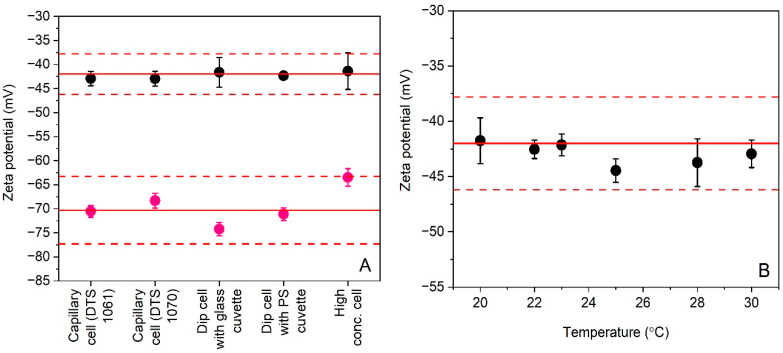
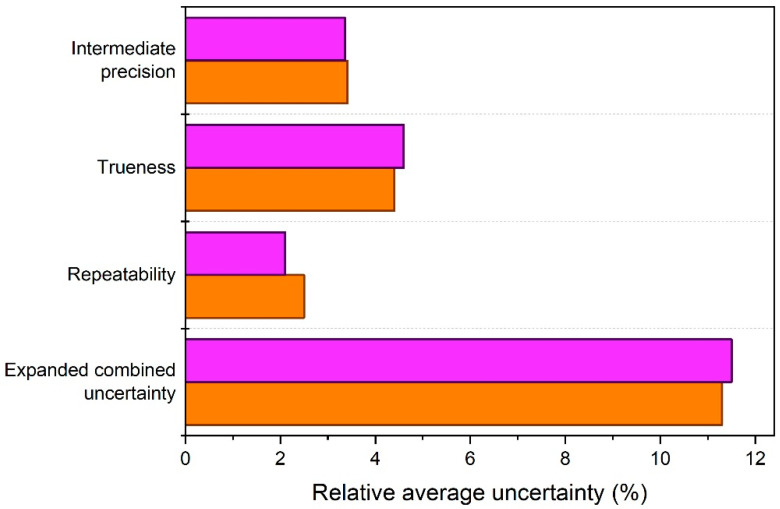
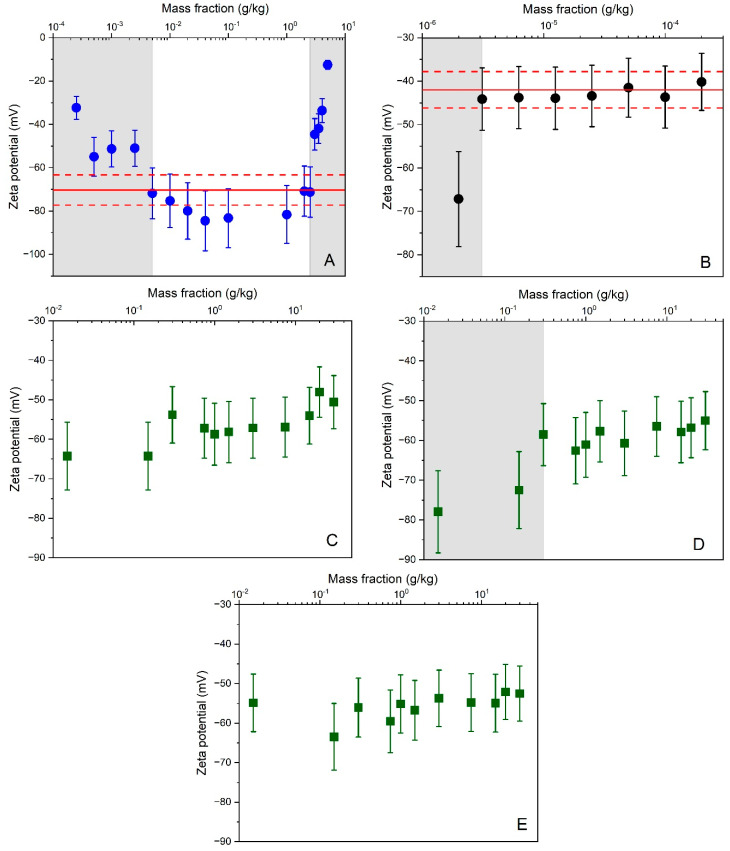
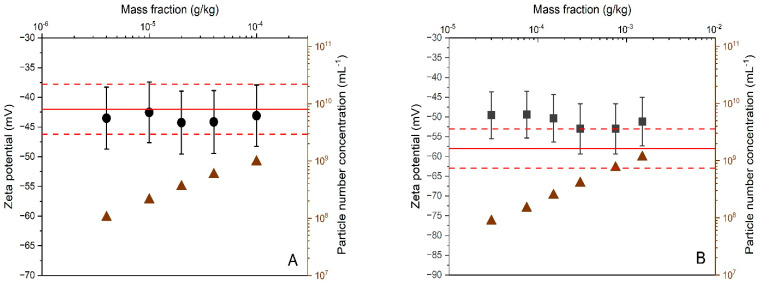
Zeta potential is frequently used to examine the colloidal stability of particles and macromolecules in liquids. Recently, it has been suggested that zeta potential can also play an important role for grouping and read-across of nanoforms in a regulatory context. Although the measurement of zeta potential is well established, only little information is reported on key metrological principles such as validation and measurement uncertainties. This contribution presents the results of an in-house validation of the commonly used electrophoretic light scattering (ELS) and the relatively new particle tracking analysis (PTA) methods. The performance characteristics were assessed by analyzing silica and polystyrene reference materials. The ELS and PTA methods are robust and have particle mass working ranges of 0.003 mg/kg to 30 g/kg and 0.03 mg/kg to 1.5 mg/kg, respectively. Despite different measurement principles, both methods exhibit similar uncertainties for repeatability (2%), intermediate precision (3%) and trueness (4%). These results confirm that the developed methods can accurately measure the zeta potential of silica and polystyrene particles and can be transferred to other laboratories that analyze similar types of samples. If direct implementation is impossible, the elaborated methodologies may serve as a guide to help laboratories validating their own methods.
ζ 电位常用于研究液体中颗粒和大分子的胶体稳定性。最近,有人提出 ζ 电位在监管背景下对纳米形态的分组和类推也可能发挥重要作用。尽管 ζ 电位的测量方法已经成熟,但关于验证和测量不确定度等关键计量原则的报道却很少。本文介绍了对常用的电泳光散射(ELS)和相对较新的颗粒追踪分析(PTA)方法进行内部验证的结果。通过分析二氧化硅和聚苯乙烯标准物质评估了这些方法的性能特征。ELS 和 PTA 方法性能可靠,颗粒质量工作范围分别为 0.003 mg/kg 至 30 g/kg 和 0.03 mg/kg 至 1.5 mg/kg。尽管测量原理不同,但两种方法在重复性(2%)、中间精密度(3%)和准确性(4%)方面表现出相似的不确定度。这些结果证实,所开发的方法能够准确测量二氧化硅和聚苯乙烯颗粒的 ζ 电位,并且可以应用于分析类似类型样品的其他实验室。如果无法直接采用,详细的方法可作为指导,帮助实验室验证自己的方法。