Zhussupova Gulzira, Utepova Dinara, Orazova Galiya, Zhaldybayeva Saule, Skvirskaya Galina, Tossekbayev Kanat
The Republican State Enterprise on the Right of Economic Management "Republican Center for Health Development" of the Ministry of Health of the Republic of Kazakhstan, Nur-Sultan 010000, Kazakhstan.
Department of Public Health, Astana Medical University, Nur-Sultan 010000, Kazakhstan.
Antibiotics (Basel). 2021 Jan 8;10(1):58. doi: 10.3390/antibiotics10010058.
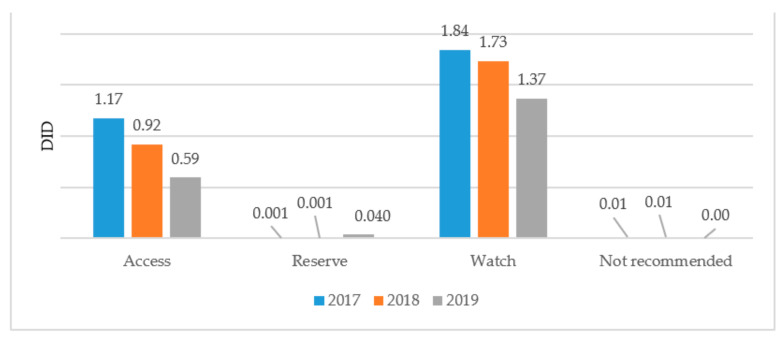
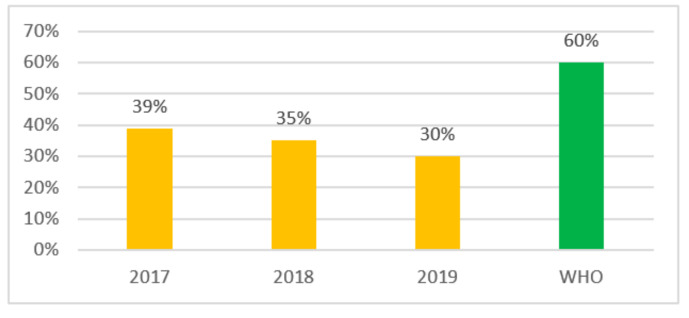
The purpose of this study is to conduct a comparative analysis of the consumption of antibiotics for systemic use reimbursed by the state in Kazakhstan for 2017-2019 with the Access, Watch, and Reserve classification (AWaRe 2019) of the World Health Organization (WHO). The evaluation of the consumption of antibiotics for systemic use in Kazakhstan for 2017-2019 was carried out using the ATC/DDD methodology in accordance with the WHO AWaRe classification. The study used data on all antibiotics that were centrally purchased by a single purchaser during the study period. To understand how often Access group antibiotics are taken in Kazakhstan, the top-10 most consumed antibiotics were additionally studied. The results of a comparative analysis of the antibiotics for systemic use consumption for 2017-2019 by the Access, Watch, and Reserve groups showed a negative trend of a decrease in the consumption of Access group drugs from 1.17 defined daily dose (DDDs) per 1000 inhabitants per day (DID) (39%) in 2017 to 0.59 DID (30%) in 2019. There is an increase in consumption of Watch group antibiotics from 1.84 DID (61%) in 2017 to 1.37 DID (68%) in 2019, as well as an increase in consumption of Reserve antibiotics from 0.001 DID (0.03%) to 0.4 DID (2.11%). In recent years in Kazakhstan, there has been a decrease in the consumption of Access group antibiotics. In addition, the Watch group antibiotics are widely consumed with a certain upward trend. In 2019, one Reserve antibiotic was included in the top-10 most commonly consumed antibiotics. There is a predominant consumption of parenteral forms of antibiotics for systemic use in the country.
本研究的目的是对哈萨克斯坦2017 - 2019年国家报销的全身用抗生素消费情况与世界卫生组织(WHO)的准入、观察和储备分类(AWaRe 2019)进行比较分析。根据WHO的AWaRe分类,采用ATC/DDD方法对哈萨克斯坦2017 - 2019年全身用抗生素的消费情况进行了评估。该研究使用了研究期间由单一采购商集中采购的所有抗生素的数据。为了解哈萨克斯坦使用准入组抗生素的频率,还对消费量排名前十的抗生素进行了研究。准入、观察和储备组对2017 - 2019年全身用抗生素消费情况的比较分析结果显示,准入组药物的消费量呈下降趋势,从2017年的每1000居民每天1.17限定日剂量(DDD)(39%)降至2019年的0.59 DDD(30%)。观察组抗生素的消费量从2017年的1.84 DDD(61%)增加到2019年的1.37 DDD(68%),储备抗生素的消费量也从0.001 DDD(0.03%)增加到0.4 DDD(2.11%)。近年来,哈萨克斯坦的准入组抗生素消费量有所下降。此外,观察组抗生素的消费广泛且呈一定上升趋势。2019年,一种储备抗生素进入了最常用的十大抗生素之列。该国全身用抗生素的注射剂型消费占主导地位。