Department of Clinical Laboratory, Peking University First Hospital, No.8 Xishiku St., Xicheng District, 100034, Beijing, China.
BMC Nephrol. 2021 Jan 11;22(1):24. doi: 10.1186/s12882-020-02225-6.
Dent disease is an X-linked form of progressive renal disease. This rare disorder was characterized by hypercalciuria, low molecular weight (LMW) proteinuria and proximal tubular dysfunction, caused by pathogenic variants in CLCN5 (Dent disease 1) or OCRL (Dent disease 2) genes. Fanconi syndrome is a consequence of decreased water and solute resorption in the proximal tubule of the kidney. Fanconi syndrome caused by proximal tubular dysfunction such as Dent disease might occur in early stage of the disease.
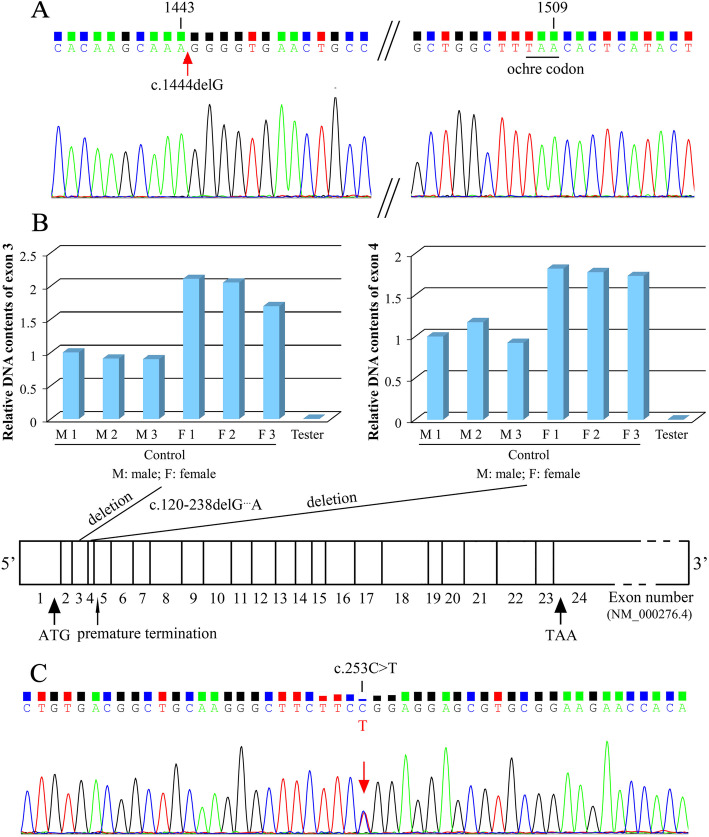
Three cases reported in this study were 3-, 10- and 14-year-old boys, and proteinuria was the first impression in all the cases. All the boys presented with LMW proteinuria and elevated urine albumin-to-creatinine ratio (ACR). Case 1 revealed a pathogenic variant in exon 11 of CLCN5 gene [NM_001127899; c.1444delG] and a nonsense mutation at nucleotide 1509 [p.L503*], and he was diagnosed as Dent disease 1. Case 2 carried a deletion of exon 3 and 4 of OCRL1 gene [NM_000276.4; c.120-238delGA] and a nonsense mutation at nucleotide 171 in exon 5 [p.E57*], and this boy was diagnosed as Dent disease 2. Genetic analysis of Case 3 showed a missense mutation located in exon 2 of HNF4A gene [EF591040.1; c.253C > T; p.R85W] which is responsible for Fanconi syndrome. All of three pathogenic variants were not registered in GenBank.
Urine protein electrophoresis should be performed for patients with proteinuria. When patients have LMW proteinuria and/or hypercalciuria, definite diagnosis and identification of Dent disease and Fanconi syndrome requires further genetic analyses.
Dent 病是一种进行性肾脏疾病的 X 连锁形式。这种罕见的疾病的特征是高钙尿症、低分子量(LMW)蛋白尿和近端肾小管功能障碍,由 CLCN5(Dent 病 1)或 OCRL(Dent 病 2)基因突变引起。范可尼综合征是肾脏近端小管中水和溶质吸收减少的结果。由于 Dent 病等近端肾小管功能障碍引起的范可尼综合征可能在疾病的早期发生。
本研究报道了 3 例病例,均为 3、10 和 14 岁男孩,所有病例的首发表现均为蛋白尿。所有男孩均表现为 LMW 蛋白尿和尿白蛋白/肌酐比值(ACR)升高。病例 1 发现 CLCN5 基因第 11 外显子 [NM_001127899; c.1444delG]存在致病性变异和核苷酸 1509 处的无义突变 [p.L503*],诊断为 Dent 病 1。病例 2 携带 OCRL1 基因第 3 和 4 外显子缺失 [NM_000276.4; c.120-238delGA]和第 5 外显子核苷酸 171 处的无义突变 [p.E57*],诊断为 Dent 病 2。病例 3 的基因分析显示,HNF4A 基因第 2 外显子存在错义突变 [EF591040.1; c.253C>T;p.R85W],该突变与范可尼综合征有关。这 3 种致病性变异均未在 GenBank 中注册。
对于蛋白尿患者应进行尿蛋白电泳检查。当患者出现 LMW 蛋白尿和/或高钙尿症时,需要进一步的基因分析以明确诊断和鉴别 Dent 病和范可尼综合征。