Department of Biochemistry and Biophysics, University of Rochester Medical Center, Rochester, NY, 14642, USA.
Instituto de Investigaciones en Ingeniería Genética y Biología Molecular "Dr. Héctor N. Torres" (INGEBI-CONICET), C1428ADN, Buenos Aires, Argentina.
Epigenetics Chromatin. 2021 Jan 11;14(1):5. doi: 10.1186/s13072-020-00381-5.
The vast majority of methods available to characterize genome-wide chromatin structure exploit differences in DNA accessibility to nucleases or chemical crosslinking. We developed a novel method to gauge genome-wide accessibility of histone protein surfaces within nucleosomes by assessing reactivity of engineered cysteine residues with a thiol-specific reagent, biotin-maleimide (BM).
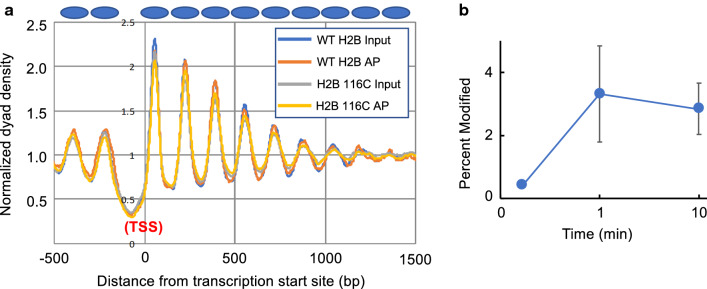
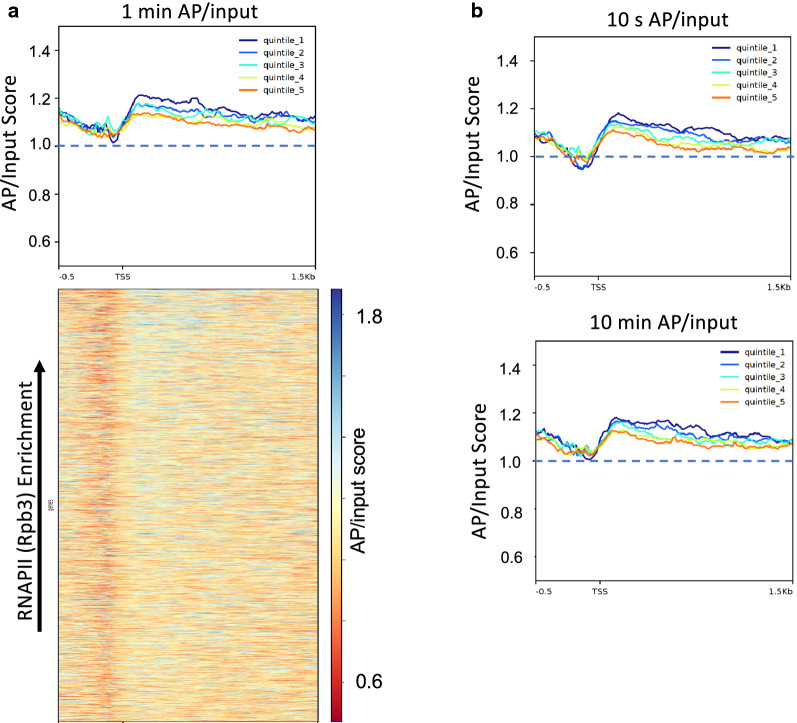
Yeast nuclei were obtained from cells expressing the histone mutant H2B S116C, in which a cysteine resides near the center of the external flat protein surface of the nucleosome. BM modification revealed that nucleosomes are generally equivalently accessible throughout the S. cerevisiae genome, including heterochromatic regions, suggesting limited, higher-order chromatin structures in which this surface is obstructed by tight nucleosome packing. However, we find that nucleosomes within 500 bp of transcription start sites exhibit the greatest range of accessibility, which correlates with the density of chromatin remodelers. Interestingly, accessibility is not well correlated with RNA polymerase density and thus the level of gene expression. We also investigated the accessibility of cysteine mutations designed to detect exposure of histone surfaces internal to the nucleosome thought to be accessible in actively transcribed genes: H3 102, is at the H2A-H2B dimer/H3-H4 tetramer interface, and H3 A110C, resides at the H3-H3 interface. However, in contrast to the external surface site, we find that neither of these internal sites were found to be appreciably exposed.
Overall, our finding that nucleosomes surfaces within S. cerevisiae chromatin are equivalently accessible genome-wide is consistent with a globally uncompacted chromatin structure lacking substantial higher-order organization. However, we find modest differences in accessibility that correlate with chromatin remodelers but not transcription, suggesting chromatin poised for transcription is more accessible than actively transcribed or intergenic regions. In contrast, we find that two internal sites remain inaccessible, suggesting that such non-canonical nucleosome species generated during transcription are rapidly and efficiently converted to canonical nucleosome structure and thus not widely present in native chromatin.
目前绝大多数用于描述全基因组染色质结构的方法都利用了核酸内切酶或化学交联对 DNA 可及性的差异。我们开发了一种新的方法,通过评估工程半胱氨酸残基与硫醇特异性试剂生物素马来酰亚胺(BM)的反应性,来衡量核小体中组蛋白表面的全基因组可及性。
我们从表达组蛋白突变体 H2B S116C 的细胞中获得酵母核,其中一个半胱氨酸残基位于核小体外部平坦蛋白表面的中心附近。BM 修饰表明,核小体在整个酿酒酵母基因组中普遍具有相同的可及性,包括异染色质区域,这表明存在有限的、高级的染色质结构,其中该表面被紧密的核小体包装所阻碍。然而,我们发现转录起始位点 500bp 内的核小体具有最大的可及性范围,这与染色质重塑因子的密度相关。有趣的是,可及性与 RNA 聚合酶的密度没有很好的相关性,因此与基因表达水平无关。我们还研究了设计用于检测被认为在活跃转录基因中可及的核小体内部组蛋白表面暴露的半胱氨酸突变的可及性:H3 102 位于 H2A-H2B 二聚体/H3-H4 四聚体界面,H3 A110C 位于 H3-H3 界面。然而,与外部表面位点不同,我们发现这两个内部位点都没有明显暴露。
总的来说,我们发现酿酒酵母染色质中核小体表面在全基因组范围内具有同等的可及性,这与缺乏实质性高级组织的全球未压缩染色质结构一致。然而,我们发现可及性存在适度差异,与染色质重塑因子相关,但与转录无关,这表明为转录准备的染色质比活跃转录或基因间区域更具可及性。相比之下,我们发现两个内部位点仍然不可及,这表明在转录过程中产生的这种非典型核小体物种会迅速有效地转化为典型核小体结构,因此在天然染色质中并不广泛存在。