Department of Biostatistics, Indiana University, School of Medicine, Indianapolis, IN, 46202, USA.
Department of Medical and Molecular Genetics, Indiana University, School of Medicine, Indianapolis, IN, 46202, USA.
Sci Rep. 2021 Jan 11;11(1):353. doi: 10.1038/s41598-020-79740-x.
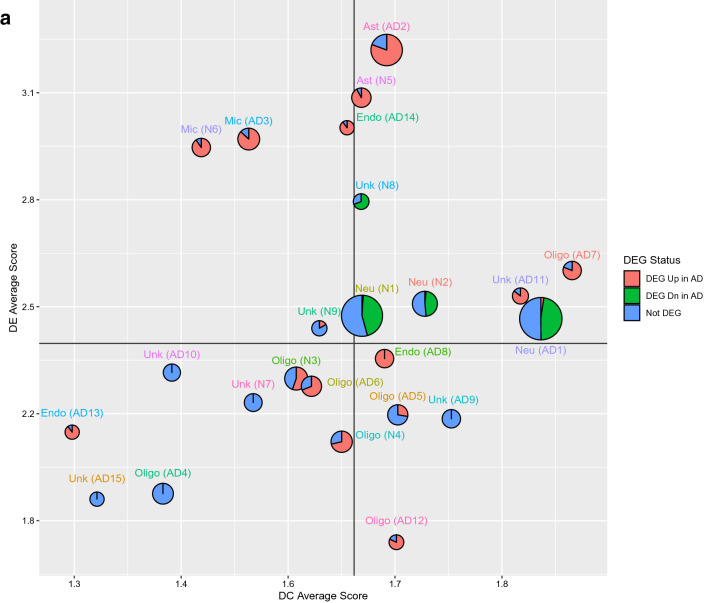
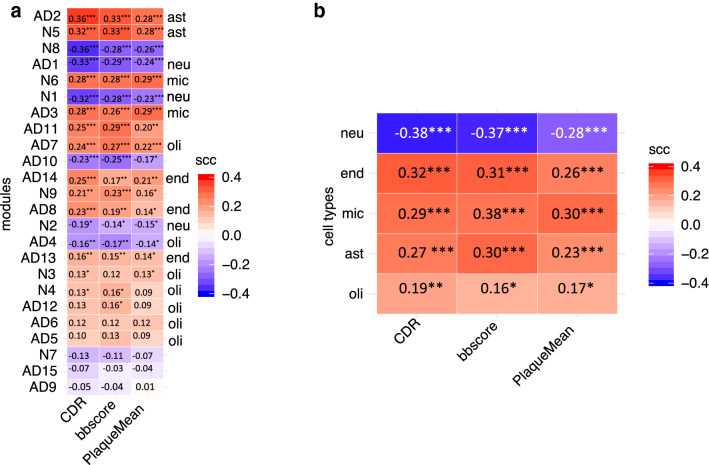
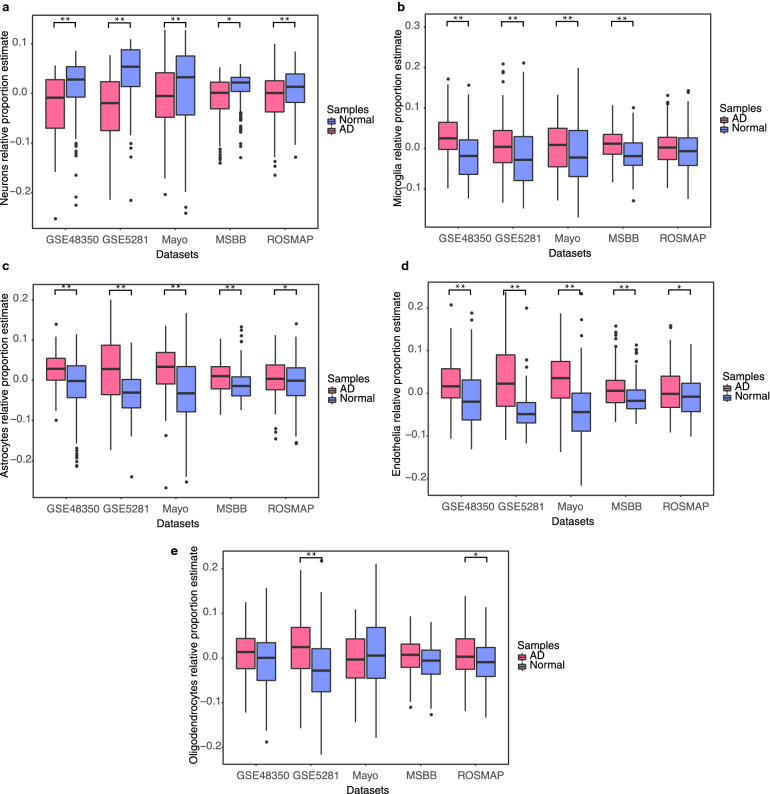
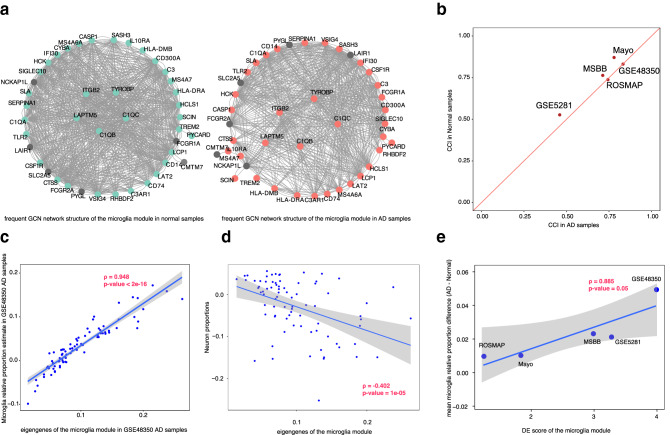
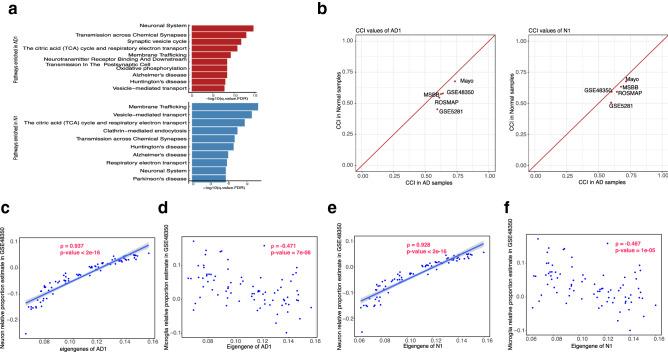
Alzheimer's disease (AD) brains are characterized by progressive neuron loss and gliosis. Previous studies of gene expression using bulk tissue samples often fail to consider changes in cell-type composition when comparing AD versus control, which can lead to differences in expression levels that are not due to transcriptional regulation. We mined five large transcriptomic AD datasets for conserved gene co-expression module, then analyzed differential expression and differential co-expression within the modules between AD samples and controls. We performed cell-type deconvolution analysis to determine whether the observed differential expression was due to changes in cell-type proportions in the samples or to transcriptional regulation. Our findings were validated using four additional datasets. We discovered that the increased expression of microglia modules in the AD samples can be explained by increased microglia proportions in the AD samples. In contrast, decreased expression and perturbed co-expression within neuron modules in the AD samples was likely due in part to altered regulation of neuronal pathways. Several transcription factors that are differentially expressed in AD might account for such altered gene regulation. Similarly, changes in gene expression and co-expression within astrocyte modules could be attributed to combined effects of astrogliosis and astrocyte gene activation. Gene expression in the astrocyte modules was also strongly correlated with clinicopathological biomarkers. Through this work, we demonstrated that combinatorial analysis can delineate the origins of transcriptomic changes in bulk tissue data and shed light on key genes and pathways involved in AD.
阿尔茨海默病(AD)大脑的特征是神经元逐渐丧失和神经胶质增生。以前使用批量组织样本进行基因表达研究时,往往没有考虑到在比较 AD 与对照时细胞类型组成的变化,这可能导致不是由于转录调控引起的表达水平差异。我们挖掘了五个大型转录组 AD 数据集的保守基因共表达模块,然后分析了 AD 样本和对照之间模块内的差异表达和差异共表达。我们进行了细胞类型去卷积分析,以确定观察到的差异表达是由于样本中细胞类型比例的变化还是由于转录调控。我们使用另外四个数据集进行了验证。我们发现,AD 样本中微胶质模块的表达增加可以用 AD 样本中微胶质比例的增加来解释。相比之下,AD 样本中神经元模块的表达下降和共表达失调可能部分归因于神经元途径的调节改变。在 AD 中差异表达的几个转录因子可能解释了这种基因调节的改变。同样,星形胶质细胞模块中基因表达和共表达的变化可能归因于星形胶质细胞增生和星形胶质细胞基因激活的综合作用。星形胶质细胞模块中的基因表达也与临床病理生物标志物强烈相关。通过这项工作,我们证明了组合分析可以描绘批量组织数据中转录组变化的起源,并揭示 AD 中涉及的关键基因和途径。