• 文献检索
  • 文档翻译
  • 深度研究
  • 学术资讯
  • Suppr Zotero 插件Zotero 插件
  • 邀请有礼
  • 套餐&价格
  • 历史记录
应用&插件
Suppr Zotero 插件Zotero 插件浏览器插件Mac 客户端Windows 客户端微信小程序
定价
高级版会员购买积分包购买API积分包
服务
文献检索文档翻译深度研究API 文档MCP 服务
关于我们
关于 Suppr公司介绍联系我们用户协议隐私条款
关注我们

Suppr 超能文献

核心技术专利:CN118964589B侵权必究
粤ICP备2023148730 号-1Suppr @ 2026

文献检索

告别复杂PubMed语法,用中文像聊天一样搜索,搜遍4000万医学文献。AI智能推荐,让科研检索更轻松。

立即免费搜索

文件翻译

保留排版,准确专业,支持PDF/Word/PPT等文件格式,支持 12+语言互译。

免费翻译文档

深度研究

AI帮你快速写综述,25分钟生成高质量综述,智能提取关键信息,辅助科研写作。

立即免费体验

重症监护病房谵妄的药物治疗管理:超过 8500 例患者的临床处方实践和结局。

Pharmacologic Management of Intensive Care Unit Delirium: Clinical Prescribing Practices and Outcomes in More Than 8500 Patient Encounters.

机构信息

From the Department of Anesthesiology.

Critical Illness, Brain Dysfunction, and Survivorship (CIBS) Center at Vanderbilt.

出版信息

Anesth Analg. 2021 Sep 1;133(3):713-722. doi: 10.1213/ANE.0000000000005365.

DOI:10.1213/ANE.0000000000005365
PMID:33433117
原文链接:https://pmc.ncbi.nlm.nih.gov/articles/PMC8793637/
Abstract

BACKGROUND

Pharmacologic agents are frequently utilized for management of intensive care unit (ICU) delirium, yet prescribing patterns and impact of medication choices on patient outcomes are poorly described. We sought to describe prescribing practices for management of ICU delirium and investigate the independent association of medication choice on key in-hospital outcomes including delirium resolution, in-hospital mortality, and days alive and free of the ICU or hospital.

METHODS

A retrospective study of delirious adult ICU patients at a tertiary academic medical center. Data were obtained regarding daily mental status (normal, delirious, and comatose), pharmacologic treatment, hospital course, and survival via electronic health record. Daily transition models were constructed to assess the independent association of previous day mental status and medication administration on mental status the following day and in-hospital mortality, after adjusting for prespecified covariates. Linear regression models investigated the association of medication administration on days alive and free of the ICU or the hospital during the first 30 days after ICU admission.

RESULTS

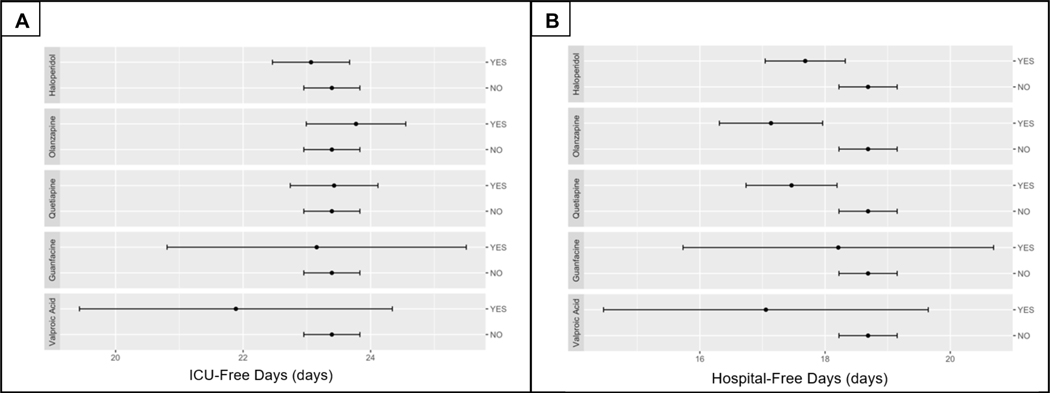
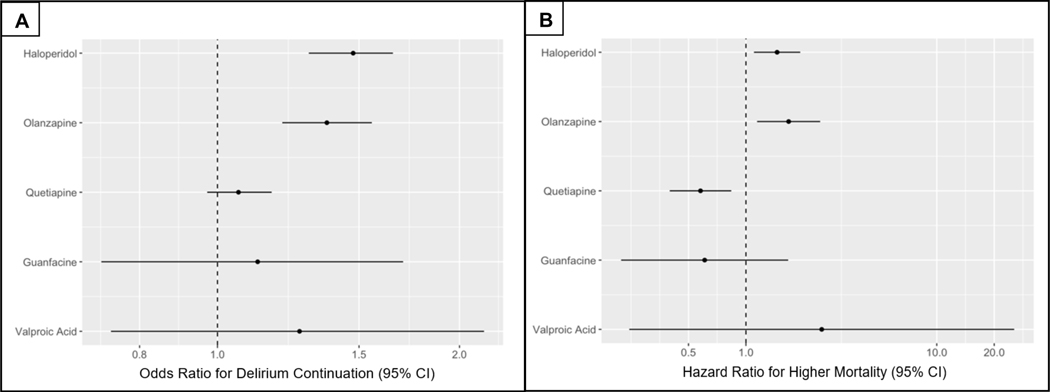
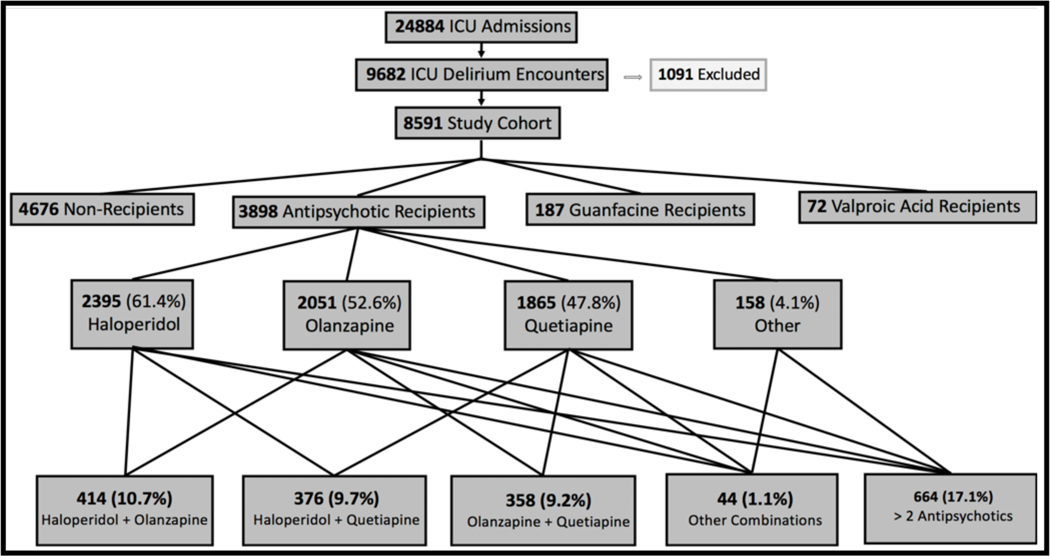
We identified 8591 encounters of ICU delirium. Half (45.6%) of patients received pharmacologic treatment for delirium, including 45.4% receiving antipsychotics, 2.2% guanfacine, and 0.84% valproic acid. Median highest Richmond Agitation-Sedation Scale (RASS) score was 1 (0, 1) in patients initiated on medications and 0 (-1, 0) for nonrecipients. Haloperidol, olanzapine, and quetiapine comprised >97% of antipsychotics utilized with 48% receiving 2 or more and 20.6% continued on antipsychotic medications at hospital discharge. Haloperidol and olanzapine were associated with greater odds of continued delirium (odds ratio [OR], 1.48; 95% confidence interval [95% CI], 1.30-1.65; P < .001 and OR, 1.37; 95% CI, 1.20-1.56; P = .003, respectively) and increased hazard of in-hospital mortality (hazard ratio [HR], 1.46; 95% CI, 1.10-1.93; P = .01 and HR, 1.67; 95% CI, 1.14-2.45; P = .01, respectively) while quetiapine showed a decreased hazard of in-hospital mortality (HR, 0.58; 95% CI, 0.40-0.84; P = .01). Haloperidol, olanzapine, and quetiapine were associated with fewer days alive and free of hospitalization (all P < .001). There was no significant association of any antipsychotic medication with days alive and free of the ICU. Neither guanfacine nor valproic acid were associated with in-hospital outcomes examined.

CONCLUSIONS

Pharmacologic interventions for management of ICU delirium are common, most often with antipsychotics, and frequently continued at hospital discharge. These medications may not portend benefit, may introduce additional harm, and should be used with caution for delirium management. Continuation of these medications through hospitalization and discharge draws into question their safety and role in patient recovery.

摘要

背景

在重症监护病房(ICU)中,经常使用药物来治疗谵妄,但药物选择的处方模式和对患者预后的影响描述得很差。我们旨在描述管理 ICU 谵妄的处方实践,并研究药物选择对关键住院结局的独立关联,包括谵妄缓解、住院死亡率以及在 ICU 或医院存活的天数。

方法

这是一项对一家三级学术医疗中心 ICU 中出现谵妄的成年患者进行的回顾性研究。通过电子病历获取关于每日神志状态(正常、谵妄和昏迷)、药物治疗、住院过程和存活情况的数据。构建每日过渡模型,以评估前一天的神志状态和药物管理对次日神志状态和住院死亡率的独立关联,同时调整了预设的协变量。线性回归模型调查了在 ICU 入院后的前 30 天内,药物管理对 ICU 或医院存活天数的关联。

结果

我们确定了 8591 例 ICU 谵妄发作。一半(45.6%)的患者接受了治疗谵妄的药物治疗,包括 45.4%接受了抗精神病药物治疗,2.2%接受了胍法辛治疗,0.84%接受了丙戊酸治疗。在开始使用药物的患者中,中位数最高的 Richmond 躁动-镇静量表(RASS)评分为 1(0,1),而非接受者为 0(-1,0)。在使用的抗精神病药物中,氟哌啶醇、奥氮平和喹硫平占 97%以上,48%的患者接受了 2 种或更多药物,20.6%的患者在出院时仍继续使用抗精神病药物。氟哌啶醇和奥氮平与持续谵妄的可能性更大相关(比值比[OR],1.48;95%置信区间[95%CI],1.30-1.65;P <.001 和 OR,1.37;95%CI,1.20-1.56;P =.003),并增加了住院死亡率的风险(风险比[HR],1.46;95%CI,1.10-1.93;P =.01 和 HR,1.67;95%CI,1.14-2.45;P =.01),而喹硫平则降低了住院死亡率的风险(HR,0.58;95%CI,0.40-0.84;P =.01)。氟哌啶醇、奥氮平和喹硫平与存活天数和无住院天数减少相关(均 P <.001)。任何抗精神病药物与 ICU 存活天数或存活天数均无显著关联。胍法辛和丙戊酸均与研究的住院结局无关。

结论

在 ICU 中治疗谵妄的药物干预措施很常见,最常使用的是抗精神病药物,并且经常在出院时继续使用。这些药物可能不会带来益处,可能会带来额外的危害,因此在治疗谵妄时应谨慎使用。这些药物在住院期间和出院后继续使用,这使得它们的安全性和在患者康复中的作用受到质疑。
https://cdn.ncbi.nlm.nih.gov/pmc/blobs/d96f/8793637/2f5e7a2a78bc/nihms-1651849-f0003.jpg
https://cdn.ncbi.nlm.nih.gov/pmc/blobs/d96f/8793637/7d3dbafa28b3/nihms-1651849-f0001.jpg
https://cdn.ncbi.nlm.nih.gov/pmc/blobs/d96f/8793637/a29671baf0bf/nihms-1651849-f0002.jpg
https://cdn.ncbi.nlm.nih.gov/pmc/blobs/d96f/8793637/2f5e7a2a78bc/nihms-1651849-f0003.jpg
https://cdn.ncbi.nlm.nih.gov/pmc/blobs/d96f/8793637/7d3dbafa28b3/nihms-1651849-f0001.jpg
https://cdn.ncbi.nlm.nih.gov/pmc/blobs/d96f/8793637/a29671baf0bf/nihms-1651849-f0002.jpg
https://cdn.ncbi.nlm.nih.gov/pmc/blobs/d96f/8793637/2f5e7a2a78bc/nihms-1651849-f0003.jpg

相似文献

1
Pharmacologic Management of Intensive Care Unit Delirium: Clinical Prescribing Practices and Outcomes in More Than 8500 Patient Encounters.重症监护病房谵妄的药物治疗管理:超过 8500 例患者的临床处方实践和结局。
Anesth Analg. 2021 Sep 1;133(3):713-722. doi: 10.1213/ANE.0000000000005365.
2
The Association of Nonmodifiable Patient Factors on Antipsychotic Medication use in the Intensive Care Unit.非可改变患者因素与 ICU 中抗精神病药物使用的相关性。
J Intensive Care Med. 2024 Feb;39(2):176-182. doi: 10.1177/08850666231198030. Epub 2023 Aug 30.
3
Pharmacological Management of Delirium in the Intensive Care Unit: A Randomized Pragmatic Clinical Trial.《重症监护病房谵妄的药物治疗:一项随机实用临床试验》。
J Am Geriatr Soc. 2019 May;67(5):1057-1065. doi: 10.1111/jgs.15781. Epub 2019 Jan 25.
4
Impact of Quetiapine Treatment on Duration of Hypoactive Delirium in Critically Ill Adults: A Retrospective Analysis.喹硫平治疗对重症成年患者活动减退型谵妄持续时间的影响:一项回顾性分析
Pharmacotherapy. 2015 Aug;35(8):731-9. doi: 10.1002/phar.1619. Epub 2015 Aug 4.
5
Pharmacologic Treatment of Intensive Care Unit Delirium and the Impact on Duration of Delirium, Length of Intensive Care Unit Stay, Length of Hospitalization, and 28-Day Mortality.重症监护病房谵妄的药物治疗及对谵妄持续时间、重症监护病房住院时间、住院时间和 28 天死亡率的影响。
Mayo Clin Proc. 2018 Dec;93(12):1739-1748. doi: 10.1016/j.mayocp.2018.06.022. Epub 2018 Oct 3.
6
Antipsychotic use and diagnosis of delirium in the intensive care unit.重症监护病房中抗精神病药物的使用与谵妄的诊断。
Crit Care. 2012 May 16;16(3):R84. doi: 10.1186/cc11342.
7
Discharge from hospital with newly administered antipsychotics after intensive care unit delirium - Incidence and contributing factors.ICU 谵妄后使用新型抗精神病药物出院 - 发生率及相关因素。
J Crit Care. 2021 Feb;61:162-167. doi: 10.1016/j.jcrc.2020.10.030. Epub 2020 Nov 2.
8
Feasibility, efficacy, and safety of antipsychotics for intensive care unit delirium: the MIND randomized, placebo-controlled trial.抗精神病药治疗 ICU 谵妄的可行性、疗效和安全性:MIND 随机、安慰剂对照试验。
Crit Care Med. 2010 Feb;38(2):428-37. doi: 10.1097/ccm.0b013e3181c58715.
9
Delirium as a predictor of mortality in mechanically ventilated patients in the intensive care unit.谵妄作为重症监护病房机械通气患者死亡率的预测指标。
JAMA. 2004 Apr 14;291(14):1753-62. doi: 10.1001/jama.291.14.1753.
10
Hospital delirium treatment: Continuation of antipsychotic therapy from the intensive care unit to discharge.医院谵妄治疗:从重症监护病房到出院持续使用抗精神病药物治疗。
Am J Health Syst Pharm. 2015 Dec 1;72(23 Suppl 3):S133-9. doi: 10.2146/ajhp150474.

引用本文的文献

1
Development of a Machine Learning-Based Predictive Model for Postoperative Delirium in Older Adult Intensive Care Unit Patients: Retrospective Study.基于机器学习的老年重症监护病房患者术后谵妄预测模型的开发:一项回顾性研究。
J Med Internet Res. 2025 Jun 19;27:e67258. doi: 10.2196/67258.
2
Efficacy and safety of guanfacine in hospitalized patients with delirium: A scoping review.胍法辛治疗住院谵妄患者的疗效和安全性:一项范围综述。
Crit Care Resusc. 2024 Nov 24;26(4):286-294. doi: 10.1016/j.ccrj.2024.08.009. eCollection 2024 Dec.
3
Exploring Antipsychotic Use for Delirium Management in Adults in Hospital, Sub-Acute Rehabilitation and Aged Care Settings: A Systematic Literature Review.
探讨在医院、亚急性康复和老年护理环境中使用抗精神病药物治疗成人谵妄的情况:系统文献回顾。
Drugs Aging. 2024 Jun;41(6):455-486. doi: 10.1007/s40266-024-01122-z. Epub 2024 Jun 10.
4
Long-term outcomes after treatment of delirium during critical illness with antipsychotics (MIND-USA): a randomised, placebo-controlled, phase 3 trial.抗精神病药物治疗危重病谵妄的长期结局(MIND-USA):一项随机、安慰剂对照、3 期试验。
Lancet Respir Med. 2024 Aug;12(8):599-607. doi: 10.1016/S2213-2600(24)00077-8. Epub 2024 Apr 30.
5
Veno-venous Extracorporeal Membrane Oxygenation: Anesthetic Considerations in Clinical Practice.静脉-静脉体外膜肺氧合:临床实践中的麻醉考量
Anesth Pain Med. 2023 Jun 14;13(3):e136524. doi: 10.5812/aapm-136524. eCollection 2023 Jun.
6
Recurrent delirium episodes within the intensive care unit: Incidence and associated factors.重症监护病房内反复出现的谵妄发作:发病率及相关因素。
J Crit Care. 2024 Feb;79:154490. doi: 10.1016/j.jcrc.2023.154490. Epub 2023 Nov 23.
7
Clinical Features of Delirium among Patients in the Intensive Care Unit According to Motor Subtype Classification: A Retrospective Longitudinal Study.根据运动亚型分类的 ICU 患者谵妄的临床特征:一项回顾性纵向研究。
Yonsei Med J. 2023 Dec;64(12):712-720. doi: 10.3349/ymj.2023.0113.
8
The Association of Nonmodifiable Patient Factors on Antipsychotic Medication use in the Intensive Care Unit.非可改变患者因素与 ICU 中抗精神病药物使用的相关性。
J Intensive Care Med. 2024 Feb;39(2):176-182. doi: 10.1177/08850666231198030. Epub 2023 Aug 30.
9
Impacts of antipsychotic medication prescribing practices in critically ill adult patients on health resource utilization and new psychoactive medication prescriptions.抗精神病药物在重症成年患者中的处方实践对卫生资源利用和新精神活性药物处方的影响。
PLoS One. 2023 Jun 29;18(6):e0287929. doi: 10.1371/journal.pone.0287929. eCollection 2023.
10
Standardized pharmacological management of delirium after on-pump cardiac surgery reduces ICU stay and ventilation in a retrospective pre-post study.回顾性前后研究表明,心脏手术后体外循环并发谵妄的标准化药理学管理可减少 ICU 住院时间和通气时间。
Sci Rep. 2023 Mar 6;13(1):3741. doi: 10.1038/s41598-023-30781-y.