Li Ci, Liu Song-Yang, Pi Wei, Zhang Pei-Xun
Department of Orthopedics and Trauma, Peking University People's Hospital; Key Laboratory of Trauma and Neural Regeneration, Peking University, Beijing, China.
Department of Orthopedics and Trauma, Peking University People's Hospital; Key Laboratory of Trauma and Neural Regeneration, Peking University; National Center for Trauma Medicine, Beijing, China.
Neural Regen Res. 2021 Aug;16(8):1518-1523. doi: 10.4103/1673-5374.303008.
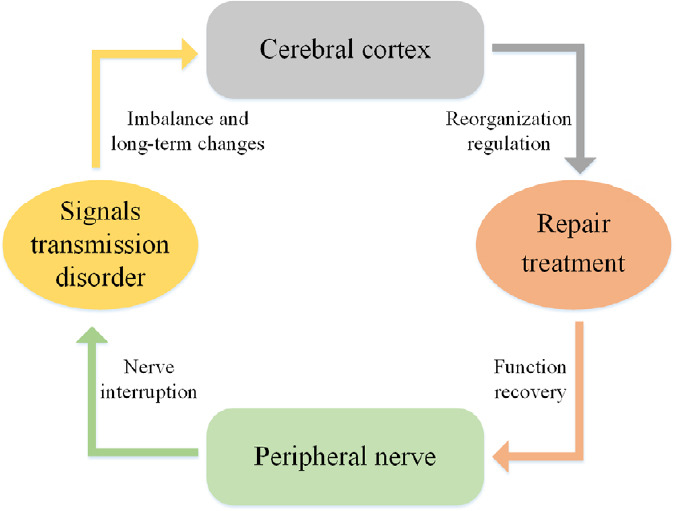
With the development of neuroscience, substantial advances have been achieved in peripheral nerve regeneration over the past decades. However, peripheral nerve injury remains a critical public health problem because of the subsequent impairment or absence of sensorimotor function. Uncomfortable complications of peripheral nerve injury, such as chronic pain, can also cause problems for families and society. A number of studies have demonstrated that the proper functioning of the nervous system depends not only on a complete connection from the central nervous system to the surrounding targets at an anatomical level, but also on the continuous bilateral communication between the two. After peripheral nerve injury, the interruption of afferent and efferent signals can cause complex pathophysiological changes, including neurochemical alterations, modifications in the adaptability of excitatory and inhibitory neurons, and the reorganization of somatosensory and motor regions. This review discusses the close relationship between the cerebral cortex and peripheral nerves. We also focus on common therapies for peripheral nerve injury and summarize their potential mechanisms in relation to cortical plasticity. It has been suggested that cortical plasticity may be important for improving functional recovery after peripheral nerve damage. Further understanding of the potential common mechanisms between cortical reorganization and nerve injury will help to elucidate the pathophysiological processes of nerve injury, and may allow for the reduction of adverse consequences during peripheral nerve injury recovery. We also review the role that regulating reorganization mechanisms plays in functional recovery, and conclude with a suggestion to target cortical plasticity along with therapeutic interventions to promote peripheral nerve injury recovery.
随着神经科学的发展,在过去几十年中,周围神经再生取得了重大进展。然而,由于随后出现的感觉运动功能损害或缺失,周围神经损伤仍然是一个严重的公共卫生问题。周围神经损伤的不适并发症,如慢性疼痛,也会给家庭和社会带来问题。许多研究表明,神经系统的正常运作不仅取决于从中枢神经系统到周围目标在解剖学水平上的完整连接,还取决于两者之间持续的双向通信。周围神经损伤后,传入和传出信号的中断会导致复杂的病理生理变化,包括神经化学改变、兴奋性和抑制性神经元适应性的改变以及体感和运动区域的重组。本综述讨论了大脑皮层与周围神经之间的密切关系。我们还重点介绍了周围神经损伤的常见治疗方法,并总结了它们与皮质可塑性相关的潜在机制。有人提出,皮质可塑性可能对改善周围神经损伤后的功能恢复很重要。进一步了解皮质重组与神经损伤之间潜在的共同机制,将有助于阐明神经损伤的病理生理过程,并可能减少周围神经损伤恢复过程中的不良后果。我们还综述了调节重组机制在功能恢复中所起的作用,并建议针对皮质可塑性以及治疗干预措施,以促进周围神经损伤的恢复。