Frankfurt School of Finance and Management, Adickesallee 32-34, 60322, Frankfurt am Main, Germany.
Appl Health Econ Health Policy. 2021 Mar;19(2):181-190. doi: 10.1007/s40258-020-00632-2. Epub 2021 Jan 12.
Germany is experiencing the second COVID-19 pandemic wave. The intensive care unit (ICU) bed capacity is an important consideration in the response to the pandemic. The purpose of this study was to determine the costs and benefits of maintaining or expanding a staffed ICU bed reserve capacity in Germany.
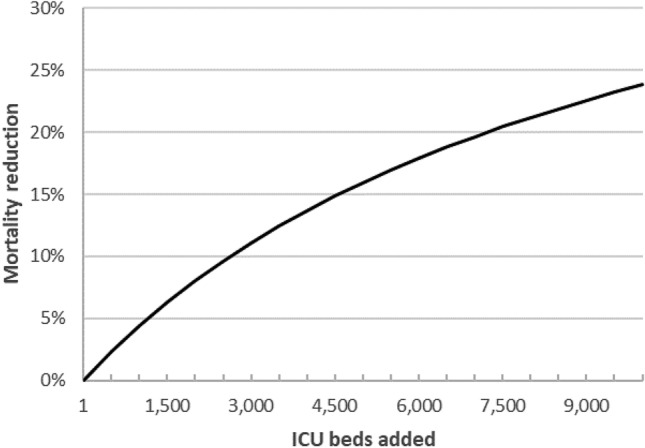
This study compared the provision of additional capacity to no intervention from a societal perspective. A decision model was developed using, e.g. information on age-specific fatality rates, ICU costs and outcomes, and the herd protection threshold. The net monetary benefit (NMB) was calculated based upon the willingness to pay for new medicines for the treatment of cancer, a condition with a similar disease burden in the near term.
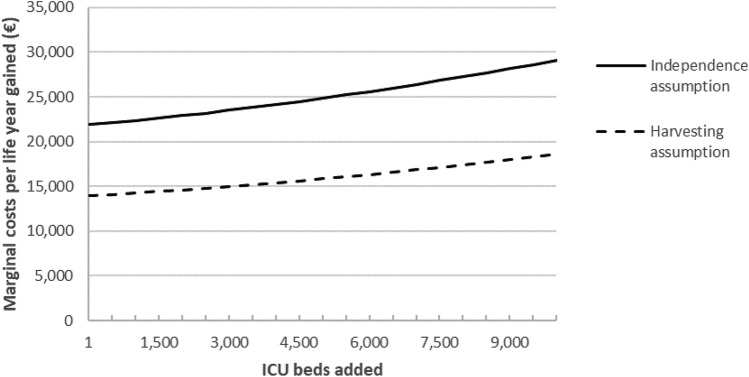
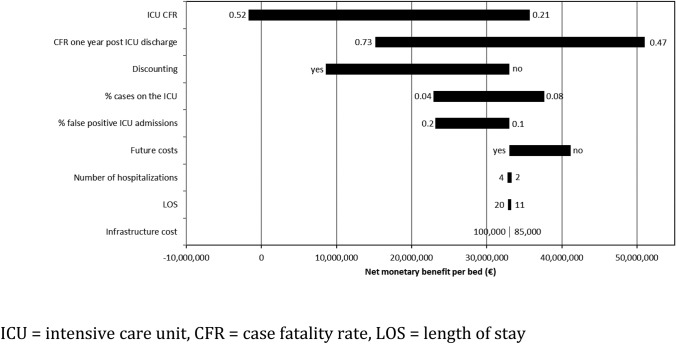
The marginal cost-effectiveness ratio (MCER) of the last bed added to the existing ICU capacity is €21,958 per life-year gained assuming full bed utilization. The NMB decreases with an additional expansion but remains positive for utilization rates as low as 2%. In a sensitivity analysis, the variables with the highest impact on the MCER were the mortality rates in the ICU and after discharge.
This article demonstrates the applicability of cost-effectiveness analysis to policies of hospital pandemic preparedness and response capacity strengthening. In Germany, the provision of a staffed ICU bed reserve capacity appears to be cost-effective even for a low probability of bed utilization.
德国正在经历第二波 COVID-19 大流行。重症监护病房(ICU)床位容量是应对大流行的重要考虑因素。本研究的目的是确定在德国维持或扩大配备人员的 ICU 床位储备能力的成本效益。
本研究从社会角度比较了提供额外容量与不干预的情况。使用特定年龄死亡率、ICU 成本和结果以及群体保护阈值等信息,开发了一个决策模型。根据为治疗癌症(在近期具有类似疾病负担的疾病)的新药支付意愿,计算了净货币效益(NMB)。
假设 ICU 床位全部得到利用,最后一张新增 ICU 床位的边际成本效益比(MCER)为每获得一个生命年 21958 欧元。随着扩展的增加,NMB 会减少,但在利用率低至 2%的情况下仍然为正。在敏感性分析中,对 MCER 影响最大的变量是 ICU 内和出院后的死亡率。
本文展示了成本效益分析在医院大流行防范和应对能力增强政策中的适用性。在德国,即使 ICU 床位的利用率很低,提供配备人员的 ICU 床位储备能力似乎也是具有成本效益的。