Ju Sunghee, Seo Ji Yeon, Lee Seung Kwon, Oh Jisun, Kim Jong-Sang
School of Food Science and Biotechnology (BK21 Plus), Kyungpook National University, Daegu, Republic of Korea.
Ginseng Biotech Research Team, Ilhwa Co. Ltd, Guri, Gyeonggi-do, Republic of Korea.
J Ginseng Res. 2021 Jan;45(1):108-118. doi: 10.1016/j.jgr.2019.12.005. Epub 2019 Dec 20.
Korean ginseng ( Meyer) contains a variety of ginsenosides that can be metabolized to a biologically active substance, compound K. Previous research showed that compound K could be enriched in the red ginseng extract (RGE) after hydrolysis by pectinase. The current study investigated whether the enzymatically hydrolyzed red ginseng extract (HRGE) containing a notable level of compound K has cognitive improving and neuroprotective effects.
A scopolamine-induced hypomnesic mouse model was subjected to behavioral tasks, such as the Y-maze, passive avoidance, and the Morris water maze tests. After sacrificing the mice, the brains were collected, histologically examined (hematoxylin and eosin staining), and the expressions of antioxidant proteins analyzed by western blot.
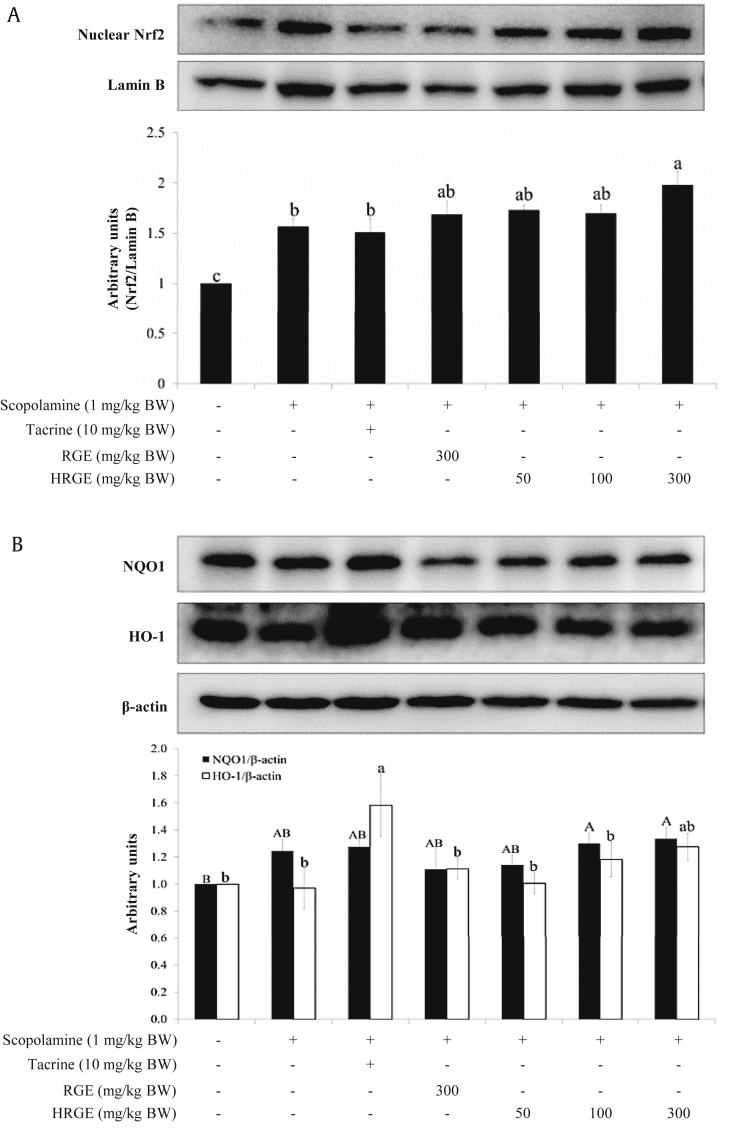
Behavioral assessment indicated that the oral administration of HRGE at a dosage of 300 mg/kg body weight reversed scopolamine-induced learning and memory deficits. Histological examination demonstrated that the hippocampal damage observed in scopolamine-treated mouse brains was reduced by HRGE administration. In addition, HRGE administration increased the expression of nuclear-factor-E2-related factor 2 and its downstream antioxidant enzymes NAD(P)H:quinone oxidoreductase and heme oxygenase-1 in hippocampal tissue homogenates. An assay using HT22 mouse hippocampal neuronal cells demonstrated that HRGE treatment attenuated glutamate-induced cytotoxicity by decreasing the intracellular levels of reactive oxygen species.
These findings suggest that HRGE administration can effectively alleviate hippocampus-mediated cognitive impairment, possibly through cytoprotective mechanisms, preventing oxidative-stress-induced neuronal cell death via the upregulation of phase 2 antioxidant molecules.
高丽参(Meyer)含有多种人参皂苷,这些人参皂苷可代谢为生物活性物质化合物K。先前的研究表明,果胶酶水解后,化合物K可在红参提取物(RGE)中富集。本研究调查了含有显著水平化合物K的酶解红参提取物(HRGE)是否具有改善认知和神经保护作用。
对东莨菪碱诱导的记忆减退小鼠模型进行行为测试,如Y迷宫、被动回避和莫里斯水迷宫试验。处死小鼠后,收集大脑,进行组织学检查(苏木精和伊红染色),并通过蛋白质印迹分析抗氧化蛋白的表达。
行为评估表明,口服剂量为300mg/kg体重的HRGE可逆转东莨菪碱诱导的学习和记忆缺陷。组织学检查表明,HRGE给药可减轻东莨菪碱处理的小鼠大脑中观察到的海马损伤。此外,HRGE给药可增加海马组织匀浆中核因子E2相关因子2及其下游抗氧化酶NAD(P)H:醌氧化还原酶和血红素加氧酶-1的表达。使用HT22小鼠海马神经元细胞的试验表明,HRGE处理可通过降低细胞内活性氧水平减轻谷氨酸诱导 的细胞毒性。
这些发现表明,HRGE给药可有效减轻海马介导的认知障碍,可能是通过细胞保护机制,通过上调二期抗氧化分子来防止氧化应激诱导的神经元细胞死亡。