Ahmadi Mohammad Aram, Moradi Ghobad, Khoshravesh Sahar, Roshani Daem, Qaderi Naseh, Amjadian Mohiadin
Social Determinants of Health Research Center, Research Institute for Health Development, Kurdistan University of Medical Sciences, Sanandaj, Iran.
Students Research Committee, Hamadan University of Medical sciences, Hamadan, Iran.
Med J Islam Repub Iran. 2020 Nov 4;34:149. doi: 10.47176/mjiri.34.149. eCollection 2020.
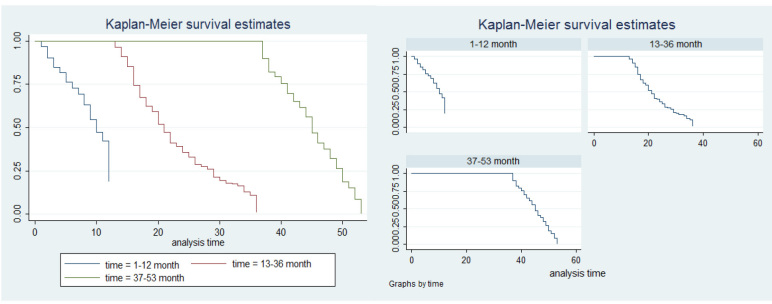
Staying in treatment is one of the basic principles in maintenance treatment with methadone and it is considered as a success criterion in the treatment procedure. This study aimed at analyzing effective determinants on staying in treatment in methadone treatment procedure. This was a retrospective cohort study, in which 6 MMT centers were randomly selected to be studied. The data were collected using the patients' medical records. Therefore, 1008 medical record files belonging to the patients who received methadone treatment from April 2013 to August 2017 were investigated. Proportional hazard Cox regression (extended) was used to specify the determinants of the methadone maintenance treatment and STATA 11 was used for data analysis. The patients' mean age was 38.8 years (±1.08), and 75.8% were married and only 39.1% had full-time jobs. The mean age for the first substance abuse was at 24.31years (±7.93). The average time of staying in the treatment was 28.8 months. The results of the adjusted Cox proportional hazards regression showed among the 14 variables entered into the model, in the 1-12-month interval age of first drug use (HR=0.945, 95 % CI=0.908-0.983, p=0.005), specific drug use (HR=1.14, 95 % CI=1.026-1.268, p=0.014), and the frequency of treatment (HR=0.974, 95 % CI=0.959-0.990, p=0.002) were significantly correlated with survival status. The 13-36- month interval drug use (HR=0.931, 95 % CI=0.886-0.978, p=0.005) was significantly correlated with survival status. Also, the range of 37-53 month drug use (HR=1.058, 95 % CI=1.001-1.119, p= .044) had a significant relationship with survival status. This study showed age of first drug use, specific drug use, the frequency of treatment and drug use were correlated with a decrease in staying duration in treatment. Therefore, taking these factors into consideration in designing and administering various interventions in addiction treatment and consulting centers is of paramount importance.
坚持治疗是美沙酮维持治疗的基本原则之一,并且被视为治疗过程中的一项成功标准。本研究旨在分析美沙酮治疗过程中坚持治疗的有效决定因素。这是一项回顾性队列研究,随机选择了6个美沙酮维持治疗中心进行研究。数据通过患者病历收集。因此,对2013年4月至2017年8月期间接受美沙酮治疗的患者的1008份病历档案进行了调查。使用比例风险Cox回归(扩展)来确定美沙酮维持治疗的决定因素,并使用STATA 11进行数据分析。患者的平均年龄为38.8岁(±1.08),75.8%已婚,只有39.1%有全职工作。首次药物滥用的平均年龄为24.31岁(±7.93)。平均治疗停留时间为28.8个月。调整后的Cox比例风险回归结果显示,在纳入模型的14个变量中,在1至12个月期间首次吸毒年龄(HR = 0.945,95%CI = 0.908 - 0.983,p = 0.005)、特定药物使用(HR = 1.14,95%CI = 1.026 - 1.268,p = 0.014)以及治疗频率(HR = 0.974,95%CI = 0.959 - 0.990,p = 0.002)与生存状态显著相关。13至36个月期间的吸毒情况(HR = 0.931,95%CI = 0.886 - 0.978,p = 0.005)与生存状态显著相关。此外,37至53个月期间的吸毒情况(HR = 1.058,95%CI = 1.001 - 1.119,p = 0.044)与生存状态有显著关系。本研究表明,首次吸毒年龄、特定药物使用、治疗频率和吸毒情况与治疗停留时间的减少相关。因此,在设计和实施成瘾治疗及咨询中心的各种干预措施时考虑这些因素至关重要。