Zhang Jian, Zheng Lili, Zhao Tian, Huang Shiyong, Hu Wenhao
Department of Interventional Radiology, First Affiliated Hospital of Wenzhou Medical University, Wenzhou, China.
Ann Transl Med. 2020 Dec;8(23):1593. doi: 10.21037/atm-20-5544.
Hemoptysis is a symptom of a life-threatening condition. Bronchial artery embolization (BAE) is recommended to control hemoptysis. However, non-bronchial systematic arteries (NBSAs) can be culprit vessels, particularly in recurrent hemoptysis patients after embolization, according to recent studies. Therefore, the purpose of the present study was to retrospectively assess the risk factors of recurrent hemoptysis patients with NBSA feeding after interventional embolization.
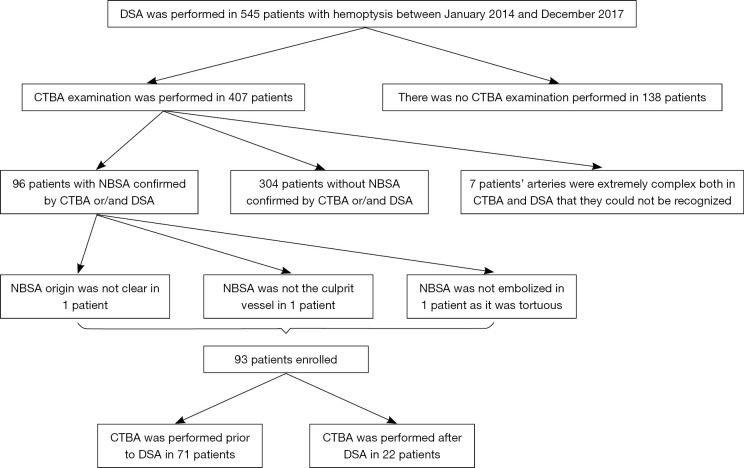
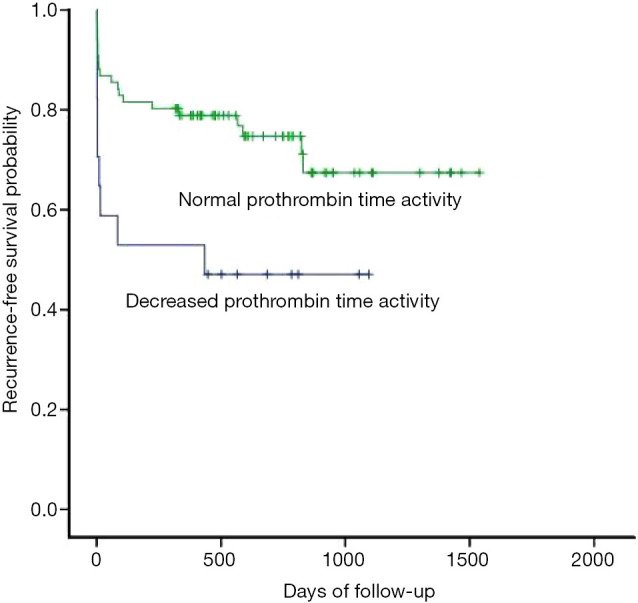
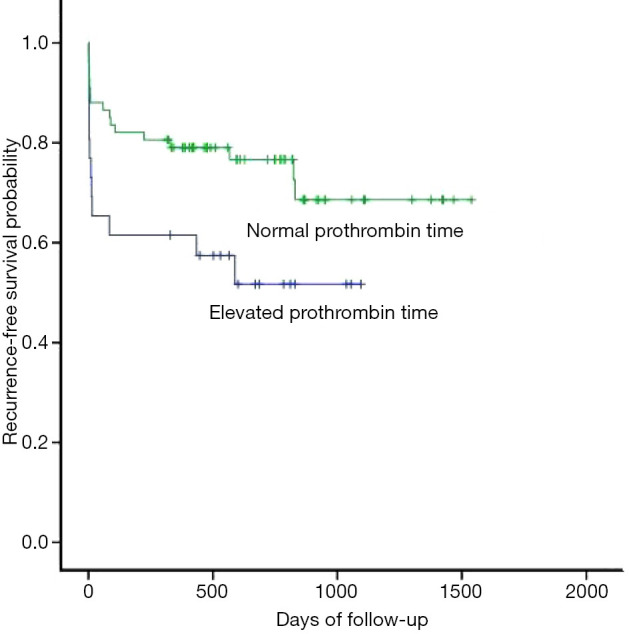
Between January 2014 and December 2017, a total of 545 patients underwent interventional embolization for hemoptysis. A total of 93 patients who were confirmed to have NBSA feeding and underwent embolization were enrolled. Patients' demographic characteristics, clinical information, laboratory tests, imaging findings, and embolization outcomes were reviewed. The Kaplan-Meier method and logistic regression analysis were performed for recurrence-free survival rates and risk factors associated with rebleeding, respectively.
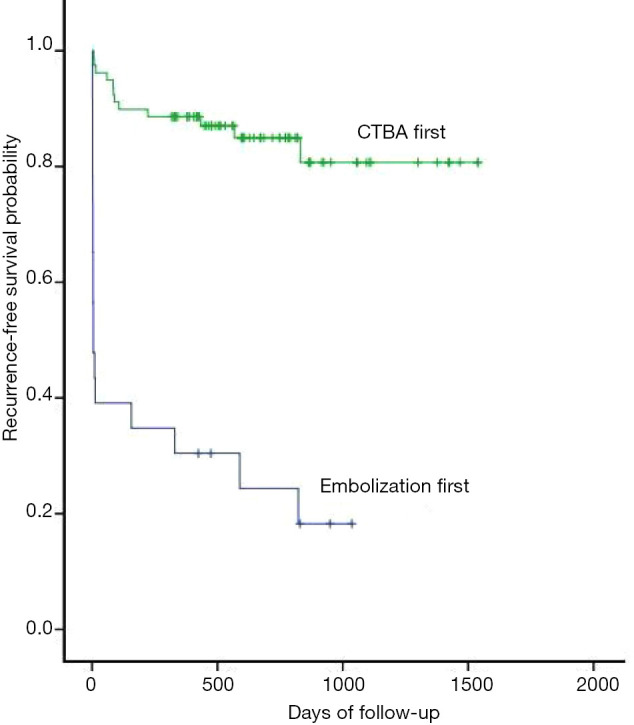
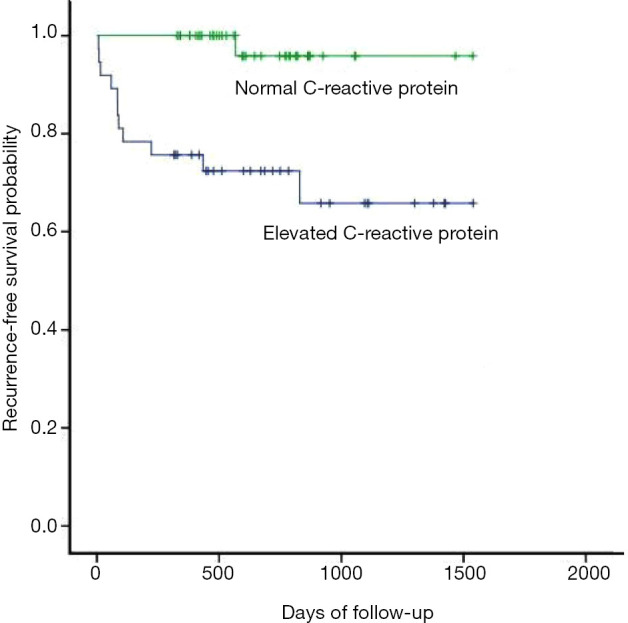
Clinical success was achieved in 40.9% (9/22) of patients who underwent embolization prior to computed tomography (CT) bronchial arteriography (BA), and in 98.6% (70/71) of patients who underwent CTBA first. The median follow-up duration was 511 days (range, 1-1,539 days). CTBA performed after the first embolization (P<0.001) and elevated pre-embolization C-reactive protein (P<0.05) were associated with hemoptysis recurrence in multivariate regression analyses.
Multidetector CTBA was recommended prior to embolization, as it shows the diagnostic value for detecting NBSA. Elevated pre-embolization C-reactive protein was found to be associated with rebleeding after embolization.
咯血是一种危及生命状况的症状。推荐采用支气管动脉栓塞术(BAE)来控制咯血。然而,根据近期研究,非支气管系统动脉(NBSAs)可能是责任血管,尤其是在栓塞术后复发性咯血患者中。因此,本研究的目的是回顾性评估介入栓塞术后有NBSA供血的复发性咯血患者的危险因素。
2014年1月至2017年12月期间,共有545例患者因咯血接受介入栓塞治疗。共有93例确诊有NBSA供血并接受栓塞治疗的患者被纳入研究。回顾了患者的人口统计学特征、临床信息、实验室检查、影像学表现和栓塞结果。分别采用Kaplan-Meier法和逻辑回归分析评估无复发生存率和与再出血相关的危险因素。
在计算机断层扫描(CT)支气管动脉造影(BA)之前接受栓塞治疗的患者中,40.9%(9/22)取得了临床成功,而先接受CTBA的患者中这一比例为98.6%(70/71)。中位随访时间为511天(范围1 - 1539天)。多因素回归分析显示,首次栓塞后进行CTBA(P<0.001)和栓塞前C反应蛋白升高(P<0.05)与咯血复发相关。
推荐在栓塞前进行多排CTBA,因为其对检测NBSA具有诊断价值。发现栓塞前C反应蛋白升高与栓塞后再出血相关。