Harvard Medical SchoolBostonMAUSA.
Department of MedicineMassachusetts General HospitalBostonMAUSA.
Hepatol Commun. 2020 Nov 13;5(1):133-143. doi: 10.1002/hep4.1640. eCollection 2021 Jan.
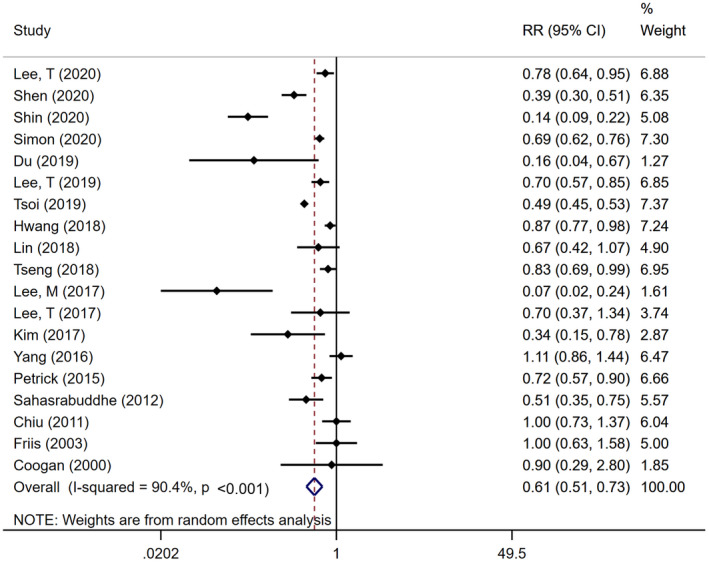
Hepatocellular carcinoma (HCC) is the third-leading cause of cancer-related death worldwide, with a growing incidence and poor prognosis. While some recent studies suggest an inverse association between aspirin use and reduced HCC incidence, other data are conflicting. To date, the precise magnitude of risk reduction-and whether there are dose-dependent and duration-dependent associations-remains unclear. To provide an updated and comprehensive assessment of the association between aspirin use and incident HCC risk, we conducted a systematic review and meta-analysis of all observational studies published through September 2020. Using random-effects meta-analysis, we calculated the pooled relative risks (RRs) and 95% confidence intervals (CIs) for the association between aspirin use and incident HCC risk. Where data were available, we evaluated HCC risk according to the defined daily dose of aspirin use. Among 2,389,019 participants, and 20,479 cases of incident HCC, aspirin use was associated with significantly lower HCC risk (adjusted RR, 0.61; 95% CI, 0.51-0.73; ≤ 0.001; I = 90.4%). In subgroup analyses, the magnitude of benefit associated with aspirin was significantly stronger in studies that adjusted for concurrent statin and/or metformin use (RR, 0.45; 95% CI, 0.28-0.64) versus those that did not ( = 0.02), studies that accounted for cirrhosis (RR, 0.49; 95% CI, 0.45-0.52) versus those that did not ( = 0.02), and studies that confirmed HCC through imaging/biopsy (RR, 0.30; 95% CI, 0.15-0.58) compared with billing codes ( < 0.001). In four studies, each defined daily dose was associated with significantly lower HCC risk (RR, 0.98; 95% CI, 0.97-0.98), corresponding to an 8.4% risk reduction per year of aspirin use. In this comprehensive systematic review and meta-analysis, aspirin use was associated with a significant reduction in HCC risk. These benefits appeared to increase with increasing dose and duration of aspirin use.
肝细胞癌 (HCC) 是全球导致癌症相关死亡的第三大原因,其发病率和预后均较差。虽然一些最近的研究表明阿司匹林的使用与 HCC 发病率的降低呈负相关,但其他数据存在矛盾。迄今为止,确切的风险降低幅度以及是否存在剂量和时间依赖性关联仍不清楚。为了提供对阿司匹林使用与 HCC 发病风险之间关联的最新和全面评估,我们对截至 2020 年 9 月发表的所有观察性研究进行了系统回顾和荟萃分析。我们使用随机效应荟萃分析计算了阿司匹林使用与 HCC 发病风险之间关联的汇总相对风险 (RR) 和 95%置信区间 (CI)。在有数据的情况下,我们根据阿司匹林使用的定义日剂量评估 HCC 风险。在 2389019 名参与者和 20479 例 HCC 发病病例中,阿司匹林的使用与 HCC 风险显著降低相关(调整 RR,0.61;95%CI,0.51-0.73; < 0.001;I = 90.4%)。在亚组分析中,与未调整同时使用他汀类药物和/或二甲双胍的研究相比(RR,0.45;95%CI,0.28-0.64),与调整同时使用他汀类药物和/或二甲双胍的研究相比,阿司匹林相关获益的幅度明显更大( = 0.02),与未考虑肝硬化的研究相比(RR,0.49;95%CI,0.45-0.52)( = 0.02),与未通过影像学/活检证实 HCC 的研究相比(RR,0.30;95%CI,0.15-0.58)( < 0.001)。在四项研究中,每个定义日剂量都与 HCC 风险的显著降低相关(RR,0.98;95%CI,0.97-0.98),这对应于每年使用阿司匹林降低 8.4%的风险。在这项全面的系统回顾和荟萃分析中,阿司匹林的使用与 HCC 风险的显著降低相关。这些益处似乎随着阿司匹林使用剂量和时间的增加而增加。