Department of Biomedical Engineering, King's College London, 4th floor North Wing St Thomas' Hospital, Westminster Bridge Road, London SE17EH, UK.
Division of Biophysics, Medical University of Graz, Graz, Austria.
Europace. 2021 Mar 4;23(23 Suppl 1):i12-i20. doi: 10.1093/europace/euaa386.
Atrial fibrillation (AF) is sustained by re-entrant activation patterns. Ablation strategies have been proposed that target regions of tissue that may support re-entrant activation patterns. We aimed to characterize the tissue properties associated with regions that tether re-entrant activation patterns in a validated virtual patient cohort.
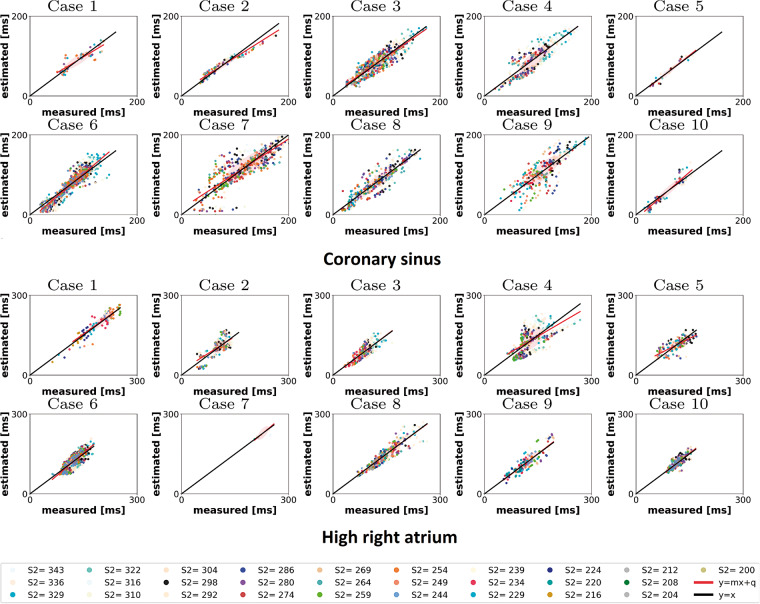
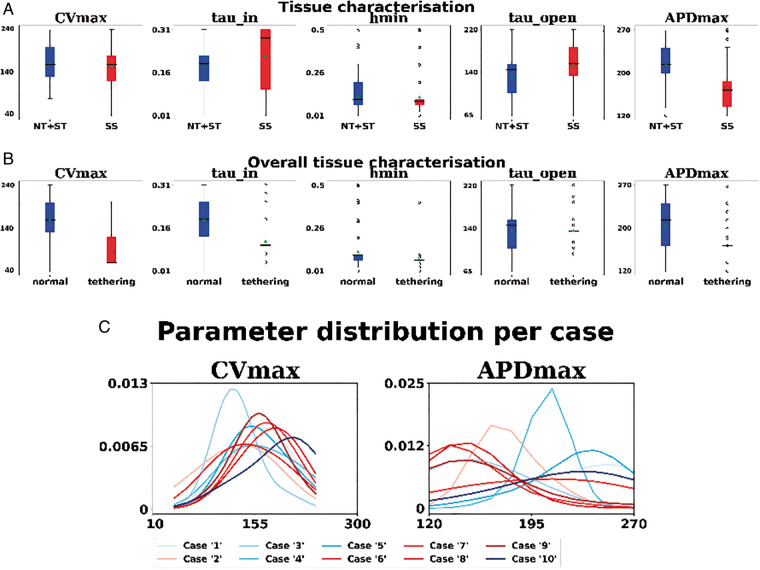
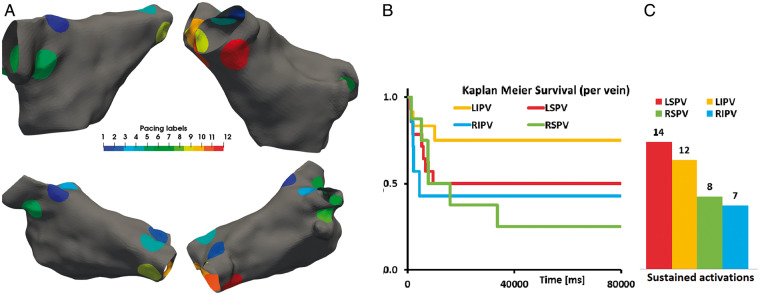
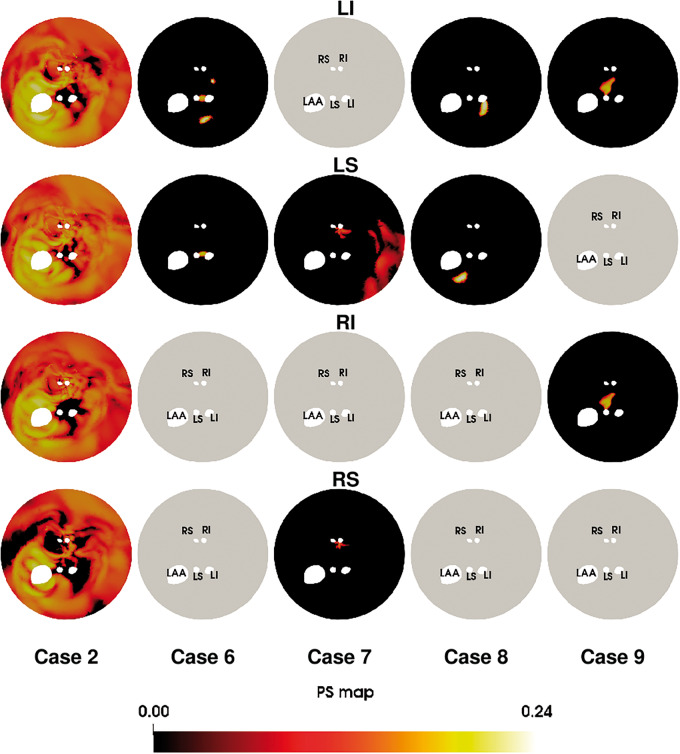
Atrial fibrillation patient-specific models (seven paroxysmal and three persistent) were generated and validated against local activation time (LAT) measurements during an S1-S2 pacing protocol from the coronary sinus and high right atrium, respectively. Atrial models were stimulated with burst pacing from three locations in the proximity of each pulmonary vein to initiate re-entrant activation patterns. Five atria exhibited sustained activation patterns for at least 80 s. Models with short maximum action potential durations (APDs) were associated with sustained activation. Phase singularities were mapped across the atria sustained activation patterns. Regions with a low maximum conduction velocity (CV) were associated with tethering of phase singularities. A support vector machine (SVM) was trained on maximum local conduction velocity and action potential duration to identify regions that tether phase singularities. The SVM identified regions of tissue that could support tethering with 91% accuracy. This accuracy increased to 95% when the SVM was also trained on surface area.
In a virtual patient cohort, local tissue properties, that can be measured (CV) or estimated (APD; using effective refractory period as a surrogate) clinically, identified regions of tissue that tether phase singularities. Combing CV and APD with atrial surface area further improved the accuracy in identifying regions that tether phase singularities.
心房颤动(AF)是由折返激活模式维持的。已经提出了消融策略,这些策略针对可能支持折返激活模式的组织区域。我们旨在描述与在经过验证的虚拟患者队列中固定折返激活模式的区域相关的组织特性。
生成了心房颤动患者特定模型(七例阵发性和三例持续性),并针对来自冠状窦和右心房高位的 S1-S2 起搏方案中的局部激活时间(LAT)测量值进行了验证。用来自三个靠近每个肺静脉的位置的爆发起搏刺激心房模型,以启动折返激活模式。五个心房表现出至少 80 秒的持续激活模式。具有短最大动作电位持续时间(APD)的模型与持续激活相关。相位奇点在心房持续激活模式上进行了映射。具有低最大传导速度(CV)的区域与相位奇点的固定有关。支持向量机(SVM)在最大局部传导速度和动作电位持续时间上进行了训练,以识别固定相位奇点的区域。SVM 以 91%的准确率识别出可固定相位奇点的组织区域。当 SVM 还接受表面积训练时,准确性增加到 95%。
在虚拟患者队列中,局部组织特性(可测量的 CV 或可估计的 APD;使用有效不应期作为替代物)可识别固定相位奇点的组织区域。将 CV 和 APD 与心房表面积结合使用,进一步提高了识别固定相位奇点的区域的准确性。