Department for Infectious Diseases, University Hospital Heidelberg, Im Neuenheimer Feld 324, 69120, Heidelberg, Germany.
Eur J Clin Microbiol Infect Dis. 2021 Jun;40(6):1217-1225. doi: 10.1007/s10096-020-04146-6. Epub 2021 Jan 12.
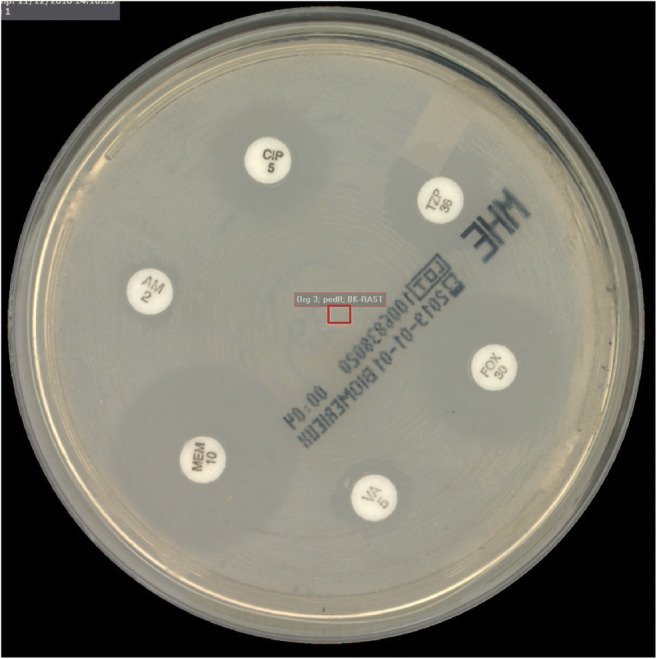
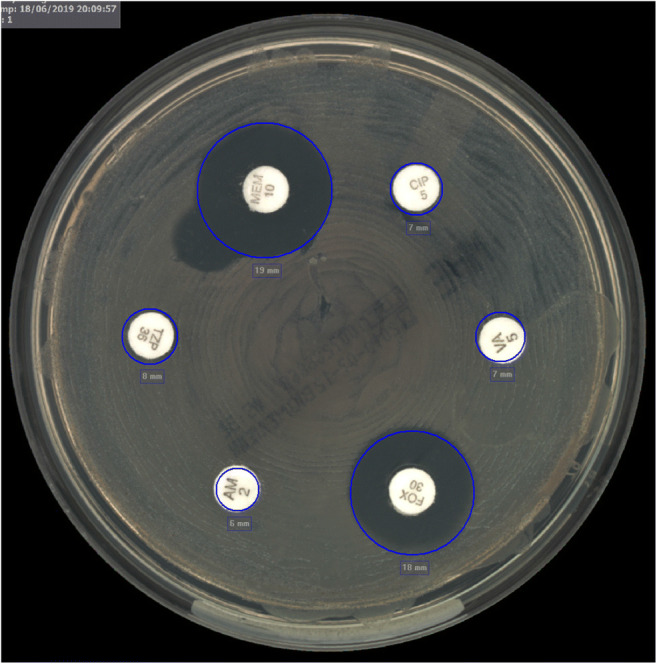
Optimisation of microbiological diagnostics in primarily sterile body fluids is required. Our objective was to apply EUCAST's RAST on primarily sterile body fluids in blood culture bottles with total lab automation (TLA) and to compare results to our reference method Vitek2 in order to report susceptibility results earlier. Positive blood culture bottles (BACTEC™ Aerobic/Anaerobic/PEDS) inoculated with primarily sterile body fluids were semi-automatically subcultured onto Columbia 5% SB agar, chocolate agar, MacConkey agar, Schaedler/KV agar and Mueller-Hinton agar. On latter, cefoxitin, ampicillin, vancomycin, piperacillin/tazobactam, meropenem and ciprofloxacin were added. After 6 h, subcultures and RAST were imaged and MALDI-TOF MS was performed. Zone sizes were digitally measured and interpreted following RAST breakpoints for blood cultures. MIC values were determined using Vitek2 panels. During a 1-year period, 197 Staphylococcus aureus, 91 Enterococcus spp., 38 Escherichia coli, 11 Klebsiella pneumoniae and 8 Pseudomonas aeruginosa were found. Categorical agreement between RAST and MIC was 96.5%. Comparison showed no very major errors, 2/7 (28.6%) and 1/7 (14.3%) of major errors for P. aeruginosa and meropenem and ciprofloxacin, 1/9 (11.1%) for K. pneumoniae and ciprofloxacin, 4/69 (7.0%) and 3/43 (5.8%) for Enterococcus spp. and vancomycin and ampicillin, respectively. Minor errors for P. aeruginosa and meropenem (1/8; 12.8%) and for E. coli and ciprofloxacin (2/29; 6.5%) were found. 30/550 RAST measurements were within area of technical uncertainty. RAST is applicable and performs well for primarily sterile body fluids in blood culture bottles, partially better than blood-based RAST. Official EUCAST evaluation is needed.
需要优化主要无菌体液中的微生物诊断。我们的目的是在具有全自动实验室(TLA)的血培养瓶中应用 EUCAST 的 RAST,并将结果与我们的参考方法 Vitek2 进行比较,以便更早报告药敏结果。将主要无菌体液接种到阳性血培养瓶(BACTEC™ Aerobic/Anaerobic/PEDS)中,半自动接种到哥伦比亚 5% SB 琼脂、巧克力琼脂、MacConkey 琼脂、Schaedler/KV 琼脂和 Mueller-Hinton 琼脂上。在后者中,添加头孢西丁、氨苄西林、万古霉素、哌拉西林/他唑巴坦、美罗培南和环丙沙星。6 小时后,进行亚培养和 RAST 成像,并进行 MALDI-TOF MS。根据血培养 RAST 临界点,数字测量和解释区带大小。使用 Vitek2 试剂盒测定 MIC 值。在 1 年期间,发现 197 株金黄色葡萄球菌、91 株肠球菌、38 株大肠杆菌、11 株肺炎克雷伯菌和 8 株铜绿假单胞菌。RAST 和 MIC 的分类一致性为 96.5%。比较显示没有非常大的错误,铜绿假单胞菌和美罗培南以及环丙沙星有 2/7(28.6%)和 1/7(14.3%)的主要错误,肺炎克雷伯菌和环丙沙星有 1/9(11.1%)的主要错误,肠球菌和万古霉素以及氨苄西林分别有 4/69(7.0%)和 3/43(5.8%)的主要错误。铜绿假单胞菌和美罗培南(1/8;12.8%)和大肠杆菌和环丙沙星(2/29;6.5%)的次要错误。550 次 RAST 测量中有 30 次处于技术不确定区域。RAST 适用于血培养瓶中的主要无菌体液,性能部分优于基于血液的 RAST,需要进行官方 EUCAST 评估。