Nuclear Signaling Lab., Department of Biochemistry and Molecular Biology, Biomedicine Discovery Institute, Monash University, Melbourne, Australia.
Biochem Soc Trans. 2021 Feb 26;49(1):281-295. doi: 10.1042/BST20200568.
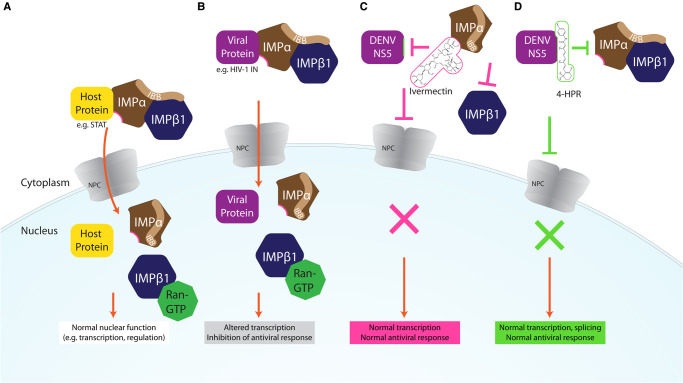
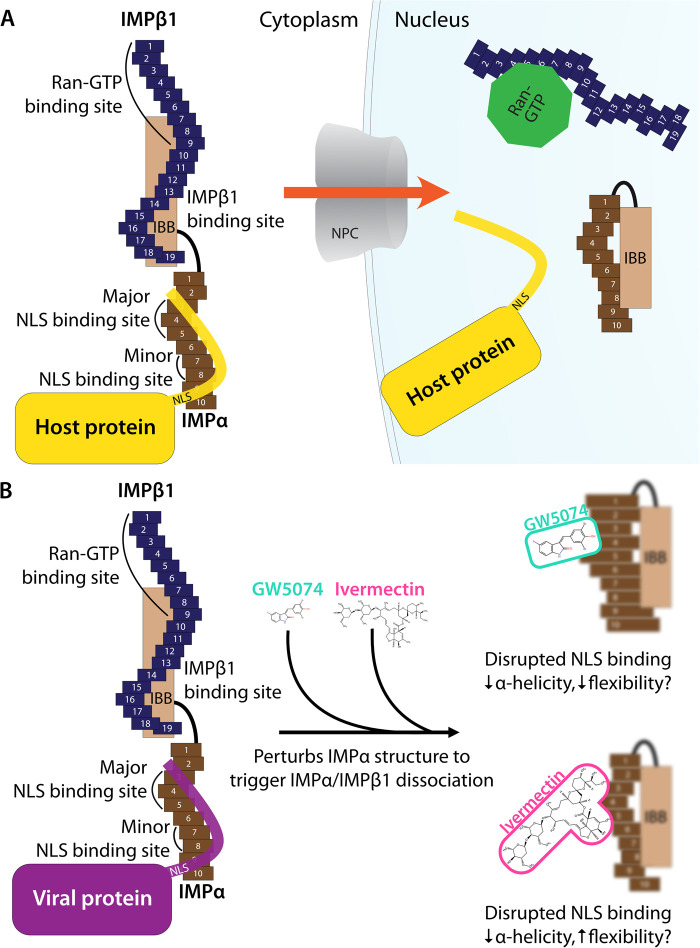
Although transport into the nucleus mediated by the importin (IMP) α/β1-heterodimer is central to viral infection, small molecule inhibitors of IMPα/β1-dependent nuclear import have only been described and shown to have antiviral activity in the last decade. Their robust antiviral activity is due to the strong reliance of many different viruses, including RNA viruses such as human immunodeficiency virus-1 (HIV-1), dengue (DENV), and Zika (ZIKV), on the IMPα/β1-virus interface. High-throughput compound screens have identified many agents that specifically target this interface. Of these, agents targeting IMPα/β1 directly include the FDA-approved macrocyclic lactone ivermectin, which has documented broad-spectrum activity against a whole range of viruses, including HIV-1, DENV1-4, ZIKV, West Nile virus (WNV), Venezuelan equine encephalitis virus, chikungunya, and most recently, SARS-CoV-2 (COVID-19). Ivermectin has thus far been tested in Phase III human clinical trials for DENV, while there are currently close to 80 trials in progress worldwide for SARS-CoV-2; preliminary results for randomised clinical trials (RCTs) as well as observational/retrospective studies are consistent with ivermectin affording clinical benefit. Agents that target the viral component of the IMPα/β1-virus interface include N-(4-hydroxyphenyl) retinamide (4-HPR), which specifically targets DENV/ZIKV/WNV non-structural protein 5 (NS5). 4-HPR has been shown to be a potent inhibitor of infection by DENV1-4, including in an antibody-dependent enhanced animal challenge model, as well as ZIKV, with Phase II clinical challenge trials planned. The results from rigorous RCTs will help determine the therapeutic potential of the IMPα/β1-virus interface as a target for antiviral development.
尽管 IMP(importin)α/β1-异二聚体介导的核内运输对于病毒感染至关重要,但直到过去十年才描述并证明小分子 IMPα/β1 依赖性核内输入抑制剂具有抗病毒活性。它们具有强大的抗病毒活性,是因为许多不同的病毒,包括 RNA 病毒如人类免疫缺陷病毒 1(HIV-1)、登革热(DENV)和寨卡(ZIKV),强烈依赖于 IMPα/β1-病毒界面。高通量化合物筛选已经鉴定出许多专门针对该界面的试剂。其中,直接靶向 IMPα/β1 的试剂包括已获得 FDA 批准的大环内酯伊维菌素,它对包括 HIV-1、DENV1-4、ZIKV、西尼罗河病毒(WNV)、委内瑞拉马脑炎病毒、基孔肯雅热和最近的 SARS-CoV-2(COVID-19)在内的多种病毒具有广泛的活性。伊维菌素迄今为止已在 DENV 的 III 期人体临床试验中进行了测试,而目前全球范围内有近 80 项针对 SARS-CoV-2 的试验正在进行;随机临床试验(RCT)和观察性/回顾性研究的初步结果一致表明,伊维菌素具有临床益处。靶向 IMPα/β1-病毒界面的病毒成分的试剂包括 N-(4-羟苯基)视黄酰胺(4-HPR),它专门针对 DENV/ZIKV/WNV 非结构蛋白 5(NS5)。已证明 4-HPR 是 DENV1-4(包括在抗体依赖性增强动物挑战模型中)和 ZIKV 的有效抑制剂,计划进行 II 期临床挑战试验。严格 RCT 的结果将有助于确定 IMPα/β1-病毒界面作为抗病毒开发目标的治疗潜力。