Fort Lauderdale Research and Education Center, Department of Entomology and Nematology, University of Florida/IFAS, 3205 College Avenue, Davie, FL, 33314-7799, USA.
Kansai Research Center, Forestry and Forest Products Research Institute, 68 Nagaikyutaroh, Fushimi, Kyoto, 612-0855, Japan.
Sci Rep. 2021 Jan 13;11(1):1211. doi: 10.1038/s41598-020-79879-7.
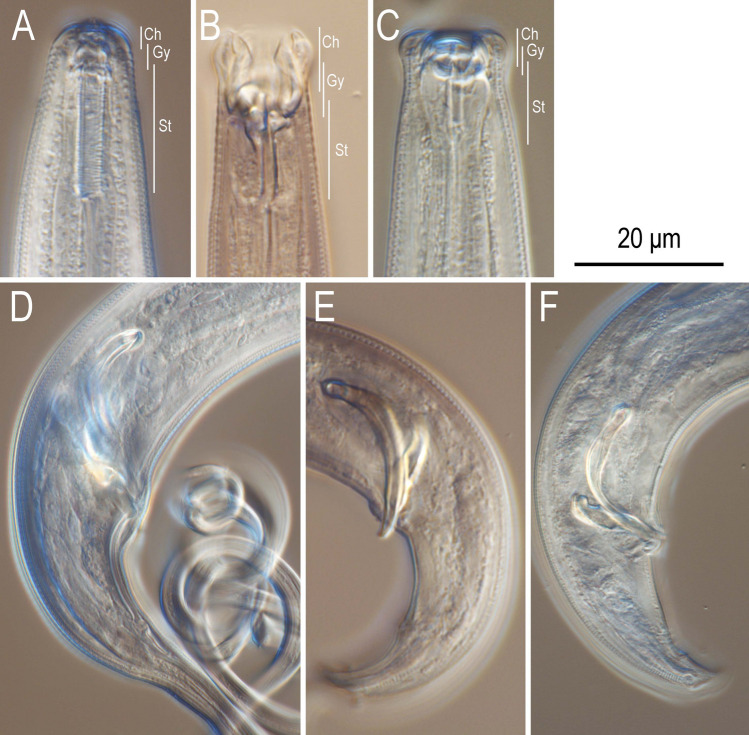
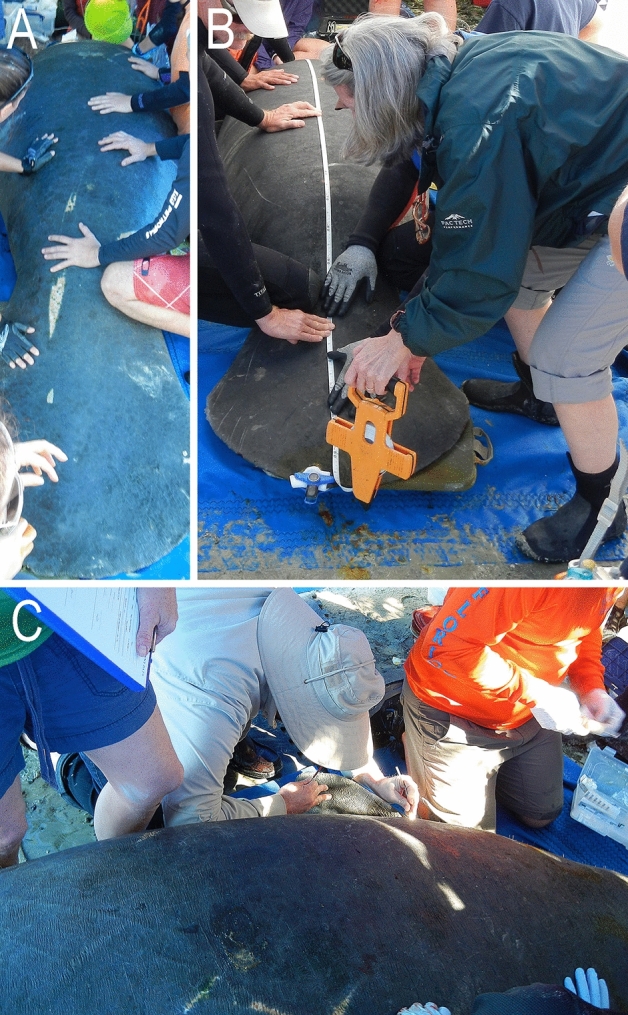
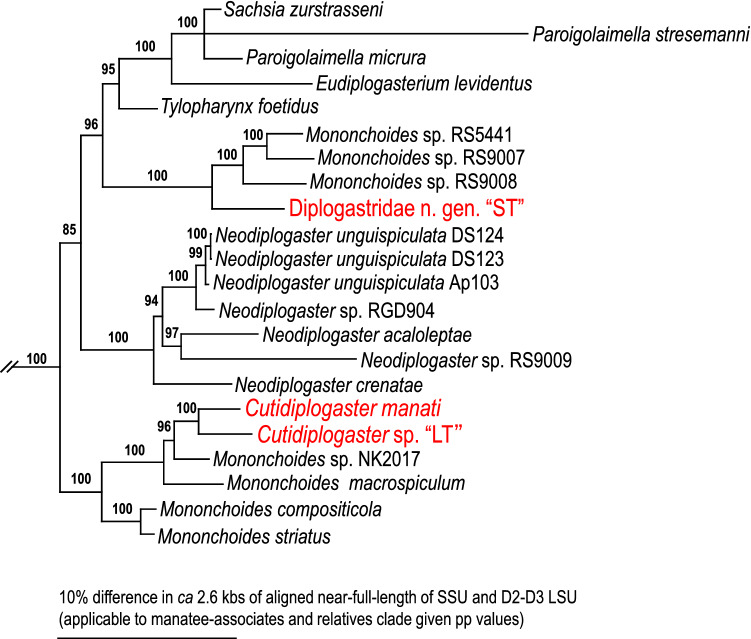
A survey for the presence of nematodes on the skin of the native Florida manatee, Trichechus manatus latirostris from Crystal River, Florida was conducted during annual manatee health assessments. A putative isolate of Cutidiplogaster manati (Diplogastridae) and two other nematodes belonging to the same family were recovered from mid-dorsal tail skin-scrapings from all sampled winter-collected healthy wild adult manatees during two successive years (2018-2019). Qualitative abundance estimates of these three species of diplogastrid nematodes suggest that an average wild Florida manatee adult might possess between 30,000 and 120,000 nematodes on its tail dorsum and that the entire body dorsum including the tail might possess 160,000-640,000 nematodes in roughly equal ratios. Attempts to culture these nematodes on a variety of different culture media were unsuccessful but examination of the mouth (stomatal) morphology suggests specialized feeding on microbes such as diatoms or predation on other nematodes. No skin lesions were observed during the 2018-2019 samplings suggesting that under normal conditions these nematodes are highly specialized free-living epibionts of the skin that are tightly bound to this niche and horizontally transferred between individual manatees in an analogous fashion to human skin mites (Demodex folliculorum and D. brevis). Molecular phylogenetic inferences using sequences of near full length SSU and D2-D3 expansion segments of LSU rRNA genes revealed a putative new morphospecies in Cutidiplogaster sister to C. manati that was monophyletic with several named Mononchoides species, and another putative new morphospecies that formed a clade with several undescribed species similar in appearance to Mononchoides as well as Tylopharyx, Eudiplogasterium, Paroigolaimella and Sachsia.
对佛罗里达州本土海牛(Trichechus manatus latirostris)皮肤中是否存在线虫进行了调查,这些海牛来自佛罗里达州水晶河,是在年度海牛健康评估期间进行的。从 2018 年至 2019 年连续两年,从所有采集到的冬季健康野生成年海牛的中背部尾皮刮片中,回收了一种假定的裂头科线虫(Diplogastridae)分离株和另外两种属于同一科的线虫。这三种裂头科线虫的定性丰度估计表明,一只普通的野生佛罗里达州海牛成年个体可能在其尾部背侧拥有 3 万至 12 万条线虫,而整个背部包括尾部可能拥有 16 万至 640 万条线虫,比例大致相等。尽管尝试在多种不同的培养基上培养这些线虫,但均未成功,但对其口(气门)形态的检查表明,它们专门以微生物(如硅藻)为食,或捕食其他线虫。在 2018 年至 2019 年的采样过程中,没有观察到皮肤损伤,这表明在正常情况下,这些线虫是皮肤的高度专业化自由生活的外生寄生虫,与这个小生境紧密结合,并以类似于人类皮肤螨(Demodex folliculorum 和 D. brevis)的方式在个体海牛之间水平转移。使用近全长 SSU 和 LSU rRNA 基因的 D2-D3 扩展片段的序列进行的分子系统发育推断表明,裂头科线虫中的一种假定新形态种与 C. manati 密切相关,它与几个命名的 Mononchoides 物种形成单系群,另一种假定的新形态种与几个外观与 Mononchoides 相似的未描述物种以及 Tylopharyx、Eudiplogasterium、Paroigolaimella 和 Sachsia 形成一个分支。