Kanzaki Natsumi, Ragsdale Erik J, Giblin-Davis Robin M
Forest Pathology Laboratory, Forestry and Forest Products Research Institute, 1 Matsunosato, Tsukuba, Ibaraki 305-8687, Japan ; Fort Lauderdale Research and Education Center, University of Florida/IFAS, 3205 College Avenue, Davie, FL 33314-7719, USA.
Department of Biology, Indiana University, 1001 E. 3rd Street, Bloomington, IN 47405, USA.
Zookeys. 2014 Sep 23(442):17-30. doi: 10.3897/zookeys.442.7459. eCollection 2014.
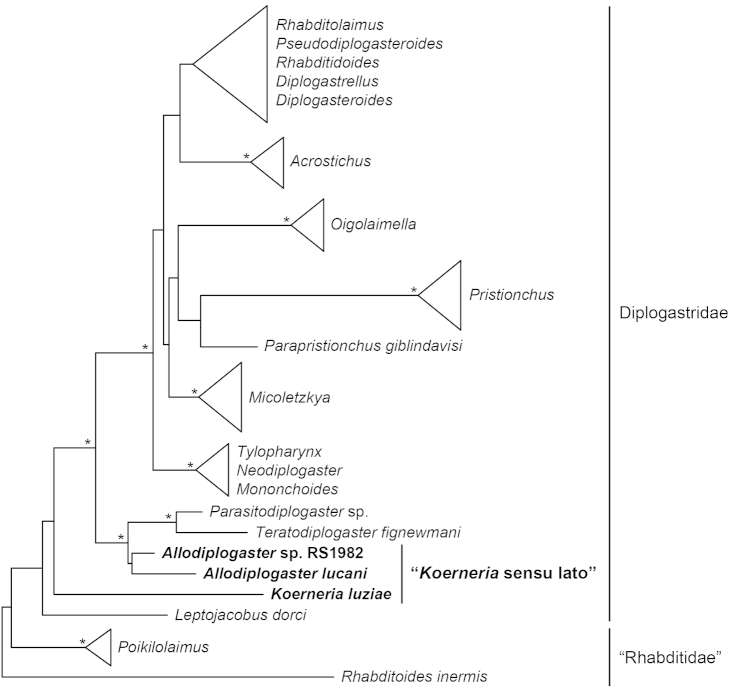
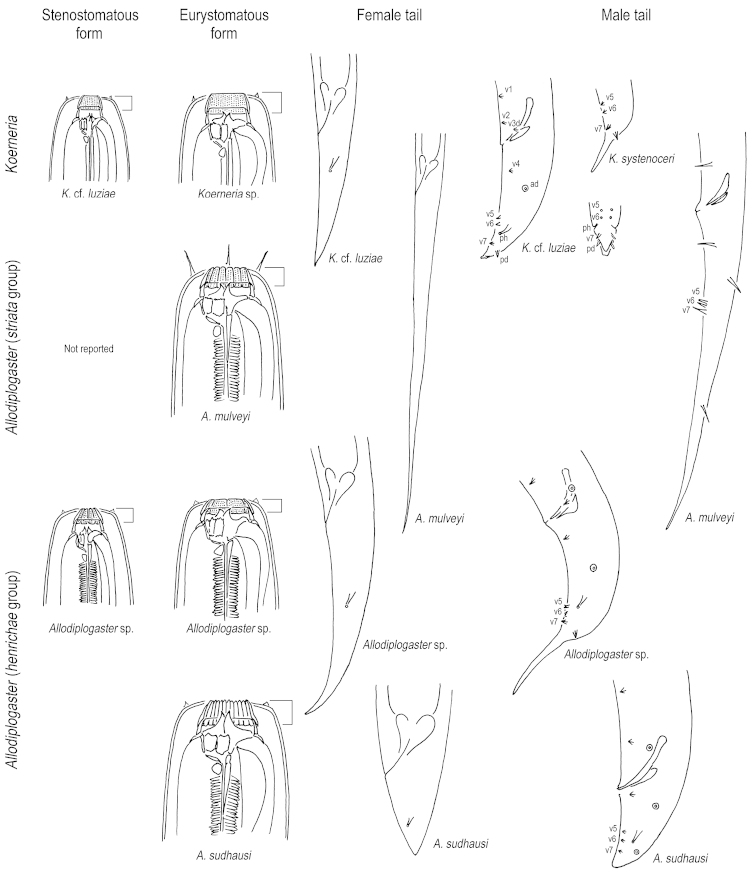
Recent inferences of phylogeny from molecular characters, as well as a reexamination of morphological and biological characters, reject the monophyly of the nematode genus Koerneria Meyl, 1960 (Diplogastridae). Here, Koerneria sensu lato is revised. The genus, which previously consisted of 40 species, is separated into three genera. Almost all of the transferred species are moved to the resurrected genus Allodiplogaster Paramonov & Sobolev in Skrjabin et al. (1954). Koerneria and Allodiplogaster are distinguished from each other by a weakly vs. clearly striated body surface, an undivided vs. divided stomatal cheilostom, and arrangement of the terminal ventral triplet of male genital papillae, namely in that v5 and v6 are paired and separated from v7 vs. v5-v7 being close to each other. Allodiplogaster is further divided into two groups of species, herein called the henrichae and striata groups, based on both morphological and life-history traits. The henrichae group is characterized by papilliform labial sensilla and male genital papillae, a conical tail in both males and females, and an association with terrestrial habitats and insects, whereas the striata group is characterized by setiform labial sensilla and male genital papillae, an elongated conical tail in both sexes, and an association with aquatic habitats. A second genus, Anchidiplogaster Paramonov, 1952, is resurrected to include a single species that is characterized by its miniscule stoma and teeth, unreflexed testis, and a distinct lack of male genital papillae or stomatal apodemes. Lastly, one further species that was previously included in Koerneria sensu lato is transferred to the genus Pristionchus Kreis, 1932. The revision of Koerneria sensu lato is necessitated by the great variability in its subordinate taxa, which occupy a variety of habitats, in addition to the increased attention to Diplogastridae as a model system for comparative mechanistic biology.
近期基于分子特征的系统发育推断,以及对形态学和生物学特征的重新审视,否定了线虫科克尔内里亚属(Koerneria Meyl,1960)(双胃线虫科)的单系性。在此,对广义的克尔内里亚属进行了修订。该属以前由40个物种组成,现被分为三个属。几乎所有被转移的物种都被归入斯基贾宾等人(1954年)复活的异双胃线虫属(Allodiplogaster Paramonov & Sobolev)。克尔内里亚属和异双胃线虫属的区别在于体表条纹弱与明显、气孔唇口未分开与分开、雄性生殖乳头末端腹侧三联体的排列,即v5和v6成对且与v7分开,而异双胃线虫属的v5 - v7彼此靠近。异双胃线虫属进一步根据形态学和生活史特征分为两组物种,在此称为亨里查组和条纹组。亨里查组的特征是乳头状唇感觉器和雄性生殖乳头、雌雄两性均为锥形尾,以及与陆地生境和昆虫有关,而条纹组的特征是刚毛状唇感觉器和雄性生殖乳头、两性均为细长锥形尾,以及与水生栖息地有关。第二个属,锚双胃线虫属(Anchidiplogaster Paramonov,1952)被复活,以包括一个单一物种,其特征是微小的口和齿、未反折的睾丸,以及明显缺乏雄性生殖乳头或气孔骨片。最后,另一个以前包含在广义克尔内里亚属中的物种被转移到普里斯顿线虫属(Pristionchus Kreis,1932)。对广义克尔内里亚属进行修订是必要的,因为其下属分类单元具有很大的变异性,它们占据了各种生境,此外,双胃线虫科作为比较机制生物学的模型系统也受到了更多关注。