Malekrah Alireza, Fatahian Alireza
Cardiovascular Research Center, Mazandaran University of Medical Science, Farah Abad Road, Sari, Mazandaran Province, Iran.
Eur Heart J Case Rep. 2020 Nov 14;4(6):1-4. doi: 10.1093/ehjcr/ytaa323. eCollection 2020 Dec.
Since late 2019, the outbreak of COVID-19 has rapidly spread worldwide. As it is a newly emerged disease, many of its manifestations and complications are unknown to us. Cardiac involvement and arrhythmias are another aspect of the disease about which very little is known.
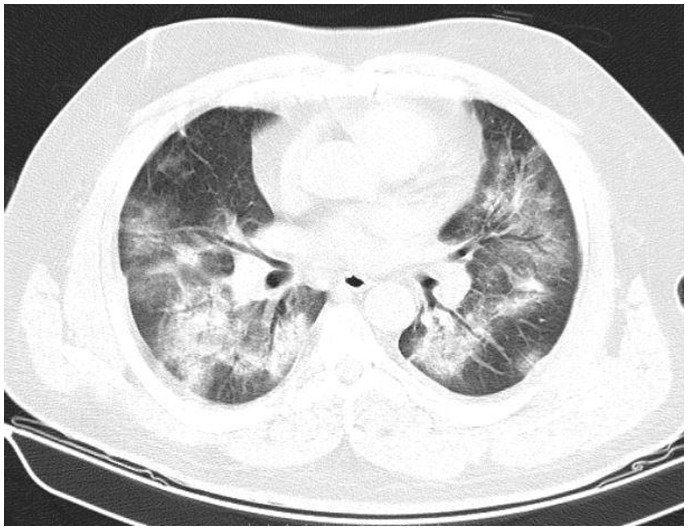
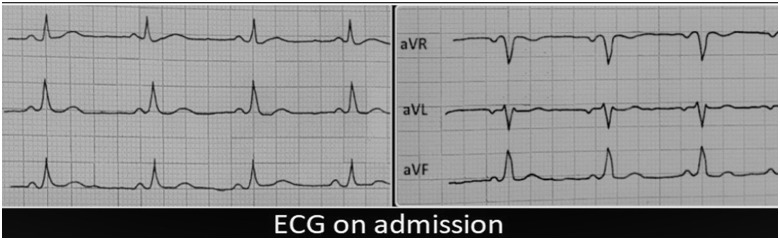
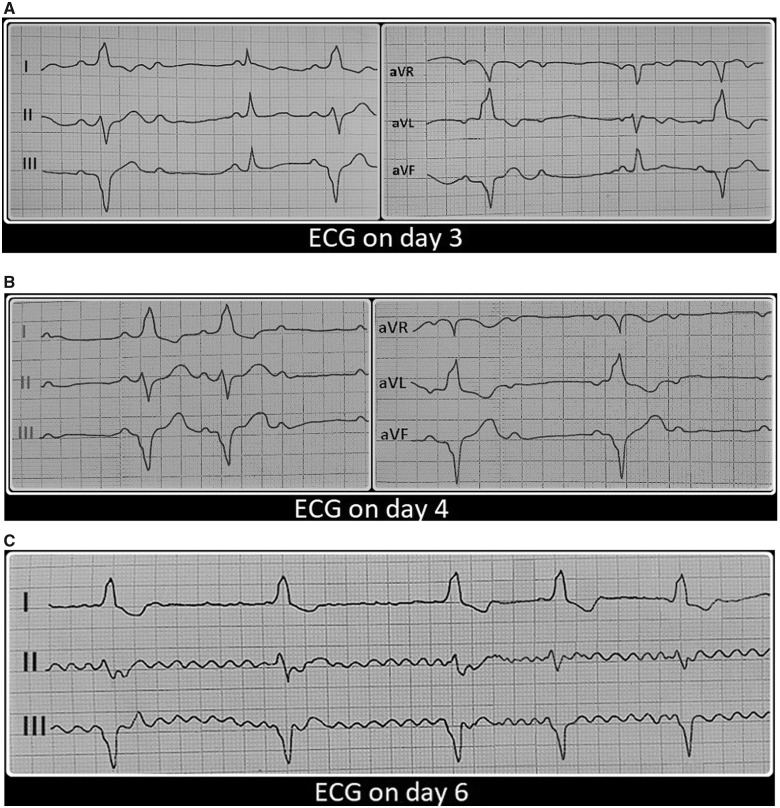
A 71-year-old male patient presented at the Emergency Department complaining of fever, a dry cough, and dyspneoa. He was admitted due to these symptoms suggestive of COVID-19, and a chest CT and PCR test confirmed the diagnosis. During admission, cardiac involvement was detected, i.e. second-degree atrioventricular block with intermittent left bundle branch block (LBBB) which progressed to fixed LBBB and eventually developed into atrial fibrillation/flutter with bradycardia. Both cardiac troponin and echocardiographic findings for detecting myocarditis were negative. We waited 14 days for resolution of atrioventricular block before permanent pacemaker implantation, but the condition still did not improve after the waiting period.
COVID-19 is mainly a respiratory infection but cardiac involvement is not uncommon in the course of the disease. Arrhythmia, during this infection, seems to be caused by an inflammatory response in the myocardium, electrolyte disturbances, and hypoxia; the course of the disease in our case study shows that the virus can preferentially and irreversibly involve the cardiac conduction system.
自2019年末以来,新型冠状病毒肺炎(COVID-19)疫情已在全球迅速蔓延。由于它是一种新出现的疾病,其许多表现和并发症我们尚不清楚。心脏受累和心律失常是该疾病鲜为人知的另一个方面。
一名71岁男性患者因发热、干咳和呼吸困难到急诊科就诊。因这些提示COVID-19的症状,他被收治入院,胸部CT和聚合酶链反应(PCR)检测确诊了该疾病。住院期间,检测到心脏受累,即二度房室传导阻滞伴间歇性左束支传导阻滞(LBBB),后者进展为持续性LBBB,最终发展为心房颤动/扑动伴心动过缓。检测心肌炎的心肌肌钙蛋白和超声心动图结果均为阴性。在植入永久性起搏器前,我们等待了14天以期房室传导阻滞缓解,但等待期过后病情仍未改善。
COVID-19主要是一种呼吸道感染,但在疾病过程中心脏受累并不少见。在这种感染期间,心律失常似乎是由心肌炎症反应、电解质紊乱和缺氧引起的;我们病例研究中的疾病进程表明,病毒可优先且不可逆地累及心脏传导系统。