Laboratory for the Conservation of Endangered Species, CSIR-Centre for Cellular and Molecular Biology, Hyderabad, Telangana, India.
Microb Ecol. 2021 Aug;82(2):554-558. doi: 10.1007/s00248-020-01669-5. Epub 2021 Jan 13.
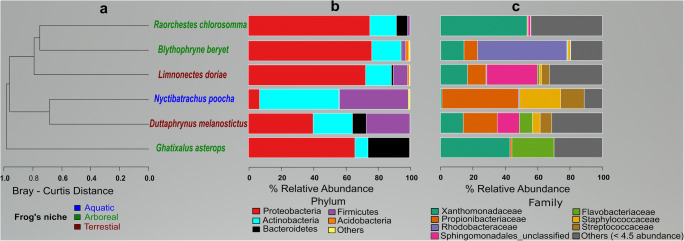
Chytridiomycosis is a fungal disease caused by the pathogens, Batrachochytrium dendrobatidis (Bd) and B. salamandrivorans (Bsal), which has caused declines in amphibian populations worldwide. Asia is considered as a coldspot of infection, since adult frogs are less susceptible to Bd-induced mortality or morbidity. Using the next-generation sequencing approach, we assessed the cutaneous bacterial community composition and presence of anti-Bd bacteria in six frog species from India using DNA isolated from skin swabs. All the six frog species sampled were tested using nested PCR and found Bd negative. We found a total of 551 OTUs on frog skin, of which the bacterial phyla such as Proteobacteria (56.15% average relative abundance) was dominated followed by Actinobacteria (21.98% average relative abundance) and Firmicutes (13.7% average relative abundance). The contribution of Proteobacteria in the anti-Bd community was highest and represented by 175 OTUs. Overall, the anti-Bd bacterial community dominated (51.7% anti-Bd OTUs) the skin microbiome of the frogs. The study highlights the putative role of frog skin microbiome in affording resistance to Bd infections in coldspots of infection.
蛙壶菌病是一种由真菌病原体,蛙壶菌(Batrachochytrium dendrobatidis,Bd)和两栖壶菌(Batrachochytrium salamandrivorans,Bsal)引起的疾病,它导致了全球范围内的两栖动物种群数量下降。亚洲被认为是感染的冷点,因为成年青蛙对 Bd 引起的死亡率或发病率的敏感性较低。使用下一代测序方法,我们评估了来自印度的六种青蛙物种的皮肤细菌群落组成和抗 Bd 细菌的存在,使用从皮肤拭子中分离的 DNA 进行分析。所有六种采样的青蛙物种都使用巢式 PCR 进行了测试,结果均为 Bd 阴性。我们在青蛙皮肤上总共发现了 551 个 OTUs,其中细菌门如变形菌门(平均相对丰度 56.15%)占主导地位,其次是放线菌门(平均相对丰度 21.98%)和厚壁菌门(平均相对丰度 13.7%)。在抗 Bd 群落中,变形菌门的贡献最高,代表了 175 个 OTUs。总的来说,抗 Bd 细菌群落主导了青蛙的皮肤微生物组(占抗 Bd OTUs 的 51.7%)。该研究强调了青蛙皮肤微生物组在提供对感染冷点的 Bd 感染的抗性方面的潜在作用。