Departamento de Epidemiologia, Faculdade de Saúde Pública, Universidade de São Paulo, São Paulo, SP, Brazil.
Superintendência de Controle de Endemias, Secretaria de Estado da Saúde de São Paulo, Araraquara, SP, Brazil.
PLoS One. 2021 Jan 14;16(1):e0245087. doi: 10.1371/journal.pone.0245087. eCollection 2021.
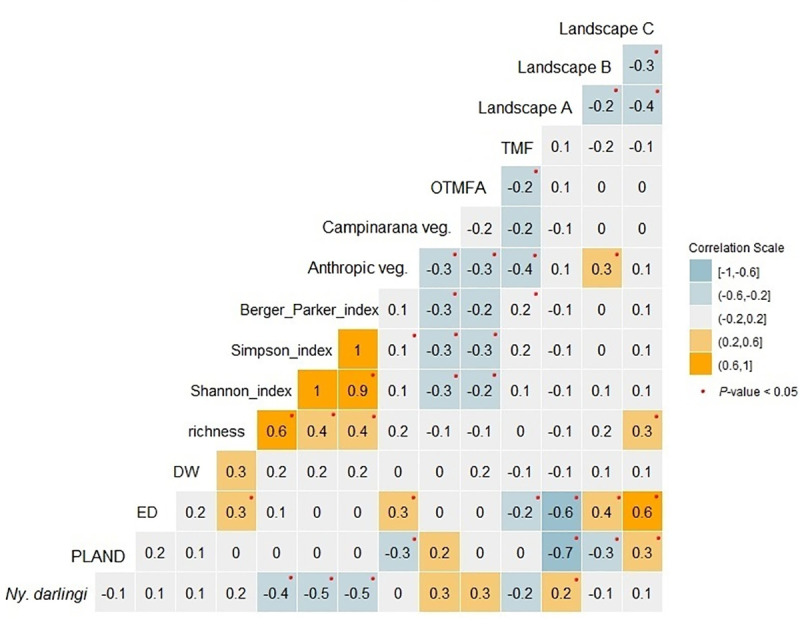
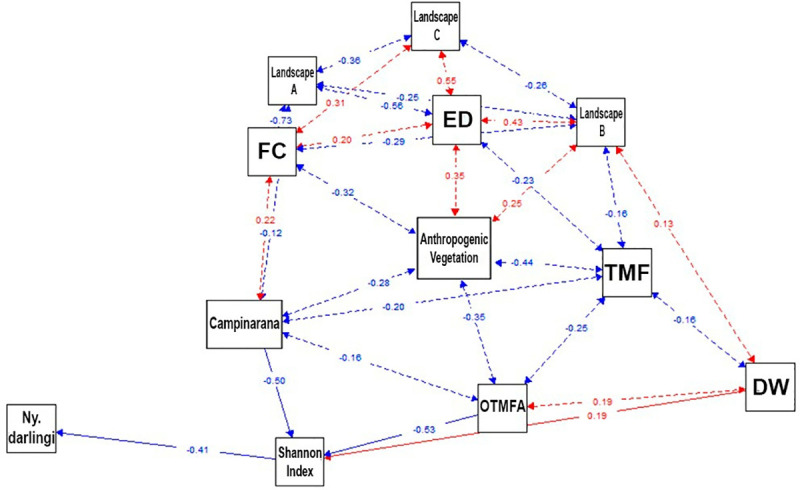
Inter-relationships among mosquito vectors, Plasmodium parasites, human ecology, and biotic and abiotic factors, drive malaria risk. Specifically, rural landscapes shaped by human activities have a great potential to increase the abundance of malaria vectors, putting many vulnerable people at risk. Understanding at which point the abundance of vectors increases in the landscape can help to design policies and interventions for effective and sustainable control. Using a dataset of adult female mosquitoes collected at 79 sites in malaria endemic areas in the Brazilian Amazon, this study aimed to (1) verify the association among forest cover percentage (PLAND), forest edge density (ED), and variation in mosquito diversity; and to (2) test the hypothesis of an association between landscape structure (i.e., PLAND and ED) and Nyssorhynchus darlingi (Root) dominance. Mosquito collections were performed employing human landing catch (HLC) (peridomestic habitat) and Shannon trap combined with HLC (forest fringe habitat). Nyssorhynchus darlingi abundance was used as the response variable in a generalized linear mixed model, and the Shannon diversity index (H') of the Culicidae community, PLAND, and the distance house-water drainage were used as predictors. Three ED categories were also used as random effects. A path analysis was used to understand comparative strengths of direct and indirect relationships among Amazon vegetation classes, Culicidae community, and Ny. darlingi abundance. Our results demonstrate that Ny. darlingi is negatively affected by H´ and PLAND of peridomestic habitat, and that increasing these variables (one-unit value at β0 = 768) leads to a decrease of 226 (P < 0.001) and 533 (P = 0.003) individuals, respectively. At the forest fringe, a similar result was found for H' (β1 = -218; P < 0.001) and PLAND (β1 = -337; P = 0.04). Anthropogenic changes in the Amazon vegetation classes decreased mosquito biodiversity, leading to increased Ny. darlingi abundance. Changes in landscape structure, specifically decreases in PLAND and increases in ED, led to Ny. darlingi becoming the dominant species, increasing malaria risk. Ecological mechanisms involving changes in landscape and mosquito species composition can help to understand changes in the epidemiology of malaria.
蚊媒、疟原虫、人类生态以及生物和非生物因素之间的相互关系,推动了疟疾风险的产生。具体来说,人类活动塑造的农村景观极有可能增加疟疾蚊媒的数量,使许多弱势群体面临风险。了解景观中蚊媒数量增加的临界点有助于设计有效的、可持续的控制政策和干预措施。本研究使用了在巴西亚马逊地区疟疾流行地区的 79 个地点收集的成年雌性蚊子数据集,旨在:(1)验证森林覆盖百分比(PLAND)、森林边缘密度(ED)和蚊子多样性变化之间的关系;以及(2)检验景观结构(即 PLAND 和 ED)与 Nyssorhynchus darlingi(Root)优势之间的关联假设。蚊媒采集采用人诱捕(HLC)(家庭周围环境)和 Shannon 陷阱结合 HLC(森林边缘栖息地)进行。以 Nyssorhynchus darlingi 的丰度作为广义线性混合模型的因变量,以 Culicidae 群落的 Shannon 多样性指数(H')、PLAND 和房屋与排水渠的距离作为预测因子。还将三个 ED 类别用作随机效应。路径分析用于了解亚马逊植被类型、Culicidae 群落和 Ny.darlingi 丰度之间的直接和间接关系的相对强度。我们的结果表明,Ny.darlingi 受到家庭周围环境的 H'和 PLAND 的负面影响,这些变量每增加一个单位(β0=768),个体数量分别减少 226(P<0.001)和 533(P=0.003)。在森林边缘,H'(β1=-218;P<0.001)和 PLAND(β1=-337;P=0.04)也有类似的结果。亚马逊植被类型的人为变化降低了蚊子的生物多样性,导致 Ny.darlingi 数量增加。景观结构的变化,特别是 PLAND 的减少和 ED 的增加,导致 Ny.darlingi 成为优势物种,增加了疟疾的风险。涉及景观和蚊子物种组成变化的生态机制有助于理解疟疾流行病学的变化。