Hager Amber, Mager Diana, Robert Cheri, Nicholas David, Gilmour Susan
Department of Agricultural, Food & Nutritional Sciences, University of Alberta, Edmonton, AB T6G 2E1, Canada.
Department of Pediatrics, University of Alberta, Edmonton, AB T6G 1C9, Canada.
Diagnostics (Basel). 2021 Jan 12;11(1):111. doi: 10.3390/diagnostics11010111.
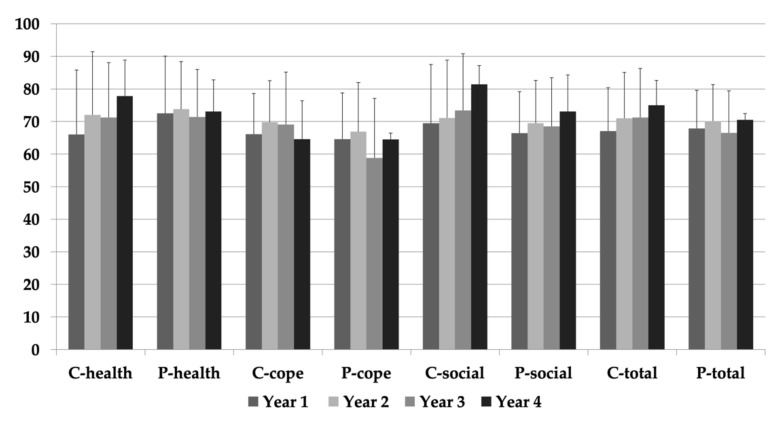
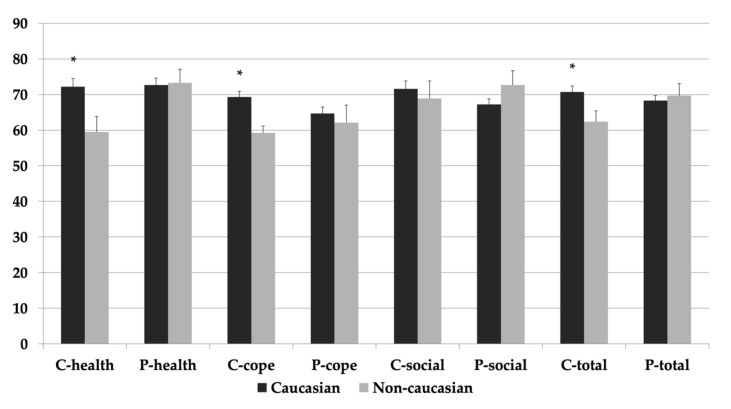
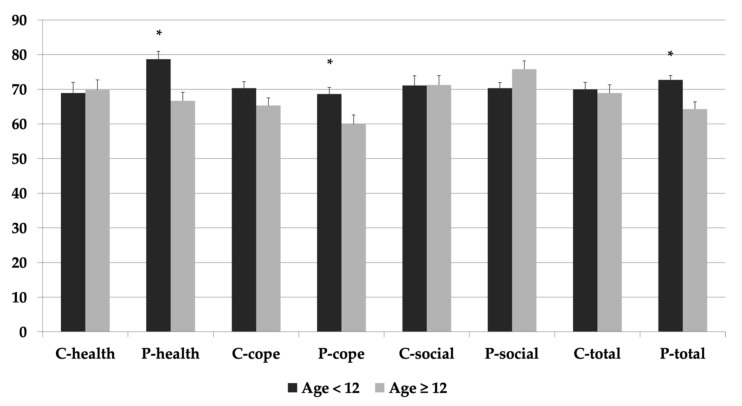
As survival post-liver transplantation (LTx) improves, it becomes increasingly important to understand how long-term health-related quality of life (HRQOL) is impacted. This was a longitudinal review examining HRQOL measured by Pediatric Liver Transplant Quality of Life (PeLTQL) in children between 8-17 years who underwent LTx (1.4 [0.8-3.3] years) at least one year prior to assessment. Demographic, medical, anthropometric, and HRQOL data (self-reported and parent proxy) were retrospectively collected over four years (2014-2017) at annual LTx clinic visits. The study included 35 patients (18M, 17F) and their parents/guardians. Parent-proxy and child PeLTQL scores (total, subdomain) showed good to excellent agreement ( > 0.05) and did not change over four years ( > 0.05). Younger age (<12 years) and Caucasian ancestry were associated with higher parental and self-reported perceptions of HRQOL, respectively (future health, coping and adjustment, total scores). Parent perceived lower HRQOL in social-emotional sub-domain ( = 0.03) and the child reported lower sub-domain scores related to coping and adjustment ( = 0.04) when the child was noted to have co-morbid conditions related to mental health and neurocognitive development (25.7%). While child-parent perceptions of HRQOL in a multi-ethnic population of pediatric LTx recipients remain unchanged 10 years post-LTx, adolescents of non-Caucasian ancestry remain a population at risk for lower HRQOL.
随着肝移植(LTx)术后生存率的提高,了解长期健康相关生活质量(HRQOL)如何受到影响变得越来越重要。这是一项纵向综述,研究对象为8至17岁接受肝移植(在评估前至少一年进行,时间为1.4[0.8 - 3.3]年)的儿童,通过儿童肝移植生活质量量表(PeLTQL)来衡量其HRQOL。在2014年至2017年的四年间,每年在肝移植门诊随访时回顾性收集人口统计学、医学、人体测量学和HRQOL数据(自我报告和家长代理报告)。该研究纳入了35名患者(18名男性,17名女性)及其父母/监护人。家长代理报告和儿童PeLTQL评分(总分、子领域)显示出良好至极好的一致性(> 0.05),且在四年间没有变化(> 0.05)。年龄较小(< 12岁)和白种人血统分别与家长和自我报告的较高HRQOL认知相关(未来健康、应对与适应、总分)。当发现儿童患有与心理健康和神经认知发育相关的合并症(25.7%)时,家长认为其在社会情感子领域的HRQOL较低(= 0.03),而儿童报告在应对与适应相关子领域的得分较低(= 0.04)。虽然在多民族儿童肝移植受者群体中,儿童与家长对HRQOL的认知在肝移植术后10年保持不变,但非白种人血统的青少年仍然是HRQOL较低的风险人群。