
β受体阻滞剂对中范围和左心室射血分数降低的经皮冠状动脉介入治疗患者长期临床结局的影响不同。
Differing effects of beta-blockers on long-term clinical outcomes following percutaneous coronary intervention between patients with mid-range and reduced left ventricular ejection fraction.
机构信息
Department of Cardiovascular Medicine, Juntendo University Graduate School of Medicine, 2-1-1 Hongo, Bunkyo-ku, Tokyo, 113-8421, Japan.
Cardiovascular Respiratory Sleep Medicine, Juntendo University Graduate School of Medicine, 2-1-1 Hongo, Bunkyo-ku, Tokyo, 113-8421, Japan.
出版信息
BMC Cardiovasc Disord. 2021 Jan 15;21(1):36. doi: 10.1186/s12872-021-01850-9.
BACKGROUND
The aim of this study was to determine the difference in effects of beta-blockers on long-term clinical outcomes between ischemic heart disease (IHD) patients with mid-range ejection fraction (mrEF) and those with reduced ejection fraction (rEF).
METHODS
Data were assessed of 3508 consecutive IHD patients who underwent percutaneous coronary intervention (PCI) between 1997 and 2011. Among them, 316 patients with mrEF (EF = 40-49%) and 201 patients with rEF (EF < 40%) were identified. They were assigned to groups according to users and non-users of beta-blockers and effects of beta-blockers were assessed between mrEF and rEF patients, separately. The primary outcome was a composite of all-cause death and non-fatal acute coronary syndrome.
RESULTS
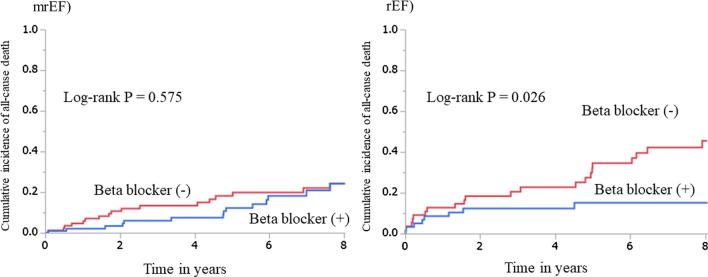
The median follow-up period was 5.5 years in mrEF patients and 4.3 years in rEF patients. Cumulative event-free survival was significantly lower in the group with beta-blockers than in the group without beta-blockers in rEF (p = 0.003), whereas no difference was observed in mrEF (p = 0.137) between those with and without beta-blockers. In the multivariate analysis, use of beta-blockers was associated with reduction in clinical outcomes in patients with rEF (hazard ratio (HR), 0.59; 95% confidence interval (CI), 0.36-0.97; p = 0.036), whereas no association was observed among those with mrEF (HR 0.74; 95% CI 0.49-1.10; p = 0.137).
CONCLUSIONS
Our observational study showed that use of beta-blockers was not associated with long-term clinical outcomes in IHD patients with mrEF, whereas a significant association was observed in those with rEF.
背景
本研究旨在确定β受体阻滞剂对射血分数处于中间范围(mrEF)和射血分数降低(rEF)的缺血性心脏病(IHD)患者长期临床结局的影响差异。
方法
评估了 1997 年至 2011 年间接受经皮冠状动脉介入治疗(PCI)的 3508 例连续 IHD 患者的数据。其中,316 例 mrEF(EF=40-49%)和 201 例 rEF(EF<40%)患者。根据β受体阻滞剂的使用者和非使用者将他们分为两组,并分别评估β受体阻滞剂在 mrEF 和 rEF 患者中的作用。主要结局是全因死亡和非致死性急性冠脉综合征的复合结局。
结果
mrEF 患者的中位随访时间为 5.5 年,rEF 患者为 4.3 年。rEF 患者中β受体阻滞剂组的累积无事件生存率明显低于无β受体阻滞剂组(p=0.003),而 mrEF 患者中两组间无差异(p=0.137)。多变量分析显示,rEF 患者使用β受体阻滞剂与临床结局改善相关(风险比(HR)0.59;95%置信区间(CI)0.36-0.97;p=0.036),而 mrEF 患者中则无相关性(HR 0.74;95%CI 0.49-1.10;p=0.137)。
结论
我们的观察性研究表明,β受体阻滞剂的使用与 mrEF 的 IHD 患者的长期临床结局无关,而在 rEF 的患者中则存在显著相关性。


 Zotero 插件