Sanchini Andrea, Jandrasits Christine, Tembrockhaus Julius, Kohl Thomas Andreas, Utpatel Christian, Maurer Florian P, Niemann Stefan, Haas Walter, Renard Bernhard Y, Kröger Stefan
Respiratory Infections Unit (FG36), Department of Infectious Disease Epidemiology, Robert Koch Institute, Berlin, Germany.
These authors contributed equally to this manuscript.
Euro Surveill. 2021 Jan;26(2). doi: 10.2807/1560-7917.ES.2021.26.2.1900677.
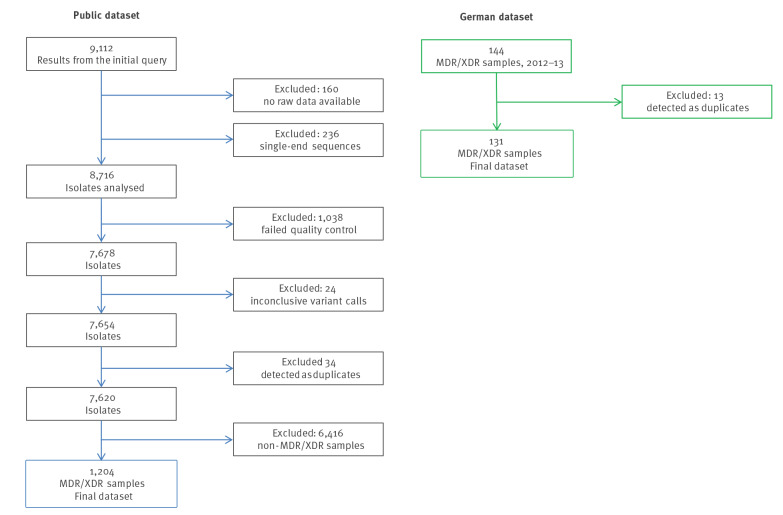
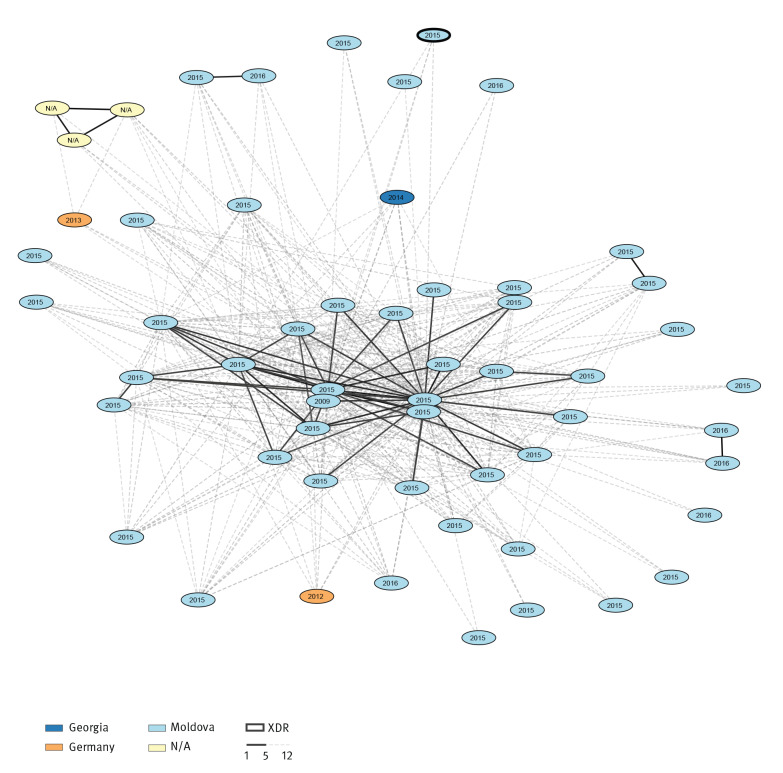
IntroductionImproving the surveillance of tuberculosis (TB) is especially important for multidrug-resistant (MDR) and extensively drug-resistant (XDR) TB. The large amount of publicly available whole genome sequencing (WGS) data for TB gives us the chance to re-use data and to perform additional analyses at a large scale.AimWe assessed the usefulness of raw WGS data of global MDR/XDR isolates available from public repositories to improve TB surveillance.MethodsWe extracted raw WGS data and the related metadata of isolates available from the Sequence Read Archive. We compared this public dataset with WGS data and metadata of 131 MDR- and XDR isolates from Germany in 2012 and 2013.ResultsWe aggregated a dataset that included 1,081 MDR and 250 XDR isolates among which we identified 133 molecular clusters. In 16 clusters, the isolates were from at least two different countries. For example, Cluster 2 included 56 MDR/XDR isolates from Moldova, Georgia and Germany. When comparing the WGS data from Germany with the public dataset, we found that 11 clusters contained at least one isolate from Germany and at least one isolate from another country. We could, therefore, connect TB cases despite missing epidemiological information.ConclusionWe demonstrated the added value of using WGS raw data from public repositories to contribute to TB surveillance. Comparing the German with the public dataset, we identified potential international transmission events. Thus, using this approach might support the interpretation of national surveillance results in an international context.
引言
加强结核病(TB)监测对于耐多药(MDR)和广泛耐药(XDR)结核病尤为重要。大量公开可用的结核病全基因组测序(WGS)数据为我们提供了重新利用数据并进行大规模额外分析的机会。
目的
我们评估了从公共数据库获取的全球耐多药/广泛耐药分离株的原始WGS数据对改善结核病监测的有用性。
方法
我们从序列读取存档中提取了原始WGS数据及相关分离株的元数据。我们将这个公共数据集与2012年和2013年来自德国的131株耐多药和广泛耐药分离株的WGS数据及元数据进行了比较。
结果
我们汇总了一个数据集,其中包括1081株耐多药分离株和250株广泛耐药分离株,我们从中识别出133个分子簇。在16个簇中,分离株来自至少两个不同国家。例如,第2簇包括来自摩尔多瓦、格鲁吉亚和德国的56株耐多药/广泛耐药分离株。当将来自德国的WGS数据与公共数据集进行比较时,我们发现11个簇中至少有一株分离株来自德国,至少有一株来自其他国家。因此,尽管缺少流行病学信息,我们仍能将结核病病例联系起来。
结论
我们证明了使用来自公共数据库中的WGS原始数据对结核病监测的附加价值。通过将德国的数据集与公共数据集进行比较,我们识别出了潜在的国际传播事件。因此,采用这种方法可能有助于在国际背景下解读国家监测结果。