N Engl J Med. 2018 Oct 11;379(15):1403-1415. doi: 10.1056/NEJMoa1800474. Epub 2018 Sep 26.
The World Health Organization recommends drug-susceptibility testing of Mycobacterium tuberculosis complex for all patients with tuberculosis to guide treatment decisions and improve outcomes. Whether DNA sequencing can be used to accurately predict profiles of susceptibility to first-line antituberculosis drugs has not been clear.
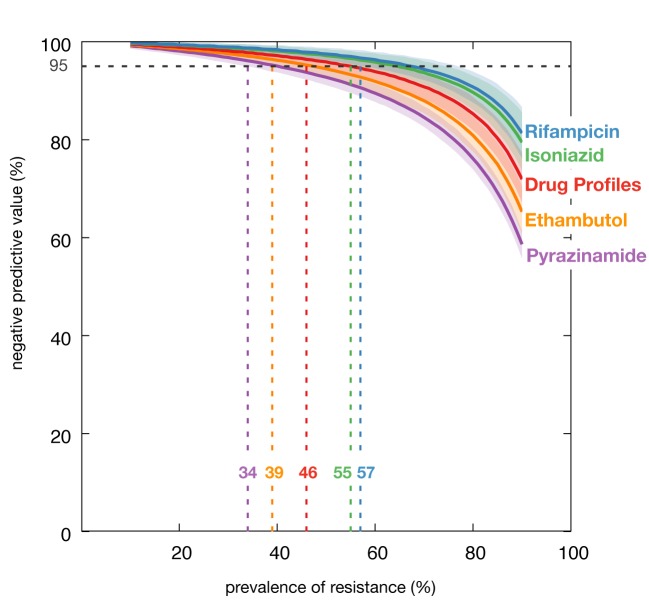
We obtained whole-genome sequences and associated phenotypes of resistance or susceptibility to the first-line antituberculosis drugs isoniazid, rifampin, ethambutol, and pyrazinamide for isolates from 16 countries across six continents. For each isolate, mutations associated with drug resistance and drug susceptibility were identified across nine genes, and individual phenotypes were predicted unless mutations of unknown association were also present. To identify how whole-genome sequencing might direct first-line drug therapy, complete susceptibility profiles were predicted. These profiles were predicted to be susceptible to all four drugs (i.e., pansusceptible) if they were predicted to be susceptible to isoniazid and to the other drugs or if they contained mutations of unknown association in genes that affect susceptibility to the other drugs. We simulated the way in which the negative predictive value changed with the prevalence of drug resistance.
A total of 10,209 isolates were analyzed. The largest proportion of phenotypes was predicted for rifampin (9660 [95.4%] of 10,130) and the smallest was predicted for ethambutol (8794 [89.8%] of 9794). Resistance to isoniazid, rifampin, ethambutol, and pyrazinamide was correctly predicted with 97.1%, 97.5%, 94.6%, and 91.3% sensitivity, respectively, and susceptibility to these drugs was correctly predicted with 99.0%, 98.8%, 93.6%, and 96.8% specificity. Of the 7516 isolates with complete phenotypic drug-susceptibility profiles, 5865 (78.0%) had complete genotypic predictions, among which 5250 profiles (89.5%) were correctly predicted. Among the 4037 phenotypic profiles that were predicted to be pansusceptible, 3952 (97.9%) were correctly predicted.
Genotypic predictions of the susceptibility of M. tuberculosis to first-line drugs were found to be correlated with phenotypic susceptibility to these drugs. (Funded by the Bill and Melinda Gates Foundation and others.).
世界卫生组织建议对所有肺结核患者进行结核分枝杆菌复合群的药敏试验,以指导治疗决策并改善治疗结果。DNA 测序是否能够准确预测一线抗结核药物的敏感性模式尚不清楚。
我们从六大洲 16 个国家获得了全基因组序列以及对一线抗结核药物异烟肼、利福平、乙胺丁醇和吡嗪酰胺的耐药性或敏感性表型。对于每个分离株,在九个基因中确定了与耐药性和药物敏感性相关的突变,并预测了个体表型,除非还存在未知关联的突变。为了确定全基因组测序如何指导一线药物治疗,我们预测了完整的药物敏感性谱。如果对异烟肼和其他药物敏感,或者在影响其他药物敏感性的基因中存在未知关联的突变,则预测为对所有四种药物(即全敏感)敏感。我们模拟了阴性预测值随耐药率变化的方式。
共分析了 10209 株分离株。对利福平(9660 [95.4%])的表型预测比例最大,对乙胺丁醇(8794 [89.8%])的预测比例最小。异烟肼、利福平、乙胺丁醇和吡嗪酰胺的耐药性预测准确率分别为 97.1%、97.5%、94.6%和 91.3%,敏感性预测准确率分别为 99.0%、98.8%、93.6%和 96.8%。在具有完整表型药物敏感性谱的 7516 株分离株中,5865 株(78.0%)具有完整的基因型预测,其中 5250 个谱(89.5%)的预测是正确的。在预测为全敏感的 4037 个表型谱中,3952 个(97.9%)的预测是正确的。
结核分枝杆菌对一线药物敏感性的基因型预测与这些药物的表型敏感性相关。(由比尔及梅琳达·盖茨基金会等资助)。