Department of Entomology & Plant Pathology, North Carolina State University, Campus Box, Raleigh, 7613, USA.
Department of Entomology, University of California Davis, Davis, USA.
Sci Rep. 2021 Jan 14;11(1):1366. doi: 10.1038/s41598-020-80525-5.
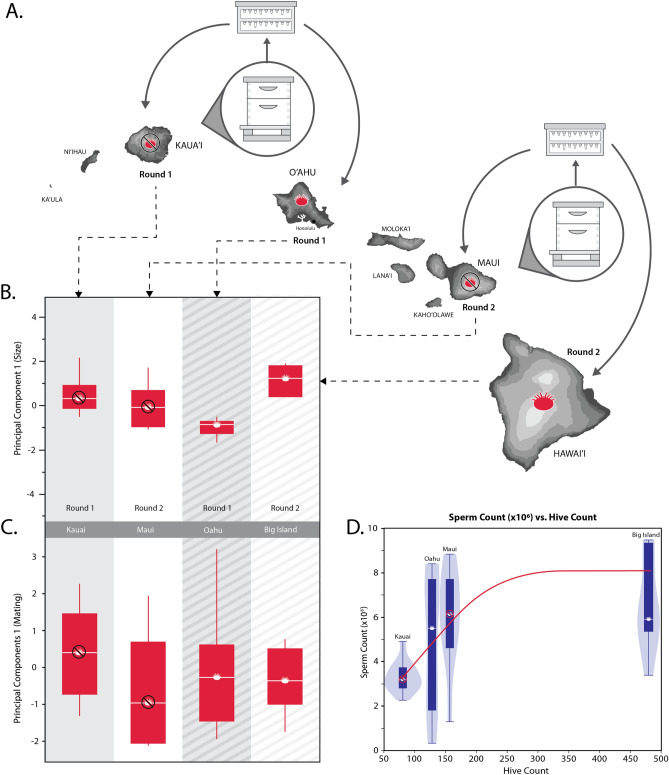
Beekeepers struggle to minimize the mortality of their colonies as a consequence of the parasitic mite Varroa destructor in order to maintain a sustainable managed pollinator population. However, little is known about how varroa mites might diminish local populations of honey bee males (drones) that might affect the mating success of queens. As one of the world's last localities invaded by varroa mites, the Hawaiian Islands offer a unique opportunity to examine this question by comparing queens mated on mite-infested and mite-free islands. We raised queen bees on four Hawaiian Islands (Kaua'i, O'ahu, Maui, and Hawai'i) and subsequently collected their offspring to determine queen mating frequency and insemination success. No significant difference for mating success was found between the islands with and without varroa mites, and relatively high levels of polyandry was detected overall. We also found a significant association between the number of sperm stored in the queens' spermathecae and the number of managed colonies within the localities of the queens mated. Our findings suggest that varroa mites, as they currently occur in Hawai'i, may not significantly reduce mating success of honey bee queens, which provides insight for both the reproductive biology of honey bees as well as the apiculture industry in Hawai'i.
养蜂人努力将寄生螨虫瓦螨对其蜂群死亡率的影响降到最低,以维持可持续管理的传粉媒介种群。然而,人们对瓦螨如何减少可能影响蜂王交配成功率的本地蜜蜂雄蜂(雄蜂)种群知之甚少。夏威夷群岛是世界上最后一个被瓦螨入侵的地区之一,为研究这一问题提供了独特的机会,即比较在有螨虫和无螨虫的岛屿上交配的蜂王。我们在四个夏威夷岛屿(考艾岛、瓦胡岛、毛伊岛和夏威夷岛)上饲养蜂王,并随后收集它们的后代,以确定蜂王的交配频率和受精成功率。在有和没有瓦螨的岛屿之间,交配成功率没有显著差异,而且总体上发现了相对较高水平的多配偶制。我们还发现,在交配的蜂王所在的地区,储存在蜂王精囊中精子的数量与管理的蜂群数量之间存在显著的相关性。我们的研究结果表明,在夏威夷,瓦螨可能不会显著降低蜜蜂蜂王的交配成功率,这为蜜蜂的生殖生物学以及夏威夷的养蜂业提供了一些启示。