Yin Shuhong, Lin Xiuying
Department of Dermatology, The Third Affiliated Hospital of Qiqihar Medical University, Qiqihar, Heilongjiang, 161000, People's Republic of China.
Int J Gen Med. 2021 Jan 8;14:27-39. doi: 10.2147/IJGM.S275016. eCollection 2021.
Though the therapeutic potentials of microRNAs (miRNAs) are extensively explored in cutaneous squamous cell carcinoma (CSCC), the concrete function of miR-21 in this disorder has not been thoroughly comprehended. Therein, this work is launched to clarify the miR-21-pivoted mechanism in CSCC from the perspective of tissue inhibitor of metalloproteinases-3 (TIMP3) and phosphatidylinositol 3-kinase (PI3K)/protein kinase B (AKT) pathway.
Microarray-based analysis was utilized to screen out miR-21 with the most up-regulated expression in CSCC tissues. The relation between miR-21 and TIMP3 expression in tissues, and the overall survival of CSCC patients was evaluated. Loss-of-function assays were performed in cells to explore the independent and combined functions of miR-21 and TIMP3 in CSCC cell progression. Mice were injected with miR-21 inhibitor or TIMP3 si for identifying their roles in tumor formation and liver metastasis. The mechanism among miR-21, TIMP3 and PI3K/AKT pathway was interpreted.
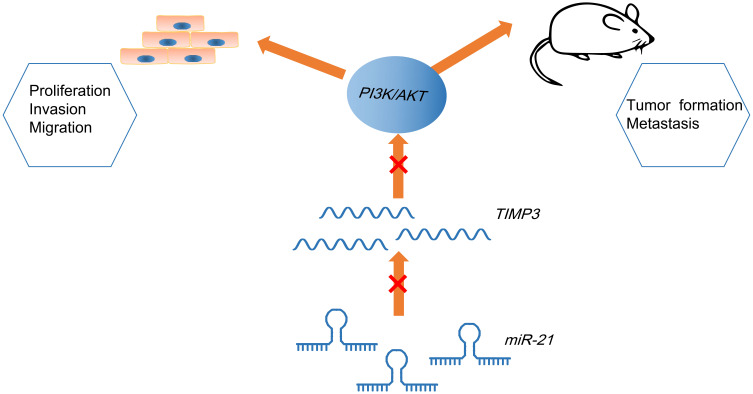
MiR-21 was up-regulated while TIMP3 was down-regulated in CSCC tissues, which were connected with unsatisfactory survival of patients. Down-regulating miR-21 inhibited CSCC cell progression and retarded CSCC tumor formation and metastasis in mice. Silencing of TIMP3 reversed the effects of miR-21 down-regulation on CSCC progression. Besides, down-regulating miR-21 inhibited PI3K/AKT pathway activation in CSCC cells via mediating TIMP3.
It is elucidated that miR-21 depletion impedes CSCC cell invasion and metastasis via enhancing TIMP3 and suppressing PI3K/AKT pathway activation.
尽管微小RNA(miRNA)的治疗潜力在皮肤鳞状细胞癌(CSCC)中得到了广泛探索,但miR-21在该疾病中的具体功能尚未被完全理解。在此,本研究旨在从金属蛋白酶组织抑制剂-3(TIMP3)和磷脂酰肌醇3激酶(PI3K)/蛋白激酶B(AKT)信号通路的角度阐明miR-21在CSCC中的作用机制。
利用基于微阵列的分析筛选出在CSCC组织中表达上调最显著的miR-21。评估miR-21与组织中TIMP3表达以及CSCC患者总生存期之间的关系。在细胞中进行功能缺失实验,以探讨miR-21和TIMP3在CSCC细胞进展中的独立作用和联合作用。给小鼠注射miR-21抑制剂或TIMP3小干扰RNA(si),以确定它们在肿瘤形成和肝转移中的作用。解读miR-21、TIMP3和PI3K/AKT信号通路之间的机制联系。
CSCC组织中miR-21上调而TIMP3下调,这与患者的不良生存情况相关。下调miR-21可抑制CSCC细胞进展,并延缓CSCC在小鼠体内的肿瘤形成和转移。沉默TIMP3可逆转miR-21下调对CSCC进展的影响。此外,下调miR-21通过介导TIMP3抑制CSCC细胞中PI3K/AKT信号通路的激活。
研究表明,miR-21表达缺失通过增强TIMP3和抑制PI3K/AKT信号通路激活来阻碍CSCC细胞的侵袭和转移。