Panburana Panyu, Komwilaisak Ratana, Tongprasert Fuanglada, Phadungkiatwattana Podjanee, Kor-Anantakul Ounjai, Lumbiganon Pisake
Department of Obstetrics & Gynecology, Faculty of Medicine, Ramathibodi University Hospital, Mahidol University, Bangkok, Thailand.
Department of Obstetrics & Gynecology, Faculty of Medicine, Khon Kaen University, Khon Kaen, Thailand.
Int J Womens Health. 2021 Jan 6;13:31-38. doi: 10.2147/IJWH.S285516. eCollection 2021.
To perform a cross-sectional observational study of calcium consumption among pregnant women from multicenter tertiary care hospitals in the middle-income country in Southeast Asia.
A cross-sectional observational study.
The study was conducted in four geographical regions (northern, northeastern, southern, and central) of Thailand. Five participating hospitals consisted of one university hospital in each region and one additional tertiary care hospital in the central region.
A cross-sectional study was performed nationwide from 1st November 2017 to 31st January 2019. All singleton aged 19-40 years were included. Exclusion criteria were any conditions that influenced calcium-containing food consumption. Dietary intake self-records immediately after eating for two working days and one holiday were analyzed via INMUCAL-NV3.0 dietary program.
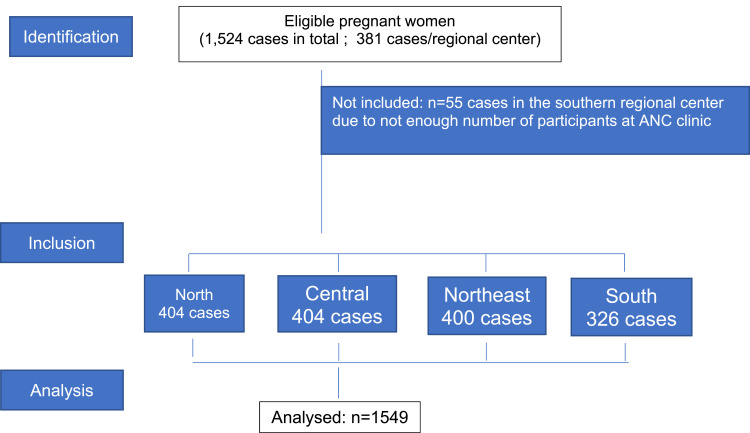
The 1549 records were obtained. The mean age was 29 ± 5.7 years. Most participants were primigravida (48.6%). The average gestational age was 20.6 ± 8.8 weeks. Mean calcium consumption was 602.4 mg/day (95% CI; 589.2615.6 mg/day) mg/dL. Inadequate calcium consumption prevalence based on the Thai dietary reference intake (less than 800 mg/day) and US Institute of Medicine (less than 1000 mg/day) were 82.0% and 93.4%, respectively.
The mean calcium consumption among pregnant women in the middle-income country in Southeast Asia was 602.4 mg/day (95% CI 589.2-615.6 mg/day). Inadequate calcium consumption of Thai pregnant women prevalence was 82.0% and 93.4% according to Thai dietary reference intake in pregnancy and the US Institute of Medicine.
对东南亚中等收入国家多中心三级护理医院的孕妇钙摄入量进行横断面观察研究。
横断面观察研究。
该研究在泰国的四个地理区域(北部、东北部、南部和中部)进行。五家参与医院包括每个区域的一家大学医院和中部地区的一家额外的三级护理医院。
于2017年11月1日至2019年1月31日在全国范围内进行横断面研究。纳入所有年龄在19 - 40岁的单胎孕妇。排除标准为任何影响含钙食物摄入的情况。通过INMUCAL - NV3.0饮食程序分析在两个工作日和一个节假日进食后立即进行的饮食摄入自我记录。
共获得1549份记录。平均年龄为29±5.7岁。大多数参与者为初产妇(48.6%)。平均孕周为20.6±8.8周。平均钙摄入量为602.4毫克/天(95%置信区间;589.2 - 615.6毫克/天)毫克/分升。根据泰国饮食参考摄入量(低于800毫克/天)和美国医学研究所(低于1000毫克/天),钙摄入不足的患病率分别为82.0%和93.4%。
东南亚中等收入国家孕妇的平均钙摄入量为602.4毫克/天(95%置信区间589.2 - 615.6毫克/天)。根据泰国孕期饮食参考摄入量和美国医学研究所的数据,泰国孕妇钙摄入不足的患病率分别为82.0%和93.4%。