Wasserman Danielle, Bindman Dorothea, Nesbitt Alexander D, Cash Diana, Milosevic Milan, Francis Paul T, Chaudhuri K Ray, Leschziner Guy D, Ferini-Strambi Luigi, Ballard Clive, Eccles Amy, Rosenzweig Ivana
Sleep and Brain Plasticity Centre, Department of Neuroimaging, Institute of Psychiatry, Psychology and Neuroscience (IoPPN), King's College London, London, UK.
Sleep Disorders Centre, Guy's and St Thomas' NHS Foundation Trust, London, UK.
Nat Sci Sleep. 2021 Jan 6;13:1-9. doi: 10.2147/NSS.S267037. eCollection 2021.
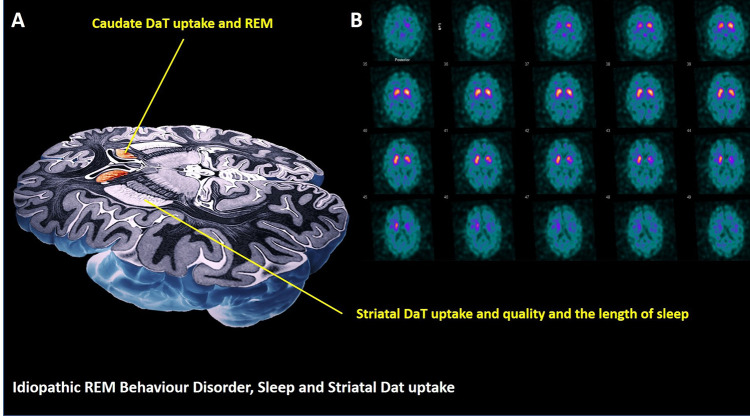
Idiopathic rapid eye movement (REM) sleep behavior disorder (iRBD) is increasingly recognised as an important precursor disease state of alpha-synucleinopathies. This parasomnia is characterized by a history of recurrent nocturnal dream enactment behaviour, loss of skeletal muscle atonia, and increased phasic muscle activity during REM sleep. Neuroimaging studies of striatal dopamine transporter uptake tracer signaling suggest increasing dopaminergic deficit across the continuum of the alpha-synucleinopathies, with early sleep dysfunction suggestive of early caudate dysfunction. Henceforth, we set out to investigate the relationship between early sleep changes and the striatal dopaminergic availability in iRBD.
Twelve patients with iRBD, who had undergone a video polysomnography and a neuroimaging assessment of striatal dopamine transporter (DaT) uptake tracer signaling, and 22 matched controls who had similarly undergone a video polysomnography were retrospectively identified. Data were statistically analyzed to identify altered sleep parameters and correlate them with striatal dopamine transporter uptake tracer signaling.
The iRBD patients exhibited an increased number of periodic limb movements during sleep (=0.001), compared to 22 age-matched healthy subjects. In addition, several significant links were found between regional DaT-uptakes and sleep architecture. Correlational analyses suggested a strong positive association between sleep fragmentation and dopamine deficiency in left caudate (r=-0.630, =0.028), whilst an increased uptake in the whole striatum was strongly linked to the sleep efficiency, and to a lesser degree to the length of sleep duration.
To the best of our knowledge, this is the first demonstration of a close relationship between dopaminergic availability in striatum and the quality of sleep in iRBD. Taken together, our exploratory findings suggest that subtle but functionally significant striatal changes in early stages of iRBD may contribute to the further shaping of sleep architecture.
特发性快速眼动(REM)睡眠行为障碍(iRBD)日益被认为是α-突触核蛋白病的一种重要前驱疾病状态。这种异态睡眠的特征是有反复夜间梦呓行为史、快速眼动睡眠期骨骼肌失弛缓以及快速眼动睡眠期肌阵挛活动增加。纹状体多巴胺转运体摄取示踪剂信号的神经影像学研究表明,在α-突触核蛋白病的整个病程中多巴胺能缺陷不断增加,早期睡眠功能障碍提示早期尾状核功能障碍。因此,我们着手研究iRBD患者早期睡眠变化与纹状体多巴胺能可用性之间的关系。
回顾性确定了12例接受过视频多导睡眠图检查和纹状体多巴胺转运体(DaT)摄取示踪剂信号神经影像学评估的iRBD患者,以及22例同样接受过视频多导睡眠图检查的匹配对照者。对数据进行统计分析,以确定改变的睡眠参数,并将其与纹状体多巴胺转运体摄取示踪剂信号相关联。
与22名年龄匹配的健康受试者相比,iRBD患者睡眠期间周期性肢体运动次数增加(=0.001)。此外,在区域DaT摄取与睡眠结构之间发现了几个显著的关联。相关性分析表明,睡眠片段化与左侧尾状核多巴胺缺乏之间存在强正相关(r=-0.630,=0.028),而整个纹状体摄取增加与睡眠效率密切相关,与睡眠时间长度的相关性较小。
据我们所知,这是首次证明纹状体多巴胺能可用性与iRBD患者睡眠质量之间存在密切关系。综上所述,我们的探索性研究结果表明,iRBD早期阶段纹状体细微但功能上显著的变化可能有助于进一步塑造睡眠结构。