Wynn-Lawrence Laura S, Bala Laksha, Fletcher Rebekah J, Wilson Rebecca K, Sam Amir H
Imperial College School of Medicine, Imperial College London, London, UK.
Adv Med Educ Pract. 2021 Jan 5;11:1047-1053. doi: 10.2147/AMEP.S280972. eCollection 2020.
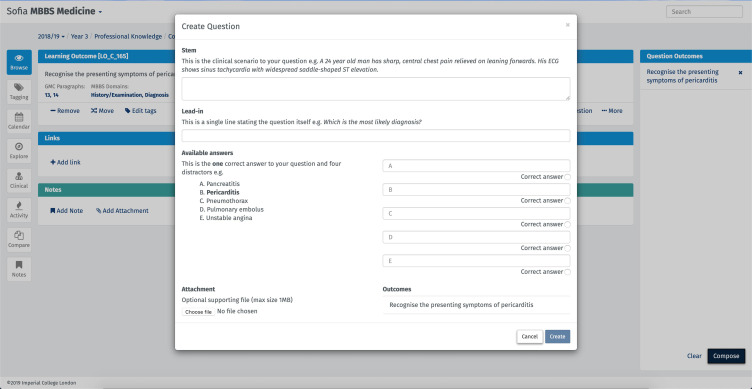
We designed a curriculum mapping tool which enables medical students to access intended learning outcomes (ILOs) on their iPads in the workplace. Students were encouraged to use the online curriculum map in a specially planned teaching session: question-based collaborative learning (QBCL). The aim of the session was to empower medical students to constructively align their experiential learning with the learning outcomes of the undergraduate curriculum. In doing so, our session aimed to provide students with a greater understanding of the curriculum, improve their insights into assessment and their question-writing abilities.
The QBCL pre-session preparation involved reviewing a patient with a presentation that aligned to the year-specific ILOs. During a 150 minute QBCL session, students received training on how to write high quality multiple choice questions (MCQs) delivered by a faculty member of Imperial College School of Medicine. They then worked collaboratively in groups and created MCQs based on their clinical encounters. Their questions were tagged to the relevant learning objective and submitted online via the curriculum map. The student-generated MCQs were analyzed using an adjusted version of Bloom's taxonomy. We also conducted a quantitative evaluation of the session.
One hundred and sixty-three questions were submitted, with 81% of questions being tagged to ILOs considered to show evidence of learning consistent with the "Apply" tier of Bloom's taxonomy. The majority of students agreed that the session was interactive (80%), thought-provoking (77%) and improved their team-working skills (70%). It gave them a greater understanding of the undergraduate curriculum (65%), improved their question-writing and insight into assessments (76%), and provided an opportunity to learn from their peers (86%). Students agreed that this session covered a variety of cases (82%) and deepened their understanding of medical conditions and presentations (87%).
We encouraged students to actively interact with the curriculum map. Students were able to achieve their own constructive alignment by writing assessment items based on real patients and linking them to the appropriate intended learning outcomes.
我们设计了一种课程映射工具,使医学生能够在工作场所通过iPad获取预期学习成果(ILO)。在一次特别安排的教学课程——基于问题的协作学习(QBCL)中,鼓励学生使用在线课程地图。该课程的目的是使医学生能够建设性地将他们的体验式学习与本科课程的学习成果相匹配。通过这样做,我们的课程旨在让学生更好地理解课程,提高他们对评估的洞察力和编写问题的能力。
QBCL课前准备包括回顾一名患者的病例展示,该病例展示与特定年份的ILO相匹配。在150分钟的QBCL课程中,学生接受了关于如何编写高质量多项选择题(MCQ)的培训,培训由帝国理工学院医学院的一名教员进行。然后,他们分组协作,根据临床接触情况编写MCQ。他们编写的问题被标记到相关学习目标,并通过课程地图在线提交。使用布鲁姆分类法的调整版本对学生编写的MCQ进行分析。我们还对该课程进行了定量评估。
共提交了163个问题,其中81%的问题被标记到被认为显示出与布鲁姆分类法“应用”层级相一致的学习证据的ILO上。大多数学生认为该课程具有互动性(80%)、发人深省(77%),并提高了他们的团队合作技能(70%)。它使他们对本科课程有了更深入的理解(65%),提高了他们编写问题和对评估的洞察力(76%),并提供了向同龄人学习的机会(86%)。学生们一致认为该课程涵盖了各种病例(82%),并加深了他们对医疗状况和病例展示的理解(87%)。
我们鼓励学生积极与课程地图互动。学生能够通过根据真实患者编写评估项目并将其与适当的预期学习成果相联系,实现自己的建设性匹配。