Ladehesa-Pineda María Lourdes, Arias de la Rosa Iván, López Medina Clementina, Castro-Villegas María Del Carmen, Ábalos-Aguilera María Del Carmen, Ortega-Castro Rafaela, Gómez-García Ignacio, Seguí-Azpilcueta Pedro, Jiménez-Gómez Yolanda, Escudero-Contreras Alejandro, López Pedrera Chary, Barbarroja Nuria, Collantes-Estévez Eduardo
Department of Rheumatology of "Reina Sofia University Hospital", Avda. Menéndez Pidal s/n, Córdoba, 14004, Spain.
Reina Sofia University Hospital/Maimonides Research Institute of Biomedical Medicine from Cordoba (IMIBIC)/University of Córdoba, Cordoba, Spain.
Ther Adv Musculoskelet Dis. 2020 Dec 30;12:1759720X20982837. doi: 10.1177/1759720X20982837. eCollection 2020.
To evaluate the association of estimated cardiovascular (CV) risk and subclinical atherosclerosis with radiographic structural damage in patients with axial spondyloarthritis (axSpA).
Cross-sectional study including 114 patients axSpA from the SpA registry of Córdoba (CASTRO) and 132 age- and sex-matched healthy controls (HCs). Disease activity and the presence of traditional CV risk factors were recorded. The presence of atherosclerotic plaques and carotid intima media thickness (cIMT) were evaluated through carotid ultrasound and the SCORE index was calculated. Radiographic damage was measured though modified Stoke Ankylosing Spondylitis Spinal Score (mSASSS). The association between mSASSS and SCORE was tested using generalized linear models (GLM), and an age-adjusted cluster analysis was performed to identify different phenotypes dependent on the subclinical CV risk.
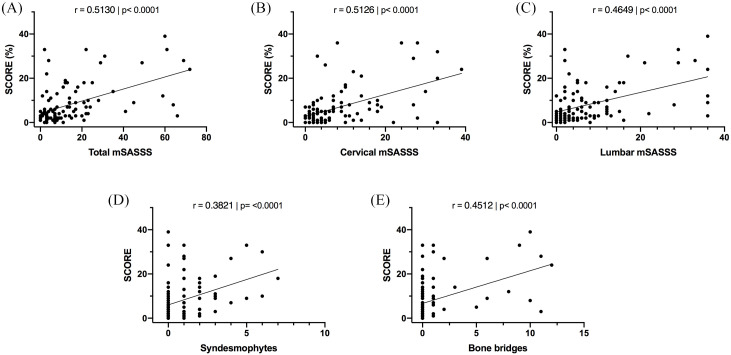
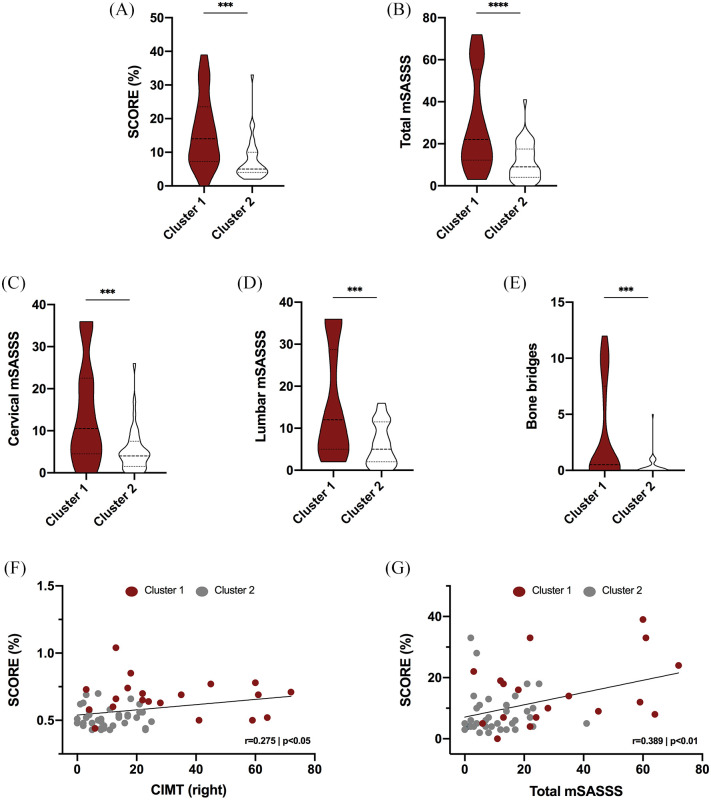
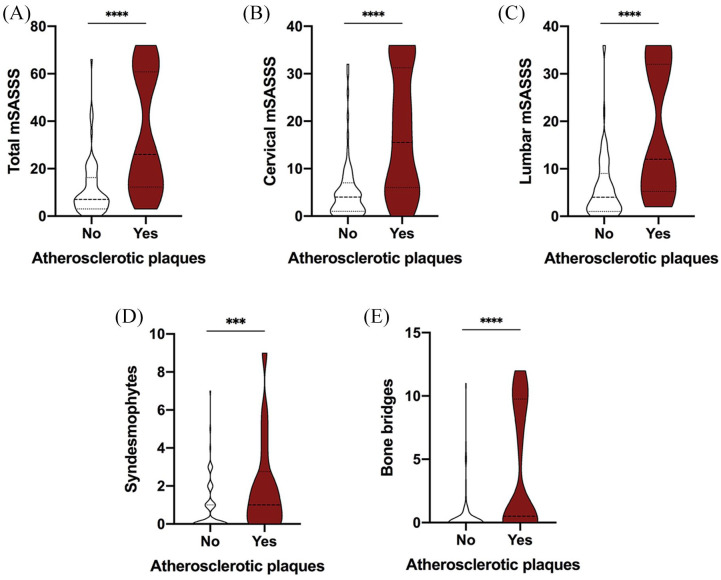
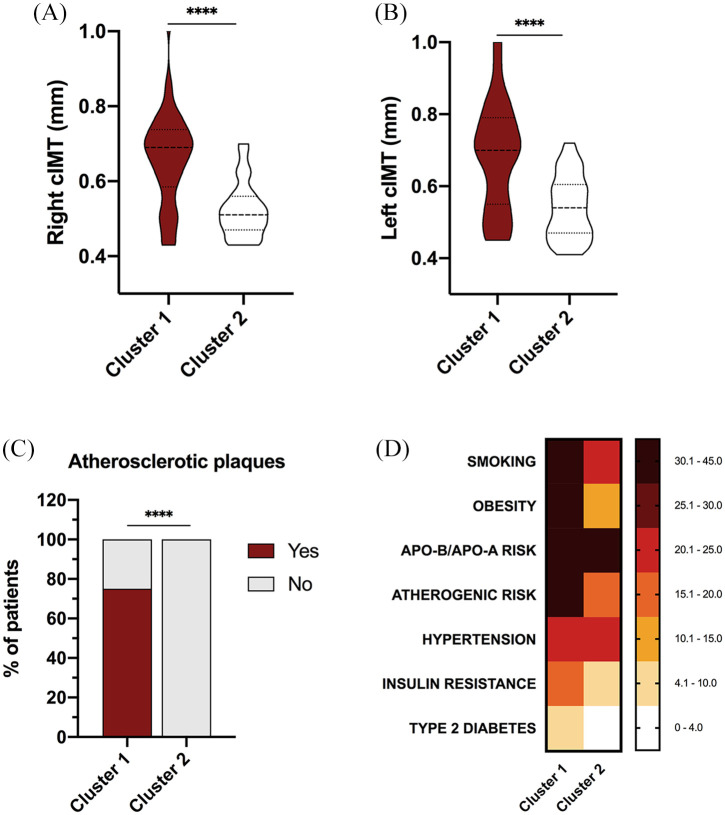
Increased traditional CV risk factors, SCORE, and the presence of carotid plaques were found in axSpA patients compared with HCs. The presence of atherosclerotic plaques and SCORE were associated with radiographic structural damage. The GLM showed that the total mSASSS was associated independently with the SCORE [β coefficient 0.24; 95% confidence interval (CI) 0.10-0.38] adjusted for disease duration, age, tobacco, C-reactive protein, and non-steroidal anti-inflammatory drugs (NSAID) intake. Hard cluster analysis identified two phenotypes of patients. Patients from cluster 1, characterized by the presence of plaques and increased cIMT, had a higher prevalence of CV risk factors and SCORE, and more structural damage than cluster two patients.
Radiographic structural damage is associated closely with increased estimated CV risk: higher SCORE levels in axSpA patients were found to be associated independently with mSASSS after adjusting for age, disease duration, CRP, tobacco and NSAID intake.
评估轴性脊柱关节炎(axSpA)患者的估计心血管(CV)风险和亚临床动脉粥样硬化与影像学结构损伤之间的关联。
横断面研究,纳入了来自科尔多瓦脊柱关节炎登记处(CASTRO)的114例axSpA患者以及132例年龄和性别匹配的健康对照(HCs)。记录疾病活动情况和传统CV危险因素的存在情况。通过颈动脉超声评估动脉粥样硬化斑块的存在情况和颈动脉内膜中层厚度(cIMT),并计算SCORE指数。通过改良斯托克强直性脊柱炎脊柱评分(mSASSS)测量影像学损伤。使用广义线性模型(GLM)测试mSASSS与SCORE之间的关联,并进行年龄调整的聚类分析,以识别依赖于亚临床CV风险的不同表型。
与HCs相比,axSpA患者中传统CV危险因素、SCORE以及颈动脉斑块的存在情况增加。动脉粥样硬化斑块的存在和SCORE与影像学结构损伤相关。GLM显示,在调整疾病持续时间、年龄、烟草、C反应蛋白和非甾体抗炎药(NSAID)摄入量后,总mSASSS与SCORE独立相关[β系数0.24;95%置信区间(CI)0.10 - 0.38]。硬聚类分析确定了两种患者表型。第1组患者的特征是存在斑块和cIMT增加,与第2组患者相比,CV危险因素和SCORE的患病率更高,结构损伤更多。
影像学结构损伤与估计的CV风险增加密切相关:在调整年龄、疾病持续时间、CRP、烟草和NSAID摄入量后,发现axSpA患者中较高的SCORE水平与mSASSS独立相关。