Li Zhi-Hao, Zhong Wen-Fang, Lv Yue-Bin, Kraus Virginia Byers, Gao Xiang, Chen Pei-Liang, Huang Qing-Mei, Ni Jin-Dong, Shi Xiao-Ming, Mao Chen, Wu Xian-Bo
1Department of Epidemiology, School of Public Health, Southern Medical University, Guangzhou, 510515 Guangdong China.
2National Institute of Environmental Health, Chinese Center for Disease Control and Prevention, Beijing, China.
Immun Ageing. 2019 Nov 5;16:28. doi: 10.1186/s12979-019-0168-5. eCollection 2019.
The association of high-sensitivity C-reactive protein (hsCRP) with mortality is controversial. We aimed to investigate the associations of hsCRP concentrations with the risks of all-cause and cause-specific mortality and identify potential modifying factors affecting these associations among middle-aged and elderly individuals.
This community-based prospective cohort study included 14,220 participants aged 50+ years (mean age: 64.9 years) from the Health and Retirement Study. Cox proportional hazard models were employed to estimate the associations between the hsCRP concentrations and the risk of all-cause and cause-specific mortality with adjustment for sociodemographic and lifestyle factors, self-reported medical history, and other potential confounders.
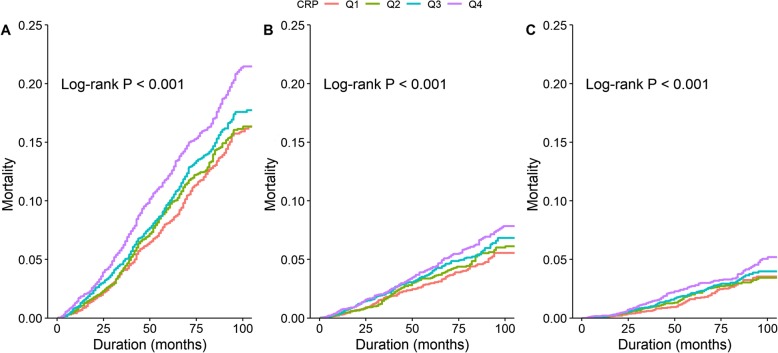
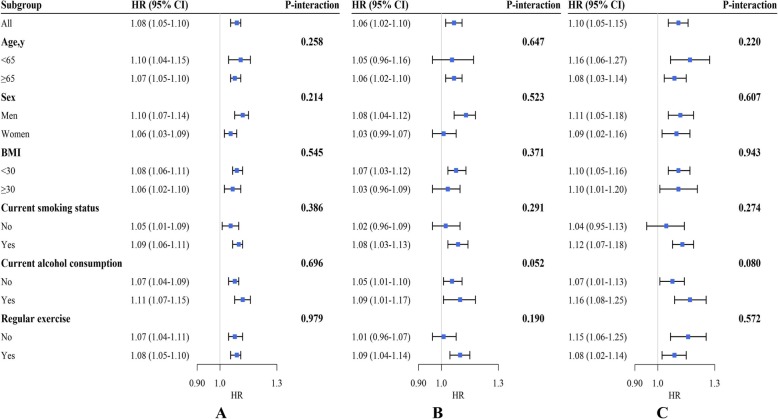
In total, 1730 all-cause deaths were recorded, including 725 cardiovascular- and 417 cancer-related deaths, after an 80,572 person-year follow-up (median: 6.4 years; range: 3.6-8.1 years). The comparisons of the groups with the highest (quartile 4) and lowest (quartile 1) hsCRP concentrations revealed that the adjusted hazard ratios and 95% confidence intervals were 1.50 (1.31-1.72) for all-cause mortality, 1.44 (1.13-1.82) for cardiovascular mortality, and 1.67 (1.23-2.26) for cancer mortality. The associations between high hsCRP concentrations and the risks of all-cause, cardiovascular, and cancer mortality were similar in the men and women ( for interaction > 0.05).
Among middle-aged and older individuals, elevated hsCRP concentration could increase the risk of all-cause, cardiovascular, and cancer mortality in men and women.
高敏C反应蛋白(hsCRP)与死亡率之间的关联存在争议。我们旨在研究hsCRP浓度与全因死亡率和特定病因死亡率风险之间的关联,并确定影响中年和老年个体中这些关联的潜在修正因素。
这项基于社区的前瞻性队列研究纳入了来自健康与退休研究的14220名年龄在50岁及以上(平均年龄:64.9岁)的参与者。采用Cox比例风险模型来估计hsCRP浓度与全因死亡率和特定病因死亡率风险之间的关联,并对社会人口学和生活方式因素、自我报告的病史以及其他潜在混杂因素进行了调整。
在80572人年的随访(中位数:6.4年;范围:3.6 - 8.1年)后,共记录了1730例全因死亡,其中包括725例心血管疾病相关死亡和417例癌症相关死亡。对hsCRP浓度最高(四分位数4)和最低(四分位数1)的组进行比较发现,全因死亡率的调整后风险比和95%置信区间为1.50(1.31 - 1.72),心血管死亡率为1.44(1.13 - 1.82),癌症死亡率为1.67(1.23 - 2.26)。hsCRP浓度高与全因、心血管和癌症死亡率风险之间的关联在男性和女性中相似(交互作用P>0.05)。
在中年和老年个体中,hsCRP浓度升高会增加男性和女性全因、心血管和癌症死亡的风险。