Kim Kyu Yean, Yoo Kwang Ha, Choi Hye Sook, Kim Bo Yeon, Ahn Sang In, Jo Yon U, Rhee Chin Kook
Division of Pulmonary and Critical Care Medicine, Department of Internal Medicine, Uijeongbu St. Mary's Hospital, College of Medicine, The Catholic University of Korea, Gyeonggi-do, Uijeongbu, South Korea.
Division of Pulmonary and Critical Care Medicine, Department of Internal Medicine, Konkuk University School of Medicine, Seoul, South Korea.
J Thorac Dis. 2020 Dec;12(12):7174-7181. doi: 10.21037/jtd-20-905.
Chronic obstructive pulmonary disease (COPD) requires careful ambulatory care. If treatment is effective, exacerbation and hospitalization can be preventable. Appropriate management is important; the disease prevalence is high, as is the demand on healthcare resources. Here, we have reported the results of nationwide quality assessment performed with the aims of improving patient management, reducing progression to severe status, and minimizing medical care expenses.
The Health Insurance Review and Assessment Service (HIRA) engaged in quality assessment three times from May 2014 to April 2017. Medical care institutions were evaluated in terms of the pulmonary function test (PFT), patient revisit, and inhaled bronchodilator prescription rates.
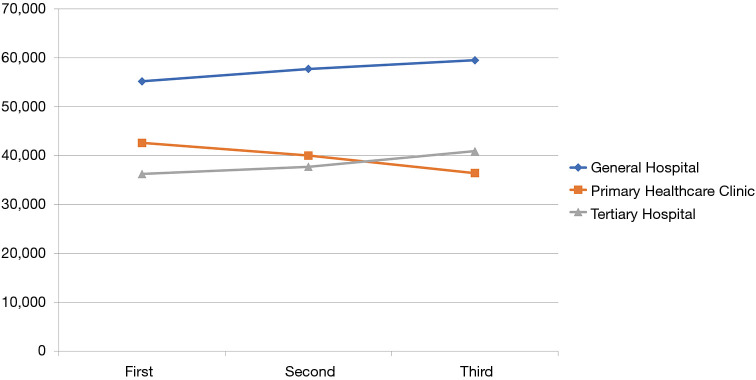
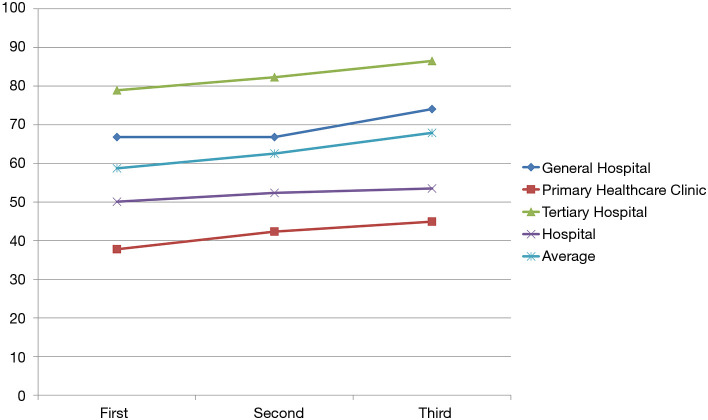
The numbers of patients assessed were 141,782, 142,790, and 143,339 in years 1, 2, and 3, respectively; the numbers of medical care institutions assessed were 6,691, 6,722, and 6,470, respectively. The PFT implementation rates were 58.7%, 62.5%, and 67.9% for years 1, 2, and 3, respectively; these rates were highest for tertiary hospitals, followed by general and local hospitals, as well as primary healthcare clinics. The repeat visit rates were 85.5%, 92.1%, and 85.0% for years 1, 2, and 3, respectively; these rates were highest for general hospitals, followed by local and tertiary hospitals, and primary healthcare clinics. The inhaled bronchodilator prescription rates were 67.9%, 71.2%, and 76.9% for years 1, 2, and 3, respectively; these rates increased with increasing hospital grade.
The PFT and inhaled bronchodilator prescription rates improved over the 3-year nationwide quality assessment period.
慢性阻塞性肺疾病(COPD)需要精心的门诊护理。如果治疗有效,病情加重和住院是可以预防的。恰当的管理很重要;该疾病患病率高,对医疗资源的需求也高。在此,我们报告了以改善患者管理、减少病情进展至严重状态以及使医疗费用最小化为目的而进行的全国性质量评估结果。
健康保险审查与评估服务机构(HIRA)在2014年5月至2017年4月期间进行了三次质量评估。医疗机构在肺功能测试(PFT)、患者复诊以及吸入性支气管扩张剂处方率方面接受评估。
第1年、第2年和第3年评估的患者数量分别为141,782例、142,790例和143,339例;评估的医疗机构数量分别为6,691家、6,722家和6,470家。第1年、第2年和第3年的PFT实施率分别为58.7%、62.5%和67.9%;这些比率在三级医院最高,其次是综合医院和地方医院以及基层医疗诊所。第第1年、第2年和第3年的复诊率分别为85.5%、92.1%和85.0%;这些比率在综合医院最高,其次是地方医院和三级医院以及基层医疗诊所。第1年、第2年和第3年的吸入性支气管扩张剂处方率分别为67.9%、71.2%和76.9%;这些比率随着医院等级的提高而增加。
在为期3年的全国性质量评估期间,PFT和吸入性支气管扩张剂处方率有所提高。