Singh Dave, Stockley Robert, Anzueto Antonio, Agusti Alvar, Bourbeau Jean, Celli Bartolome R, Criner Gerard J, Han MeiLan K, Martinez Fernando J, Montes de Oca Maria, Ozoh Obianuju B, Papi Alberto, Pavord Ian, Roche Nicolas, Salvi Sandeep, Sin Don D, Troosters Thierry, Wedzicha Jadwiga, Zheng Jinping, Volgelmeier Claus, Halpin David
University of Manchester, Manchester University NHS Foundation Hospital Trust, Manchester, UK
University Hospital, Birmingham, UK.
Eur Respir J. 2025 Feb 6;65(2). doi: 10.1183/13993003.01603-2024. Print 2025 Feb.
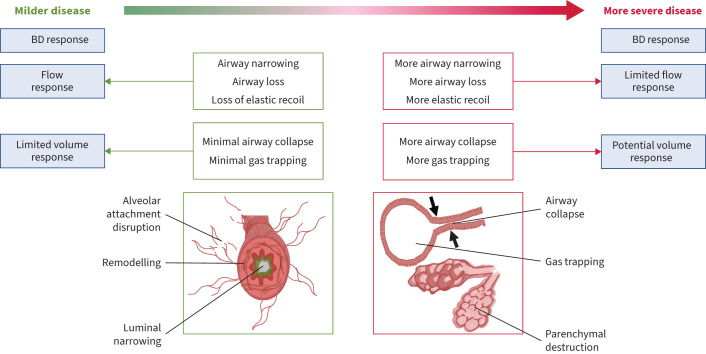
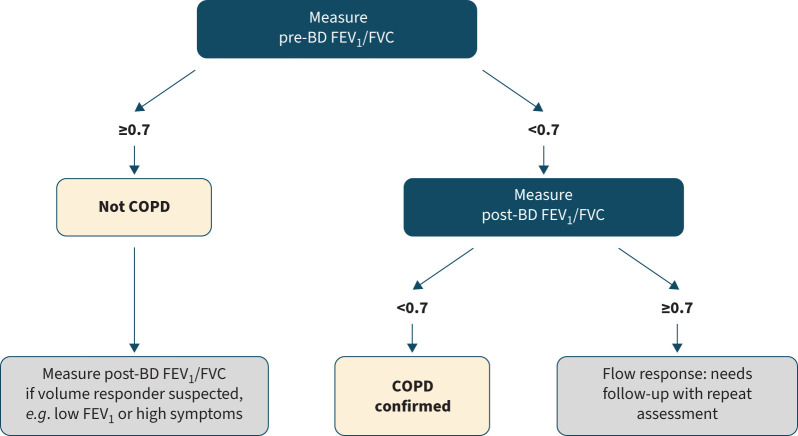
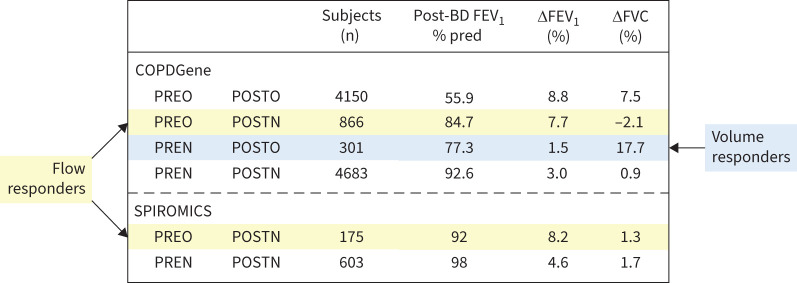
The Global Initiative for Chronic Obstructive Lung Disease (GOLD) report states that the diagnosis of COPD should be considered in individuals with chronic respiratory symptoms and/or exposure to risk factors. Forced spirometry demonstrating airflow obstruction after bronchodilation is required to confirm the diagnosis using a threshold of forced expiratory volume in 1 s (FEV)/forced vital capacity (FVC) ratio <0.7. This GOLD Science Committee review weighs the evidence for using pre- or post-bronchodilator (BD) spirometry to diagnose COPD. Cohort studies have shown that pre- and post-BD spirometry give concordant diagnostic results in most cases, although the prevalence of COPD is up to 36% lower with post-BD values. Discordant results may occur in "volume" or "flow" responders. Volume responders have reduced FVC due to gas trapping causing FEV/FVC ≥0.7 pre-BD, but a volume response occurs post-BD with a greater improvement in FVC relative to FEV decreasing the ratio to <0.7. Flow responders show a greater FEV improvement relative to FVC which may increase FEV/FVC from <0.7 pre-BD to ≥0.7 post-BD; these individuals have an increased likelihood of developing post-BD obstruction during follow-up and require monitoring longitudinally. GOLD 2025 recommends using pre-BD spirometry to rule out COPD and post-BD measurements to confirm the diagnosis. This will reduce clinical workload. Post-BD results close to the threshold should be repeated to ensure a correct diagnosis is made. Post-BD measurements ensure that volume responders are not overlooked and limit COPD overdiagnosis.
慢性阻塞性肺疾病全球倡议(GOLD)报告指出,对于有慢性呼吸道症状和/或接触风险因素的个体,应考虑慢性阻塞性肺疾病的诊断。需要通过支气管扩张后用力肺活量测定显示气流受限,使用1秒用力呼气容积(FEV)/用力肺活量(FVC)比值<0.7的阈值来确诊。本GOLD科学委员会综述权衡了使用支气管扩张剂前或后肺活量测定来诊断慢性阻塞性肺疾病的证据。队列研究表明,支气管扩张剂前和后肺活量测定在大多数情况下给出一致的诊断结果,尽管支气管扩张剂后的值显示慢性阻塞性肺疾病的患病率低至36%。在“容积”或“流量”反应者中可能出现不一致的结果。容积反应者由于气体潴留导致FVC降低,使得支气管扩张剂前FEV/FVC≥0.7,但支气管扩张剂后出现容积反应,FVC相对于FEV有更大改善,使比值降至<0.7。流量反应者相对于FVC显示出更大的FEV改善,这可能使FEV/FVC从支气管扩张剂前<0.7增加到支气管扩张剂后≥0.7;这些个体在随访期间发生支气管扩张剂后气流受限的可能性增加,需要进行纵向监测。GOLD 2025建议使用支气管扩张剂前肺活量测定排除慢性阻塞性肺疾病,使用支气管扩张剂后测量结果确诊。这将减少临床工作量。接近阈值的支气管扩张剂后结果应重复测量以确保做出正确诊断。支气管扩张剂后测量可确保不遗漏容积反应者,并限制慢性阻塞性肺疾病的过度诊断。