Esquer Garrigos Zerelda, Jandhyala Deeksha, Vijayvargiya Prakhar, Castillo Almeida Natalia E, Gurram Pooja, Corsini Campioli Cristina G, Stulak John M, Rizza Stacey A, O'Horo John C, DeSimone Daniel C, Baddour Larry M, Sohail M Rizwan
Division of Infectious Diseases, Department of Medicine, University of Mississippi Medical Center, Jackson, Mississippi, USA.
Division of Infectious Diseases, Department of Medicine, Mayo Clinic College of Medicine and Science, Rochester, Minnesota, USA.
Open Forum Infect Dis. 2020 Nov 16;8(1):ofaa532. doi: 10.1093/ofid/ofaa532. eCollection 2021 Jan.
Ascertaining involvement of left ventricular assist device (LVAD) in a patient presenting with bloodstream infection (BSI) can be challenging, frequently leading to use of chronic antimicrobial suppressive (CAS) therapy. We aimed to assess the efficacy of CAS therapy to prevent relapse of BSI from LVAD and non-LVAD sources.
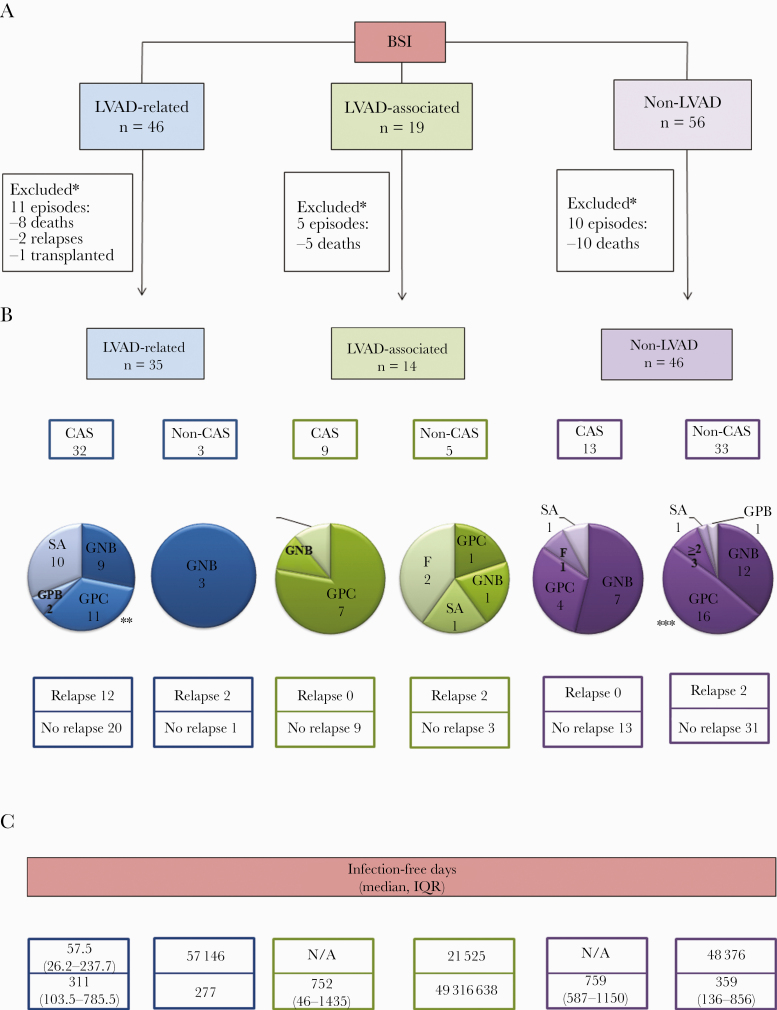
We retrospectively screened adults receiving LVAD support from 2010 through 2018, to identify cases of BSI. Bloodstream infection events were classified into LVAD-related, LVAD-associated, and non-LVAD BSIs.
A total of 121 episodes of BSI were identified in 80 patients. Of these, 35 cases in the LVAD-related, 14 in the LVAD-associated, and 46 in the non-LVAD BSI groups completed the recommended initial course of therapy and were evaluated for CAS therapy. Chronic antimicrobial suppressive therapy was prescribed in most of the LVAD-related BSI cases (32 of 35, 91.4%) and 12 (37.5%) experienced relapse. Chronic antimicrobial suppressive therapy was not prescribed in a majority of non-LVAD BSI cases (33, 58.9%), and most (31, 93.9%) did not experience relapse. Chronic antimicrobial suppressive therapy was prescribed in 9 of 14 (64.2%) cases of LVAD-associated BSI and none experienced relapse. Of the 5 cases in this group that were managed without CAS, 2 had relapse.
Patients presenting with LVAD-related BSI are at high risk of relapse. Consequently, CAS therapy may be a reasonable approach in the management of these cases. In contrast, routine use of CAS therapy may be unnecessary for non-LVAD BSIs.
确定左心室辅助装置(LVAD)与血流感染(BSI)患者的相关性具有挑战性,这常常导致使用慢性抗菌抑制(CAS)疗法。我们旨在评估CAS疗法预防LVAD和非LVAD来源的BSI复发的疗效。
我们回顾性筛查了2010年至2018年接受LVAD支持的成年人,以确定BSI病例。血流感染事件分为与LVAD相关、与LVAD关联和非LVAD BSI。
80例患者共确诊121次BSI发作。其中,LVAD相关组35例、LVAD关联组14例和非LVAD BSI组46例完成了推荐的初始治疗疗程,并接受了CAS疗法评估。大多数LVAD相关BSI病例(35例中的32例,91.4%)接受了慢性抗菌抑制治疗,12例(37.5%)复发。大多数非LVAD BSI病例(33例,58.9%)未接受慢性抗菌抑制治疗,大多数(31例,93.9%)未复发。14例LVAD关联BSI病例中有9例(64.2%)接受了慢性抗菌抑制治疗,无一例复发。该组中5例未接受CAS治疗的患者中有2例复发。
出现LVAD相关BSI的患者复发风险很高。因此,CAS疗法可能是处理这些病例的合理方法。相比之下,非LVAD BSI常规使用CAS疗法可能不必要。