Abdo Mona, Coyle Ryan P, Seifert Sharon M, Castillo-Mancilla Jose R, Jankowski Catherine M, Mawhinney Samantha, Anderson Peter L, Erlandson Kristine M
Department of Epidemiology, Colorado School of Public Health, Aurora, Colorado, USA.
Division of Infectious Diseases, School of Medicine, University of Colorado-Anshutz Medical Campus, Aurora, Colorado, USA.
Open Forum Infect Dis. 2020 Nov 27;8(1):ofaa577. doi: 10.1093/ofid/ofaa577. eCollection 2021 Jan.
In this study, we evaluate associations between cumulative antiretroviral adherence/exposure, quantified using tenofovir diphosphate (TFV-DP) in dried blood spots (DBS), and human immunodeficiency virus (HIV)-related aging factors.
This is a cross-sectional analysis of younger (ages 18-35) and older (ages ≥60) persons with HIV (PWH) taking TFV disoproxil fumarate. Tenofovir diphosphate concentrations were quantified in DBS. Linear and logistic regression models were used to evaluate associations between TFV-DP and bone mineral density (BMD), physical function, frailty, and falls.
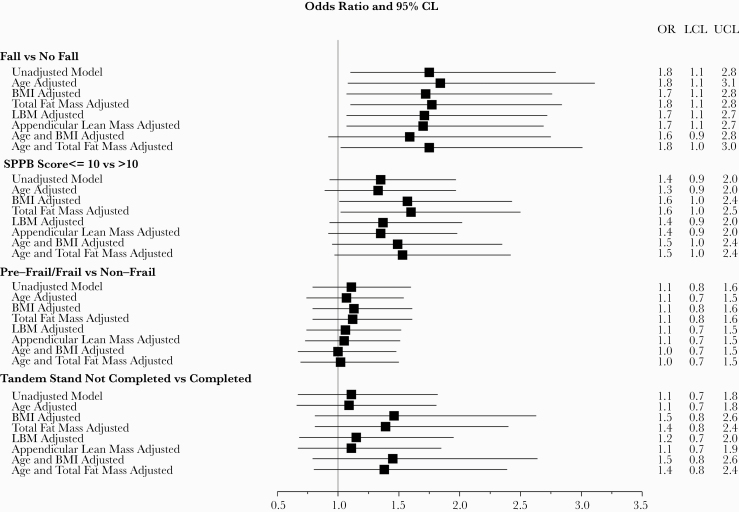
Forty-five PWH were enrolled (23 younger, 22 older). Every 500 fmol/punch (equivalent to an increase in ~2 doses/week) increase in TFV-DP was associated with decreased hip BMD (-0.021 g/cm; 95% confidence interval [CI], -0.040 to -0.002; = .03). Adjusting for total fat mass, every 500 fmol/punch increase in TFV-DP was associated with higher odds of Short Physical Performance Battery impairment (score ≤10; adjusted odds ratio [OR], 1.6; 95% CI, 1.0-2.5; = .04). Every 500 fmol/punch increase in TFV-DP was associated with slower 400-meter walk time (14.8 seconds; 95% CI, 3.8-25.8; = .01) and remained significant after adjusting for age, lean body mass, body mass index (BMI), and fat mass (all ≤ .01). Every 500 fmol/punch increase in TFV-DP was associated with higher odds of reporting a fall in the prior 6 months (OR, 1.8; 95% CI, 1.1-2.8; = .02); this remained significant after adjusting for age, lean body mass, BMI, and total fat mass (all < .05).
Higher TFV-DP levels were associated with lower hip BMD, poorer physical function, and greater risk for falls, a concerning combination for increased fracture risk.
在本研究中,我们评估了使用干血斑(DBS)中的替诺福韦二磷酸(TFV-DP)定量的累积抗逆转录病毒药物依从性/暴露与人类免疫缺陷病毒(HIV)相关衰老因素之间的关联。
这是一项对服用富马酸替诺福韦二吡呋酯的年轻(18 - 35岁)和年长(≥60岁)HIV感染者(PWH)的横断面分析。对DBS中的替诺福韦二磷酸浓度进行定量。使用线性和逻辑回归模型评估TFV-DP与骨矿物质密度(BMD)、身体功能、虚弱和跌倒之间的关联。
共纳入45名PWH(23名年轻者,22名年长者)。TFV-DP每增加500 fmol/打孔(相当于每周增加约2剂)与髋部BMD降低相关(-0.021 g/cm;95%置信区间[CI],-0.040至-0.002;P = 0.03)。调整总脂肪量后,TFV-DP每增加500 fmol/打孔与短身体性能电池受损几率更高相关(得分≤10;调整后的优势比[OR],1.6;95% CI,1.0 - 2.5;P = 0.04)。TFV-DP每增加500 fmol/打孔与400米步行时间延长相关(14.8秒;95% CI,3.8 - 25.8;P = 0.01),在调整年龄、瘦体重、体重指数(BMI)和脂肪量后仍具有显著性(所有P≤0.01)。TFV-DP每增加500 fmol/打孔与在过去6个月内报告跌倒的几率更高相关(OR,1.8;95% CI,1.1 - 2.8;P = 0.02);在调整年龄、瘦体重、BMI和总脂肪量后仍具有显著性(所有P<0.05)。
较高的TFV-DP水平与较低的髋部BMD、较差的身体功能以及更高的跌倒风险相关,这是增加骨折风险的一个令人担忧的组合。