Wilkins John T, Gray Elizabeth L, Wallia Amisha, Hirschhorn Lisa R, Zembower Teresa R, Ho Joyce, Kalume Naomi, Agbo Ojoma, Zhu Alex, Rasmussen-Torvik Laura J, Khan Sadiya S, Carnethon Mercedes, Huffman Mark, Evans Charlesnika T
Department of Preventive Medicine, Feinberg School of Medicine, Northwestern University, Chicago, Illinois, USA.
Division of Cardiology, Department of Medicine, Feinberg School of Medicine, Northwestern University, Chicago, Illinois, USA.
Open Forum Infect Dis. 2020 Dec 9;8(1):ofaa582. doi: 10.1093/ofid/ofaa582. eCollection 2021 Jan.
Identifying factors associated with severe acute respiratory syndrome coronavirus 2 (SARS-CoV-2) infection among health care workers (HCWs) may help health systems optimize SARS-CoV-2 infection control strategies.
We conducted a cross-sectional analysis of baseline data from the Northwestern HCW SARS-CoV-2 Serology Cohort Study. We used the Abbott Architect Nucleocapsid IgG assay to determine seropositivity. Logistic regression models (adjusted for demographics and self-reported community exposure to coronavirus disease 2019 [COVID-19]) were fit to quantify the associations between occupation group, health care delivery tasks, and community exposure and seropositive status.
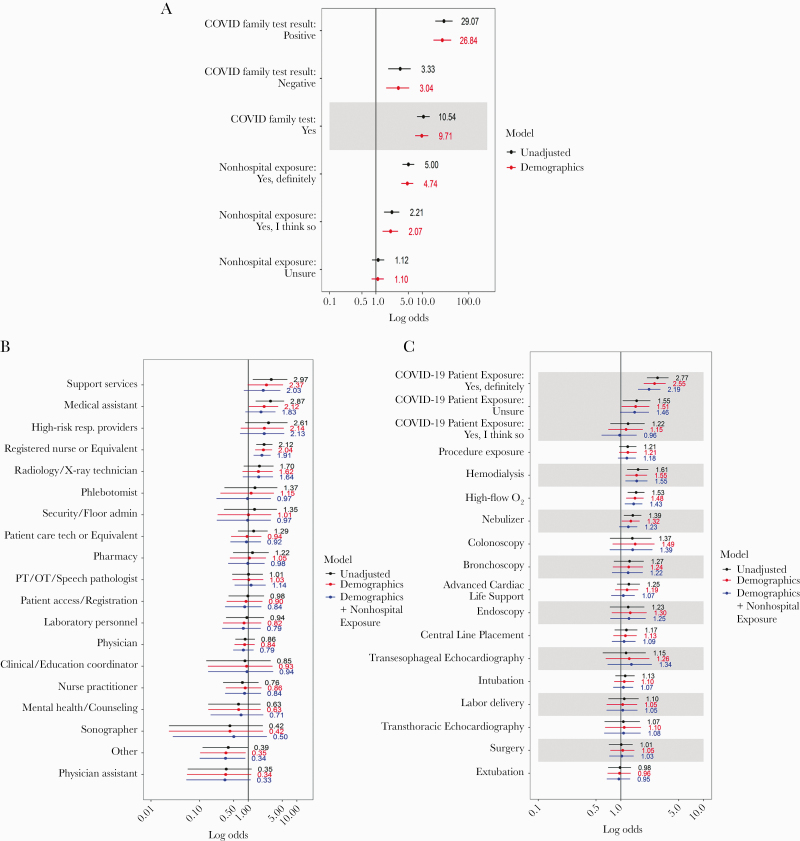
A total of 6510 HCWs, including 1794 nurses and 904 non-patient-facing administrators, participated. The majority were women (79.6%), 74.9% were White, 9.7% were Asian, 7.3% were Hispanic, and 3.1% were non-Hispanic Black. The crude prevalence of seropositivity was 4.8% (95% CI, 4.6%-5.2%). Seropositivity varied by race/ethnicity as well as age, ranging from 4.2% to 9.6%. Out-of-hospital exposure to COVID-19 occurred in 9.3% of HCWs, 15.0% (95% CI, 12.2%-18.1%) of whom were seropositive; those with family members diagnosed with COVID-19 had a seropositivity rate of 54% (95% CI, 44.2%-65.2%). Support service workers (10.4%; 95% CI, 4.6%-19.4%), medical assistants (10.1%; 95% CI, 5.5%-16.6%), and nurses (7.6%; 95% CI, 6.4%-9.0%) had significantly higher seropositivity rates than administrators (referent; 3.3%; 95% CI, 2.3%-4.4%). However, after adjustment, nursing was the only occupation group with a significantly higher odds (odds ratio, 1.9; 95% CI, 1.3-2.9) of seropositivity. Exposure to patients receiving high-flow oxygen therapy and hemodialysis was significantly associated with 45% and 57% higher odds for seropositive status, respectively.
HCWs are at risk for SARS-CoV-2 infection from longer-duration exposures to people infected with SARS-CoV-2 within health care settings and their communities of residence.
识别医护人员中与严重急性呼吸综合征冠状病毒2(SARS-CoV-2)感染相关的因素,可能有助于卫生系统优化SARS-CoV-2感染控制策略。
我们对西北医护人员SARS-CoV-2血清学队列研究的基线数据进行了横断面分析。我们使用雅培Architect核衣壳IgG检测法来确定血清阳性。采用逻辑回归模型(对人口统计学和自我报告的社区暴露于2019冠状病毒病[COVID-19]进行了调整)来量化职业组、医疗服务任务和社区暴露与血清阳性状态之间的关联。
共有6510名医护人员参与,其中包括1794名护士和904名不面向患者的管理人员。大多数为女性(79.6%),74.9%为白人,9.7%为亚洲人,7.3%为西班牙裔,3.1%为非西班牙裔黑人。血清阳性的粗患病率为4.8%(95%CI,4.6%-5.2%)。血清阳性率因种族/族裔以及年龄而异,范围从4.2%到9.6%。9.3%的医护人员有院外接触COVID-19的情况,其中15.0%(95%CI,12.2%-18.1%)血清呈阳性;家庭成员被诊断为COVID-19的医护人员血清阳性率为54%(95%CI,44.2%-65.2%)。支持服务人员(10.4%;95%CI,4.6%-19.4%)、医疗助理(10.1%;95%CI,5.5%-16.6%)和护士(7.6%;95%CI,6.4%-9.0%)的血清阳性率显著高于管理人员(参照组;3.3%;95%CI,2.3%-4.4%)。然而,调整后,护理是唯一血清阳性几率显著更高(优势比,1.9;95%CI,1.3-2.9)的职业组。接触接受高流量氧疗和血液透析的患者分别使血清阳性状态的几率显著增加45%和57%。
医护人员在医疗环境及其居住社区中因长时间接触感染SARS-CoV-2的人而有感染SARS-CoV-2的风险。