Ohyama Yoshiaki, Imai Kunihiko, Obokata Masaru, Araki Mie, Sumiyoshi Hisako, Koitabashi Norimichi, Nakamura Tetsuya, Kurabayashi Masahiko
Clinical Investigation and Research Unit, Gunma University Hospital, Maebashi, Japan.
Department of Cardiovascular Medicine, Gunma University Hospital, Maebashi, Japan.
Int J Cardiol Hypertens. 2019 May 27;2:100009. doi: 10.1016/j.ijchy.2019.100009. eCollection 2019 Aug.
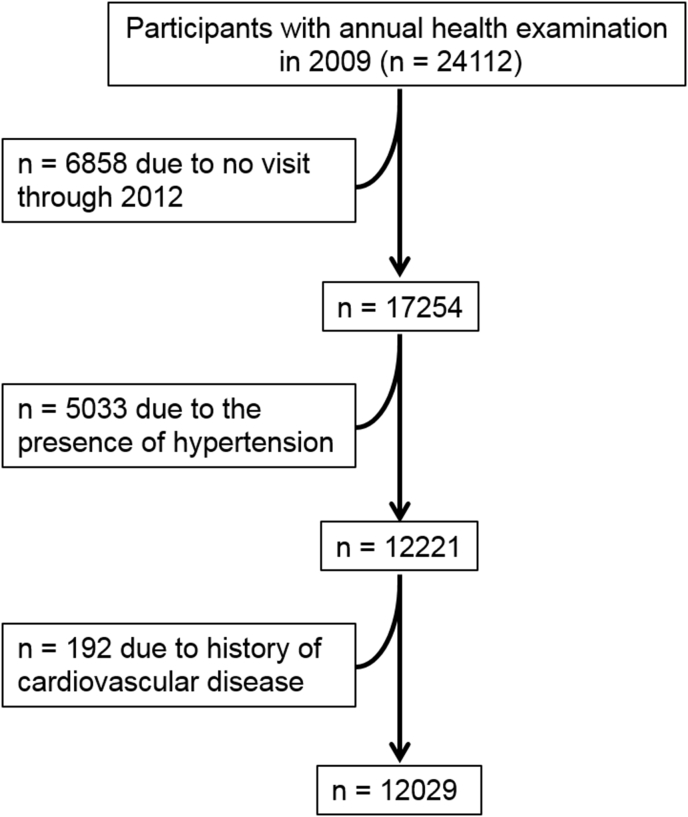
The aim of the present study is to evaluate the association of serum uric acid (UA) levels with the risk of incident hypertension among different age groups in men and women using a single large Japanese general cohort. The present study is based on annual health check-up program in Gunma, Japan. We studied 12,029 participants (mean age, 48 ± 9 years old; 31% women) free of prevalent cardiovascular disease and hypertension at baseline (2009). Hypertension was defined by self-report, hypertensive medication use, or measured BP > 140/90 mmHg at each visit. Discrete proportional hazards regression model was used to evaluate the association of UA level at baseline with incident hypertension through 2012 adjusted for age, gender, baseline blood pressure, and other CVD risk factors among different age decade groups in men and women. During follow-up of 3 years, 12% of the cohort (n = 1457) developed hypertension. UA was strongly associated with incident hypertension in the multivariable model in all participants. In age-stratified analysis, participants below 50 years of age in men had the significant association of UA with incident hypertension, whereas participants above 50 years did not. In women, participants above 40 years had the significant association, whereas participants below 40 years did not. The present data suggest that UA level is an independent predictor for incident hypertension among middle aged men below 50 years old and middle aged and the elderly women above 40 years.
本研究的目的是利用一个大型日本普通队列,评估男性和女性不同年龄组血清尿酸(UA)水平与新发高血压风险之间的关联。本研究基于日本群马县的年度健康检查项目。我们研究了12,029名参与者(平均年龄48±9岁;31%为女性),这些参与者在基线时(2009年)无心血管疾病和高血压病史。高血压通过自我报告、使用降压药物或每次就诊时测量血压>140/90 mmHg来定义。采用离散比例风险回归模型,评估2012年前基线时UA水平与新发高血压之间的关联,并对男性和女性不同年龄组的年龄、性别、基线血压和其他心血管疾病风险因素进行校正。在3年的随访期间,该队列中有12%(n = 1457)患高血压。在所有参与者的多变量模型中,UA与新发高血压密切相关。在年龄分层分析中,男性50岁以下参与者的UA与新发高血压有显著关联,而50岁以上参与者则无。在女性中,40岁以上参与者有显著关联,而40岁以下参与者则无。目前的数据表明,UA水平是50岁以下中年男性以及40岁以上中年和老年女性新发高血压的独立预测因素。