International Nursing Development, Tokyo Medical and Dental University, Tokyo, Japan.
School of Nursing and Rehabilitation Sciences, Showa University, Tokyo, Japan.
Jpn J Nurs Sci. 2021 Apr;18(2):e12404. doi: 10.1111/jjns.12404. Epub 2021 Jan 14.
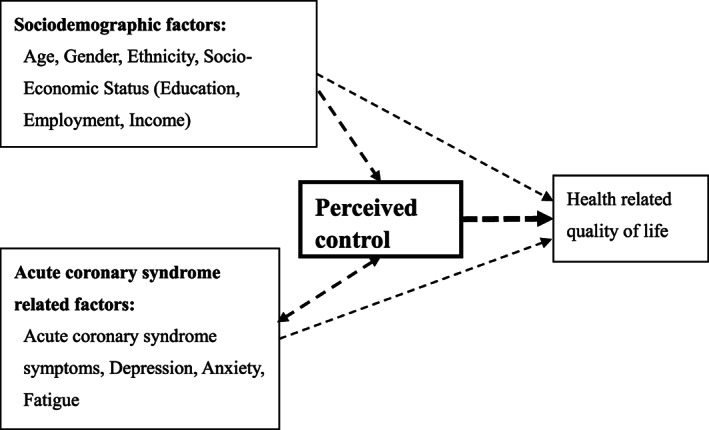
To explore the relationship between demographic factors, acute coronary syndrome-related factors, perceived control and health-related quality of life during admission, 3 months and 6 months after discharge, in patients with acute coronary syndrome.
Participants were recruited for this longitudinal study after admission for acute coronary syndrome in three university hospitals in the Tokyo metropolitan area, Japan. Self-administered questionnaires included demographic data, perceived control, health-related quality of life, acute coronary syndrome symptoms, fatigue, depression and anxiety.
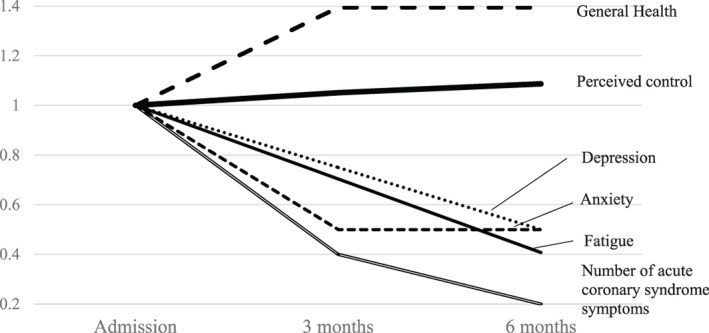
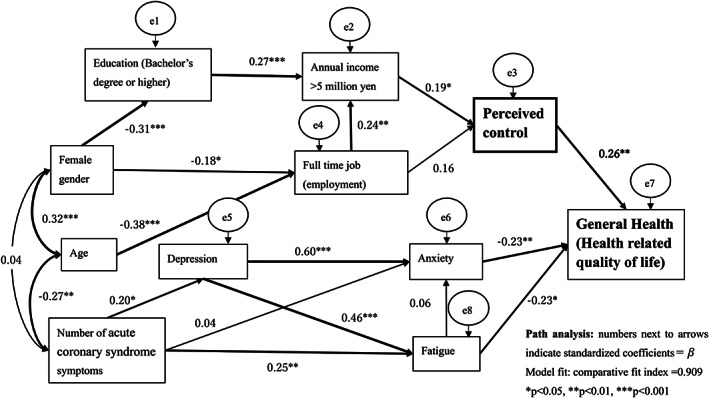
Participants (N = 137) had an average age of 62.8 (SD 11.6) years and 80.3% were male. As a result of Path analysis, higher perceived control (β = 0.258, p = .001), lower anxiety (β = -0.226, p = .009) and lower fatigue (β = -0.231, p = .010), were significantly related to better health-related quality of life (General health). Only annual income was significantly related to perceived control (β = 0.187, p = .029). Eighty-two (59.9%) participants at 3 months and 54 (39.4%) participants at 6 months completed the questionnaires. Perceived control (F = 7.074, p = .001) and General health (χ = 10.22, p = .006) significantly increased over the 6 months. Perceived control during admission was significantly related with health-related quality of life at 3 months. Perceived control at 3 months was significantly related with health-related quality of life at 6 months.
Perceived control was an important factor for health-related quality of life of the Japanese patients with acute coronary syndrome. It is necessary to investigate whether nursing interventions to enhance perceived control lead to improvement of health-related quality of life.
探讨急性冠状动脉综合征患者入院时、出院后 3 个月和 6 个月时人口统计学因素、与急性冠状动脉综合征相关的因素、感知控制与健康相关生活质量之间的关系。
这项纵向研究在日本东京都的 3 所大学医院招募了急性冠状动脉综合征患者。自填式问卷包括人口统计学数据、感知控制、健康相关生活质量、急性冠状动脉综合征症状、疲劳、抑郁和焦虑。
参与者(N=137)的平均年龄为 62.8(SD 11.6)岁,80.3%为男性。通过路径分析,感知控制较高(β=0.258,p=.001)、焦虑程度较低(β=-0.226,p=.009)和疲劳程度较低(β=-0.231,p=.010)与健康相关生活质量(总体健康)显著相关。只有年收入与感知控制显著相关(β=0.187,p=.029)。82 名(59.9%)参与者在 3 个月时和 54 名(39.4%)参与者在 6 个月时完成了问卷。感知控制(F=7.074,p=.001)和总体健康(χ=10.22,p=.006)在 6 个月内显著增加。入院时的感知控制与 3 个月时的健康相关生活质量显著相关。3 个月时的感知控制与 6 个月时的健康相关生活质量显著相关。
感知控制是日本急性冠状动脉综合征患者健康相关生活质量的一个重要因素。需要研究增强感知控制的护理干预是否会改善健康相关生活质量。