Consiglio Nazionale delle Ricerche, Istituto di Neuroscienze, via Volturno 39/E, 43125, Parma, Italy.
Department of Biomedical, Metabolic, and Neuronal Sciences, University of Modena and Reggio Emilia, Modena, Italy.
J Neurol. 2022 Feb;269(2):627-638. doi: 10.1007/s00415-021-10397-w. Epub 2021 Jan 15.
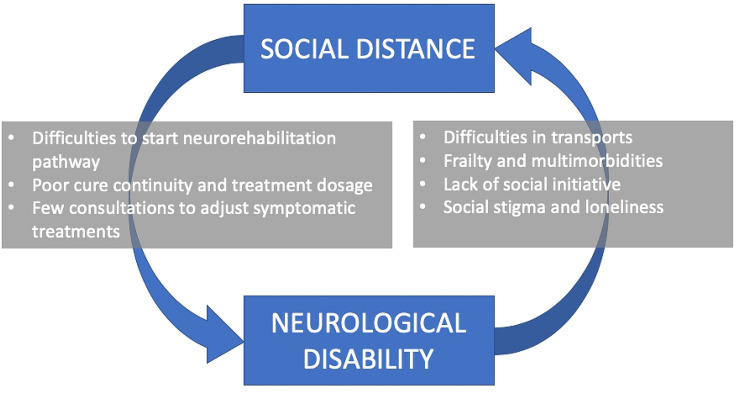
Ensuring proper dosage of treatment and repetition over time is a major challenge in neurorehabilitation. However, a requirement of physical distancing to date compromises their achievement. While mostly associated to COVID-19, physical distancing is not only required in a pandemic scenario, but also advised for several clinical conditions (e.g. immunocompromised individuals) or forced for specific social contexts (e.g. people living in remote areas worldwide). All these contexts advocate for the implementation of alternative healthcare models. The objective of this perspective is to highlight the benefits of remote administration of rehabilitative treatment, namely telerehabilitation, in counteracting physical distancing barriers in neurorehabilitation. Sustaining boosters of treatment outcome, such as compliance, sustainability, as well as motivation, telerehabilitation may adapt to multiple neurological conditions, with the further advantage of a high potential for individualization to patient's or pathology's specificities. The effectiveness of telerehabilitation can be potentiated by several technologies available to date: virtual reality can recreate realistic environments in which patients may bodily operate, wearable sensors allow to quantitatively monitor the patient's performance, and signal processing may contribute to the prediction of long-term dynamics of patient recovery. Telerehabilitation might spark its advantages far beyond the mere limitation of physical distancing effects, mitigating criticalities of daily neurorehabilitative practice, and thus paving the way to the envision of mixed models of care, where hospital-based procedures are complementarily integrated with telerehabilitative ones.
确保治疗的适当剂量和随着时间的重复是神经康复的主要挑战。然而,迄今为止,为了保持身体距离,这一目标难以实现。虽然身体距离主要与 COVID-19 相关,但它不仅在大流行期间需要,而且还建议在几种临床情况下(例如免疫功能低下的个体)或在特定的社会环境下(例如,居住在世界偏远地区的人们)采取。所有这些情况都倡导实施替代医疗保健模式。本观点的目的是强调远程康复治疗(即远程康复)在克服神经康复中身体距离障碍方面的益处。远程康复可以维持治疗效果的促进因素,如依从性、可持续性和动机,可能适用于多种神经疾病,并且具有高度个性化患者或病理特异性的进一步优势。远程康复的有效性可以通过目前可用的几种技术来增强:虚拟现实可以在其中重建逼真的环境,患者可以在其中进行身体操作;可穿戴传感器允许定量监测患者的表现;信号处理可以有助于预测患者康复的长期动态。远程康复的优势可能远远超出仅仅限制身体距离的影响,减轻日常神经康复实践中的关键问题,从而为混合护理模式铺平道路,在这种模式中,医院内的程序与远程康复程序互补。